
180mm Santoku Aogami #2 Green Micarta Handle with Turquoise Spacer
Carbon Steel Japanese Knives are often described as difficult to maintain. They can rust, they react with certain foods, and compared with stainless steel, they certainly require a little more attention.
But after more than 25 years working as a professional chef, I don’t think carbon steel knives are as difficult to live with as many people imagine.
I currently use Aogami Super, Aogami #2 and VG10 knives in my daily work, and my experience with each one has been quite different. For me, the important thing is not trying to find a completely maintenance-free knife. It is understanding the steel you are using and learning how to look after it.
If you are looking for Japanese knives in Australia, you can also explore our collection here:
Carbon Steel Japanese Knives Can Rust — But That Is Not the Whole Story

There is no point pretending otherwise: Carbon Steel Japanese Knives can rust faster than stainless steel.
I also feel that once a carbon steel knife has developed rust, that particular knife can sometimes seem more likely to rust again.
However, that does not mean carbon steel is constantly difficult to maintain.
One knife I currently use regularly is an Aogami Super (青紙スーパー)sujihiki. I use it for fish, meat and vegetables, and sometimes even acidic ingredients such as lemons and limes.
My routine is extremely simple.
After using it, I wash it with water and immediately wipe it dry with a towel.
That’s basically it.
Despite using it constantly, rust has not been a major problem.
Perhaps the fact that I use this knife almost every day helps. It is regularly being used, washed, dried and checked rather than being left somewhere for weeks. I cannot say that daily use itself prevents rust, but in my experience, regular care makes carbon steel much easier to manage.
👉 INTERNAL LINK: Japanese Knife Patina article
Understanding the difference between normal patina and harmful rust is also important when living with carbon steel.
My Aogami #2 Knife Is a Different Story
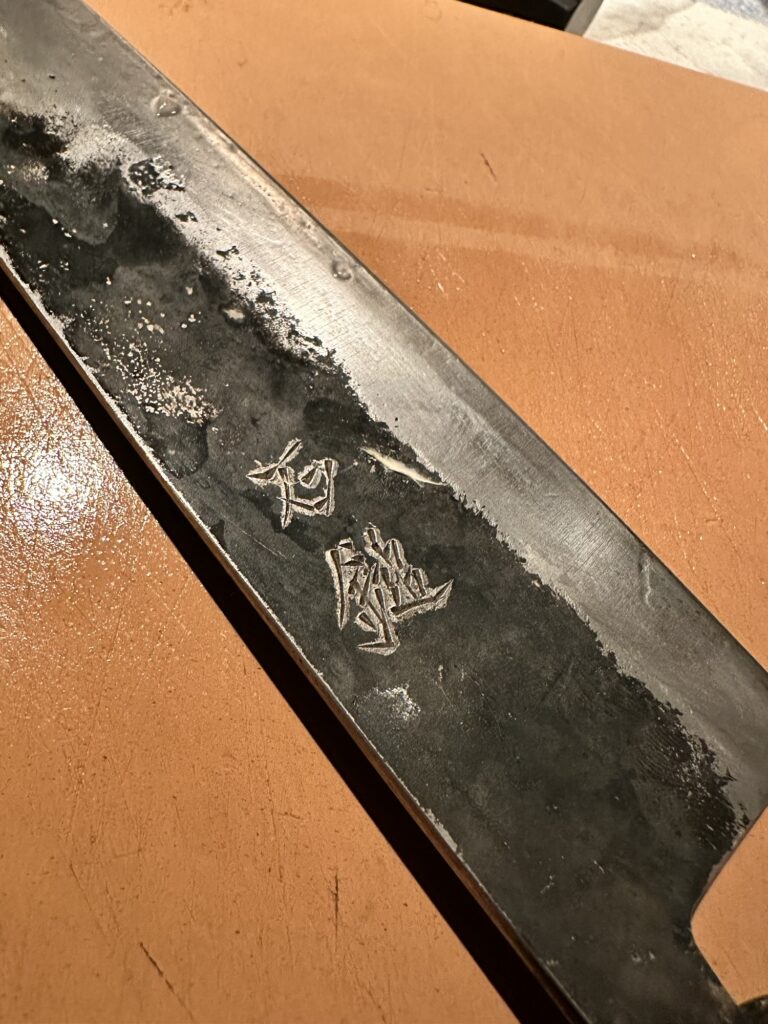
180mm Kiritsuke Aogami #2 Kurouchi Walnut Octagonal Handle
My Aogami #2 kurouchi gyuto behaves differently.
This knife has rusted before, and since then I have found that if I use it, wipe away the moisture and simply leave it for a long period, rust can return.
So I treat this knife differently.
When necessary, I deal with the rust through sharpening and use Sabitoru to remove surface rust. If I know I will not use the knife for a while, I apply a thin layer of camellia oil before storing it.
👉 INTERNAL LINK: Sabitoru Fine article
Sabitoru has become a useful part of my maintenance routine when small areas of rust appear.
👉 INTERNAL LINK: Camellia Oil article
Camellia oil is another simple option when storing carbon steel knives for longer periods.
This is why I don’t believe owning Carbon Steel Japanese Knives needs to be stressful. Once you have a basic maintenance kit and understand what your knife needs, caring for it becomes part of owning and using the knife.
Carbon Steel Japanese Knives vs VG10 in Daily Use

240mm Sujihiki VG10 Hammered 17 Layer Damascus Mahogany
The VG10 sujihiki I currently use is completely different when it comes to rust.
Honestly, rust is something I barely think about with this knife.
But I still treat it almost exactly the same way as my carbon steel knives.
Use it. Wash it. Dry it.
That’s all.
Stainless steel gives you considerably more freedom when it comes to corrosion resistance, but I still don’t believe that means you should leave a good knife wet or dirty.
There is also another side to stainless steel maintenance that I have noticed during my career.
Because stainless steel is so easy to live with, it can be tempting to keep using the knife without sharpening it until it becomes seriously dull.
That can create another problem.
A Rust-Resistant Knife Is Not a Maintenance-Free Knife

135mm Petty VG10 Polished Hammered 67 Layer Damascus Green Handle
In my experience, when some stainless steels become extremely dull, bringing the edge back can feel harder than maintaining the knife regularly.
This is where people can make a mistake.
When a knife is not getting sharp quickly enough, there is a temptation to raise the sharpening angle and concentrate only on creating a sharp edge.
You may get an edge again, but over time the geometry behind that edge can become thicker. Eventually, the knife may feel sharp at the very edge but still struggle to move smoothly through food.
This connects directly with something I recently wrote about: knife thinning.
👉 INTERNAL LINK: Japanese Knife Thinning article
Thinning is not simply about making the edge sharp. It is about maintaining the geometry behind the cutting edge so the knife can continue cutting the way it should.
That is why regular maintenance matters whether your knife is carbon steel or stainless steel.
Are Carbon Steel Japanese Knives Really Difficult?

210mm Sujihiki Aogami #2 Kurouchi Magnolia Handle
After using different steels professionally, my answer is no.
Carbon steel requires more awareness of moisture and rust. Stainless steel such as VG10 makes that part much easier.
But neither should be neglected.
For me, Carbon Steel Japanese Knives are not difficult knives. They are knives that you need to understand and learn how to live with.
Wash them after use. Dry them properly. Deal with rust early if it appears. Use camellia oil when storing carbon steel for longer periods. And don’t wait until any knife becomes completely dull before thinking about sharpening.
That small amount of care can make a very big difference.
For anyone exploring Japanese Knives Australia, I believe the question should not simply be, “Which steel is best?”
A better question is:
Which steel suits the way I cook, sharpen and care for my knives?
👉 INTERNAL LINK: Japanese Knives Australia: 5 Powerful Choices I Would Make After 25 Years as a Professional Chef
There is no single steel that is perfect for everyone. Understanding how you actually use your knife is far more important than simply choosing carbon steel or stainless steel.
👉 Explore more:
https://blog.asaoyayaichi.com.au
👉 Visit our online store:
https://asaoyayaichi.com.au
Thank you for reading, and I hope to see you again in the next story.
—————————————————
Where to See and Buy Our Knives
Our Partner Stores
Chanoyu — Nerang, Gold Coast

Visit Chanoyu and See Our Japanese Knives
If you are on the Gold Coast, we would love you to visit Chanoyu, a Japanese café in Nerang where you can see and purchase a selection of Asaoya Yaichi knives in person.
Chanoyu is a lovely place to slow down and enjoy Japanese-inspired food, excellent matcha, coffee and handmade desserts. Its warm, peaceful atmosphere makes it a pleasure to visit, whether you are stopping in for breakfast, lunch or something sweet. We are delighted that our knives have a place there.

Visit Chanoyu: Shop 6A, 54–58 Nerang Street, Nerang QLD 4211
Opening hours: Monday to Saturday, 7:00 am–2:00 pm; closed Sunday
Website: https://www.chanoyucafe.com/
Instagram: https://www.instagram.com/chanoyugc/
The selection of knives on display may change. If you are interested in a particular Asaoya Yaichi knife, please contact us through https://asaoyayaichi.com.au before visiting, and we will help you check whether it is available at Chanoyu.