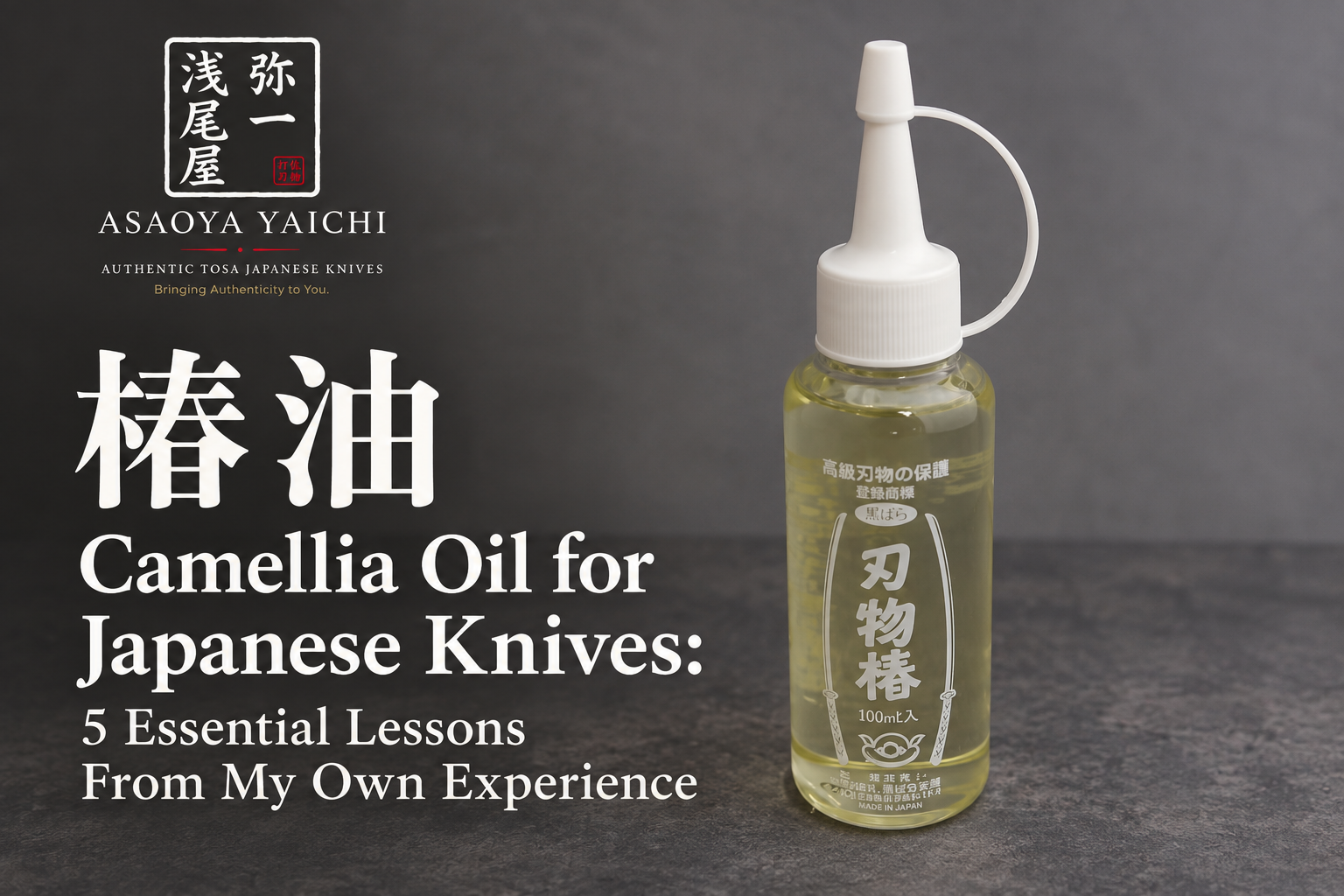
Camellia oil for Japanese knives is often recommended as a traditional way to help protect blades from rust, especially carbon steel knives. I have worked with Japanese knives throughout more than 25 years in professional kitchens, but surprisingly, camellia oil has never been something I used regularly.
I had used it before, however, and one particular experience has stayed with me for years.
Now that Asaoya Yaichi will soon be carrying Kurobara Hamono Tsubaki, a Japanese blade-care oil, it seemed like the right time to look again at what knife oil actually does, when it is useful, and what I learned from my own experience.
If you are looking for authentic Japanese kitchen knives and traditional knife-care products, you can also visit our online store:
Why Camellia Oil for Japanese Knives Has Been Used for So Long

Ishizuchi Kanamono Manufactory
Japanese carbon steel knives can develop rust when moisture remains on the blade. This is simply part of owning reactive carbon steel. With normal daily use, washing and thoroughly drying the knife immediately after use is often the most important habit.
However, a protective oil becomes particularly useful when a carbon steel knife will not be used for some time.
A very thin film of oil creates an additional barrier between the steel and moisture in the surrounding environment. This is why knife oils have traditionally been associated not only with kitchen knives but also with Japanese swords, woodworking tools and other high-quality steel tools.
👉 INTERNAL LINK: Tosa Knives and Kurouchi — Why the Black Finish Became So Common
Kurouchi knives are a good example. Their dark forge scale may provide some protection to parts of the blade, but the exposed cutting edge is still reactive carbon steel and needs proper care.
My Own Mistake With Camellia Oil for Japanese Knives

240mm Sujihiki VG10 Hammered 17 Layer Damascus Mahogany
Years ago, one of the restaurants where I worked kept camellia oil for knife maintenance. Because it was available, I occasionally used it, although it never became part of my normal knife-care routine.
At one point, I applied the oil to a knife that I planned to store for a longer period.
Then I forgot about it.
When I eventually took the knife out again, the oil had become unpleasantly sticky. Instead of finding a beautifully protected blade covered with a light film of oil, I found a knife with a thick, tacky residue.
That experience stayed in my mind.
Importantly, I do not know the brand or exact composition of the oil I used at that time, so I cannot say that the problem was caused by camellia oil itself. It may have been the particular product, the amount I applied, the storage conditions, the length of storage, or a combination of these factors.
What I can say is that it taught me a simple lesson: more oil does not necessarily mean better protection.
👉 INTERNAL LINK: Japanese Knife Rust Removal: 5 Powerful Reasons I Keep a Sabitoru Fine in My Knife Kit
That connects directly with another lesson from professional kitchens: preventing rust is much easier than removing it later.
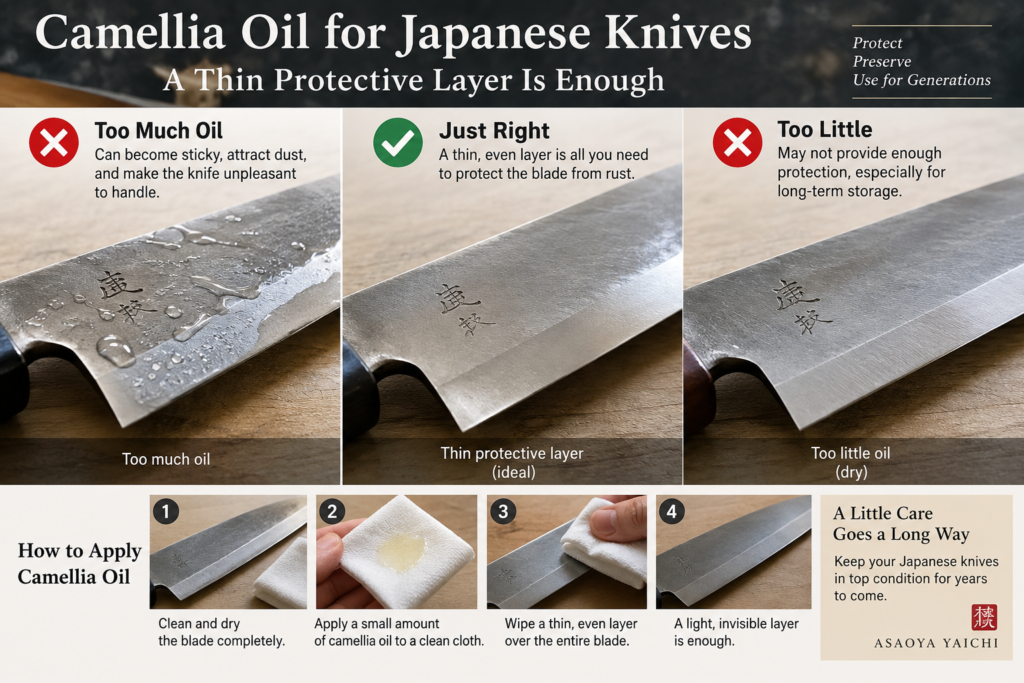
Camellia Oil for Japanese Knives Should Be a Thin Protective Layer
About Tosa Knives
Knife oil does not need to make the blade look wet.
For storage, the goal is simply to leave a very thin and even protective film on a completely clean and dry blade. Applying excessive oil can create unnecessary mess and may attract dust or make the knife unpleasant to handle when it comes out of storage.
This is particularly relevant for carbon steels such as Aogami #2 and other traditional Japanese steels.
👉 INTERNAL LINK: Is an Expensive Japanese Knife Really Worth the Money?
For a knife that is being used every day in a professional kitchen, careful washing and immediate drying may be more practical than constantly applying oil. For a knife that may sit unused for weeks or months, however, a protective oil makes much more sense.
Why I Chose Kurobara Hamono Tsubaki
180mm Santoku Ginsan Nashiji Forged Magnolia Octagonal Handle Buffalo Horn
This time, I wanted a product specifically intended for blade maintenance rather than simply assuming that any bottle labelled camellia oil would be suitable.
Kurobara Hamono Tsubaki is made in Japan specifically for the maintenance and storage of blades. Kurobara describes it as suitable for Japanese swords, high-quality blades, tools and kitchen knives, and as a non-drying, odourless rust-prevention oil.
This is also an important distinction: Hamono Tsubaki is not simply a bottle of 100% pure camellia seed oil. It is a formulated blade-care product containing mineral oil, camellia seed oil and other ingredients.
That difference is one reason I am interested in trying it properly myself.
👉 INTERNAL LINK: Is an Expensive Japanese Knife Really Worth It?
A good Japanese knife can last for many years, but price alone does not protect it. How the knife is used, sharpened, cleaned and stored matters just as much.
Good Knife Care Is About Understanding Your Knife
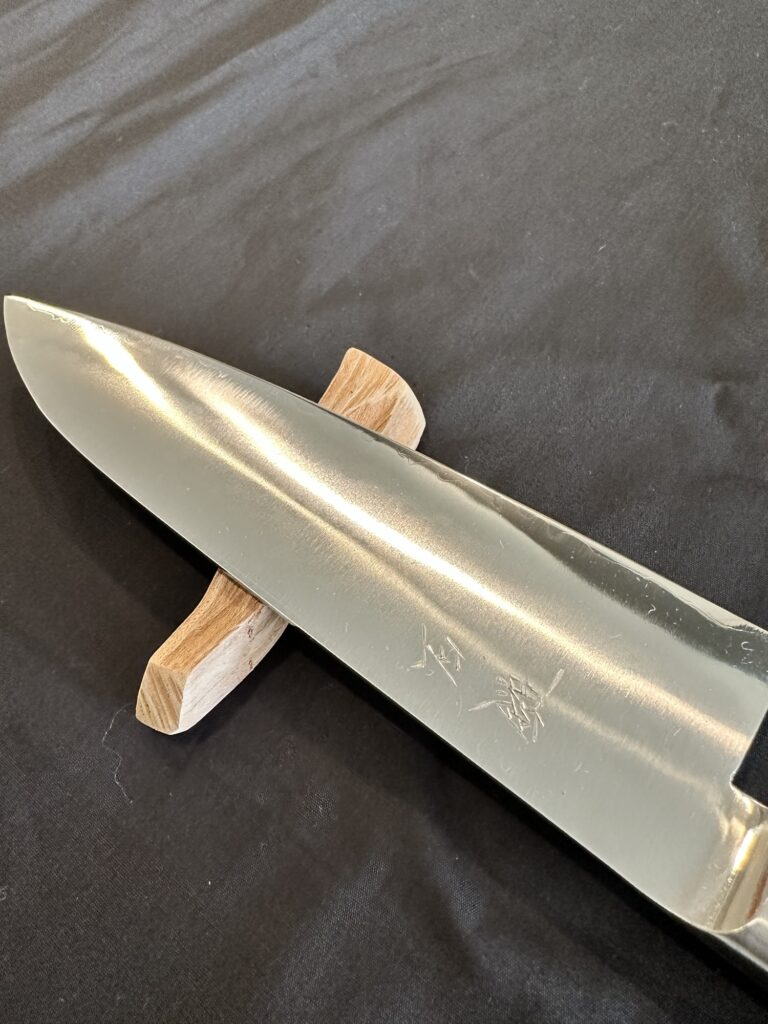
180mm Santoku Aogami #2 Green Micarta Handle with Turquoise Spacer
After more than 25 years in kitchens, I still do not believe there is one maintenance routine that suits every Japanese knife or every cook.
A stainless VG10 knife used every day has very different maintenance needs from an Aogami carbon steel knife that might remain in storage for several months.
👉 INTERNAL LINK: 一目惚れ Hitomebore | 7 Powerful Reasons to Fall in Love With a Japanese Knife
Understanding the steel, how frequently you use the knife and how you store it is more useful than blindly following a traditional routine.
That is also why my old sticky-oil experience does not make me dismiss camellia oil. Instead, it makes me want to understand and use the right product correctly.
A New Knife-Care Product Coming to Asaoya Yaichi
Kurobara Hamono Tsubaki will soon be available from Asaoya Yaichi in Australia.
Once it arrives, I will use it myself and see how it performs with the carbon steel knives I actually work with. Rather than recommending something simply because it is traditional, I prefer to understand how it works in real use.
👉 INTERNAL LINK: Kiritsuke | Japanese Knife for Chefs: 1 Powerful Choice After 25 Years in Professional Kitchens
Japanese knives are tools designed to be used, but looking after them properly is part of keeping them working for years. Sometimes that means sharpening. Sometimes it means removing rust. And sometimes, especially before longer storage, it may be as simple as applying the right protective oil — and remembering that a little can go a long way.
👉 Explore more:
https://blog.asaoyayaichi.com.au
👉 Visit our online store:
https://asaoyayaichi.com.au
Thank you for reading, and I hope to see you again in the next story.