Buying a quality Japanese knife is just the beginning.
With proper care, a handcrafted knife can provide exceptional performance for many years—often decades. Unfortunately, many knives lose their edge prematurely, not because they’re poor quality, but because they’re cared for incorrectly.
After more than 25 years working as a chef in Japan and Australia, I’ve seen many excellent knives damaged by simple mistakes that are easy to avoid.
1. Wash Your Knife by Hand
Always wash your knife by hand using warm water and a mild detergent.
Never leave it soaking in the sink, and avoid putting it in the dishwasher. The high heat, harsh detergents, and contact with other utensils can damage both the blade and the handle.
After washing, dry the knife immediately with a soft towel.
2. Use the Right Cutting Board
A quality knife deserves a quality cutting surface.
Wooden and soft rubber cutting boards are ideal because they are gentle on the edge.
Glass, ceramic, marble, granite, or very hard plastic boards will dull even the best knife much faster.
3. Don’t Twist or Pry
Japanese knives are designed for precise slicing.
Avoid twisting the blade while cutting or using it to pry frozen food, bones, or hard shells. Doing so can chip or damage the edge.
Instead, let the knife do the work with smooth, controlled cuts.
4. Store Your Knife Properly
Never throw your knife loosely into a drawer.
Use a knife block, magnetic knife rack, or a blade guard to protect the edge and improve safety.
Proper storage also helps prevent accidental damage to the blade.
5. Sharpen Before It Becomes Completely Dull
Many people wait until their knife struggles to cut before sharpening it.
In reality, regular maintenance keeps the knife performing at its best and usually removes less steel over time.
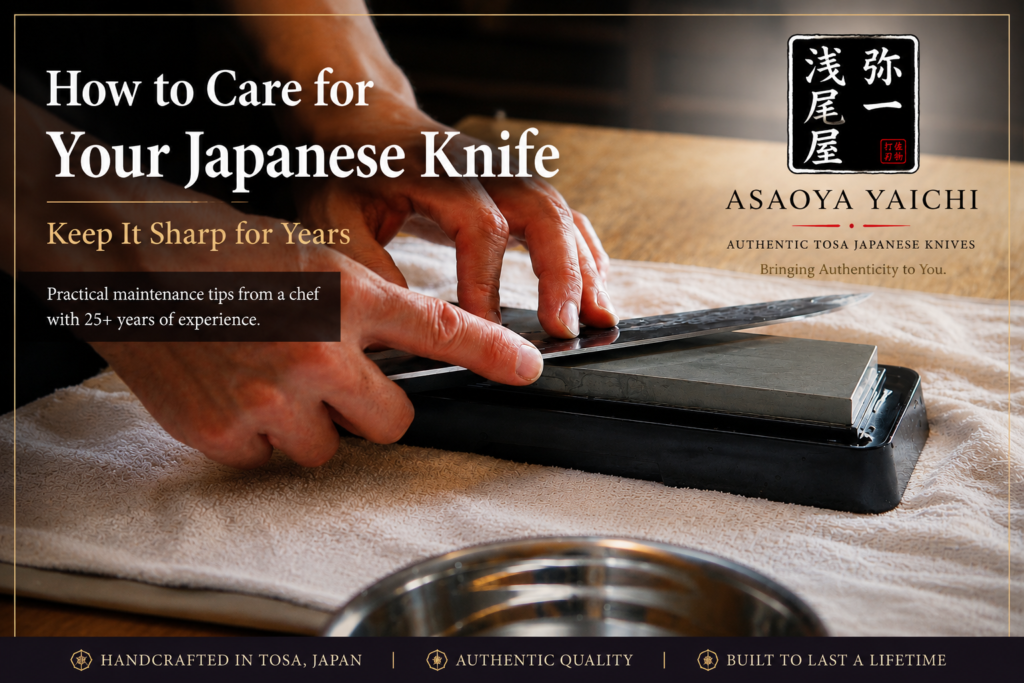
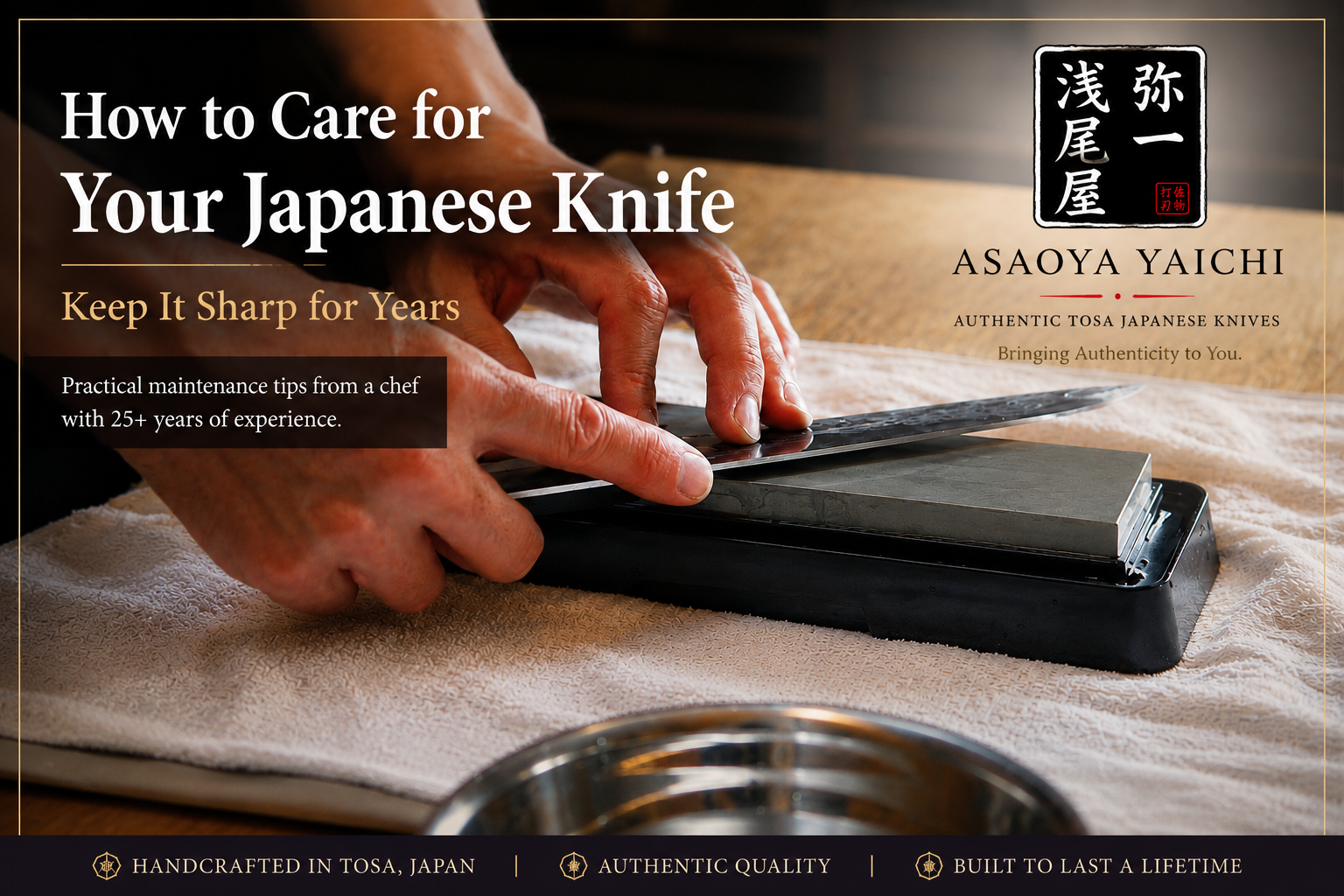
A whetstone remains the best method for maintaining a traditional Japanese knife.
Carbon Steel vs Stainless Steel
Different steels require different levels of care.
Carbon steel can develop a beautiful natural patina with use, but it should always be dried immediately after washing to prevent rust.
Stainless steel is more resistant to corrosion and generally easier to maintain, making it a great choice for many home cooks.
Neither is “better”—they simply suit different users and cooking styles.
A Good Knife Is Meant to Last
One of the greatest pleasures of owning a handcrafted Japanese knife is watching it improve with age.
As the handle develops character and the blade is maintained over the years, the knife becomes uniquely yours.
With proper care, a handcrafted knife isn’t simply a kitchen tool—it’s an investment that can accompany you through thousands of meals.
At Asaoya Yaichi, we carefully select authentic handcrafted knives from Tosa, Japan, believing that quality craftsmanship deserves proper care and appreciation.
If you’re looking for a genuine Japanese knife that will last for many years, we invite you to explore our collection.
Browse our collection:
https://www.asaoyayaichi.com.au
Read more knife guides:
https://blog.asaoyayaichi.com.au