
Tosa Knives are often easy to recognise. Among polished Japanese knives, Damascus patterns and mirror finishes, many traditional Tosa knives have a much rougher appearance: a dark, almost black surface left above the cutting edge.
This finish is called Kurouchi (黒打ち).
Today, Kurouchi has become something many people associate with traditional Japanese knives. But while researching the history of Tosa Knives, I became curious about a more specific question: why does Kurouchi seem to fit Tosa knives so naturally?
The answer is not as simple as I first expected.
Tosa Knives Began as Tools for Working People
From Agricultural Tools to Kitchen Knives
To understand Kurouchi, we first need to understand where Tosa Knives came from.
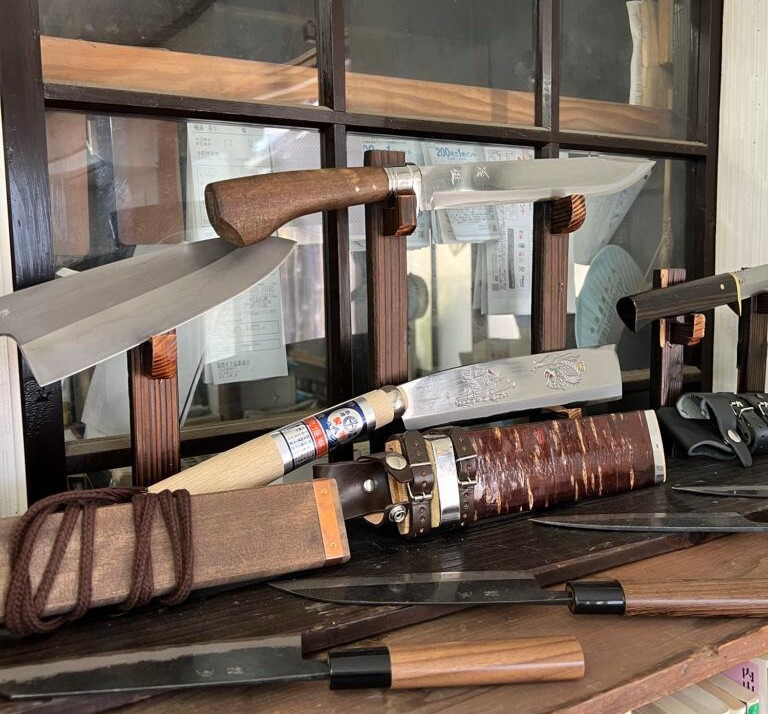
Kochi Prefecture has one of Japan’s strongest historical connections with forestry. Surrounded by mountains and forests, the region developed a long tradition of producing tools for agriculture and forestry.
Tosa blacksmiths were not historically making only kitchen knives. They produced sickles, hatchets, saws and many other cutting tools required by farmers and forestry workers.
According to Kochi City, records from the Chosokabe land survey of 1590 indicate that there were 399 blacksmiths in the region. Demand for agricultural and forestry blades later increased during the Edo period as these industries developed.
These were working tools.
They needed to cut well, survive hard use and remain practical.
👉 INTERNAL LINK: Link here to “The History of Tosa Knives”
That practical background is important when looking at the appearance of traditional Tosa blades.
Tosa Knives and the Tradition of Free Forging
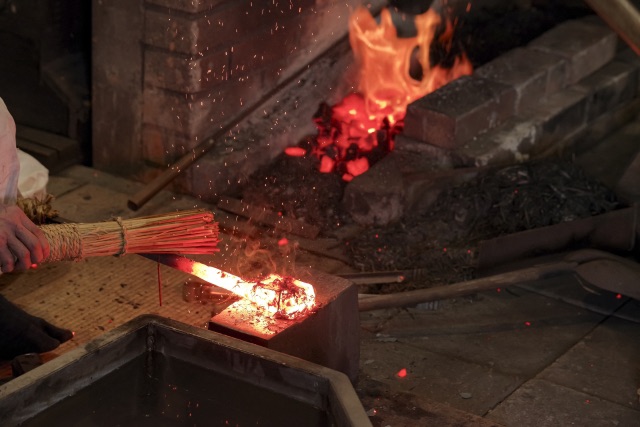
One of the defining characteristics of Tosa cutlery is a technique known as Jiyu Tanzo (自由鍛造), or free forging.
Rather than simply cutting a standard shape from sheet steel, Tosa blacksmiths traditionally forged blades according to their intended purpose. Different regions, working conditions and users could require different dimensions and shapes.
Kochi Prefecture still describes this free-forging tradition as one of the defining characteristics of Tosa cutlery.
In other words, the blade begins with its purpose.
Its shape follows what the user needs.
That philosophy helps explain why the sometimes rugged appearance of traditional Tosa Knives does not feel out of place. These blades developed from a culture where function mattered enormously.
👉 INTERNAL LINK: Link here to “What Makes Tosa Knives Different from Other Japanese Knives”
What Is Kurouchi on Tosa Knives?
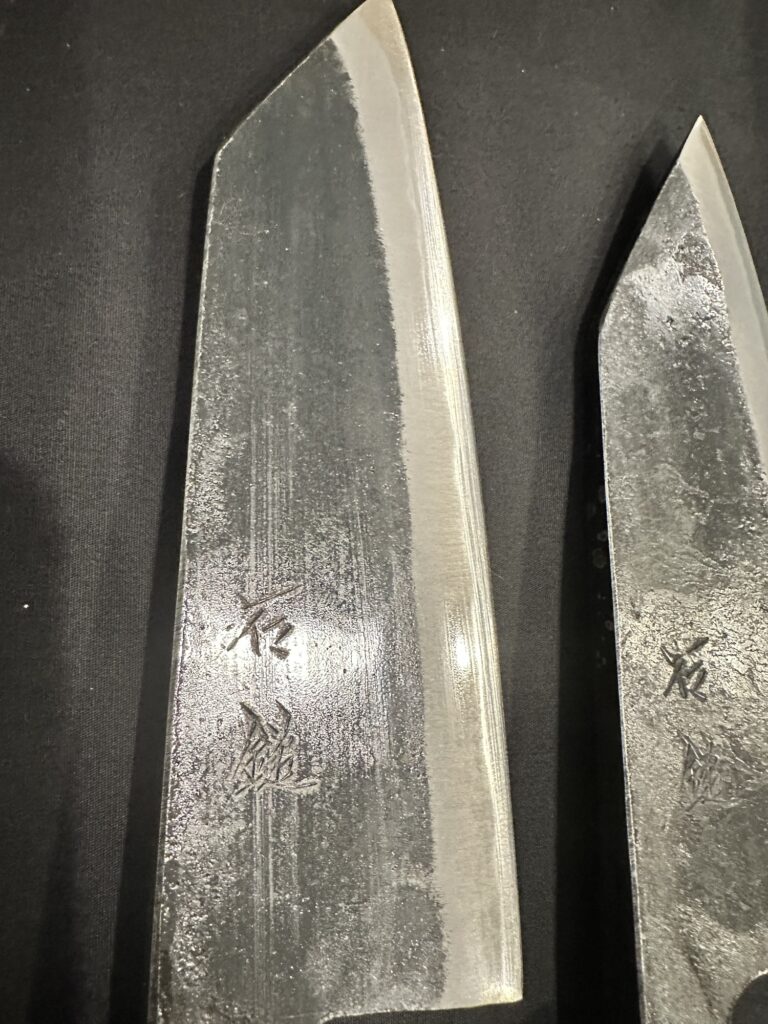
165mm Kiritsuke Thick Deba Aogami #2 Kurouchi Walnut Octagonal Handle
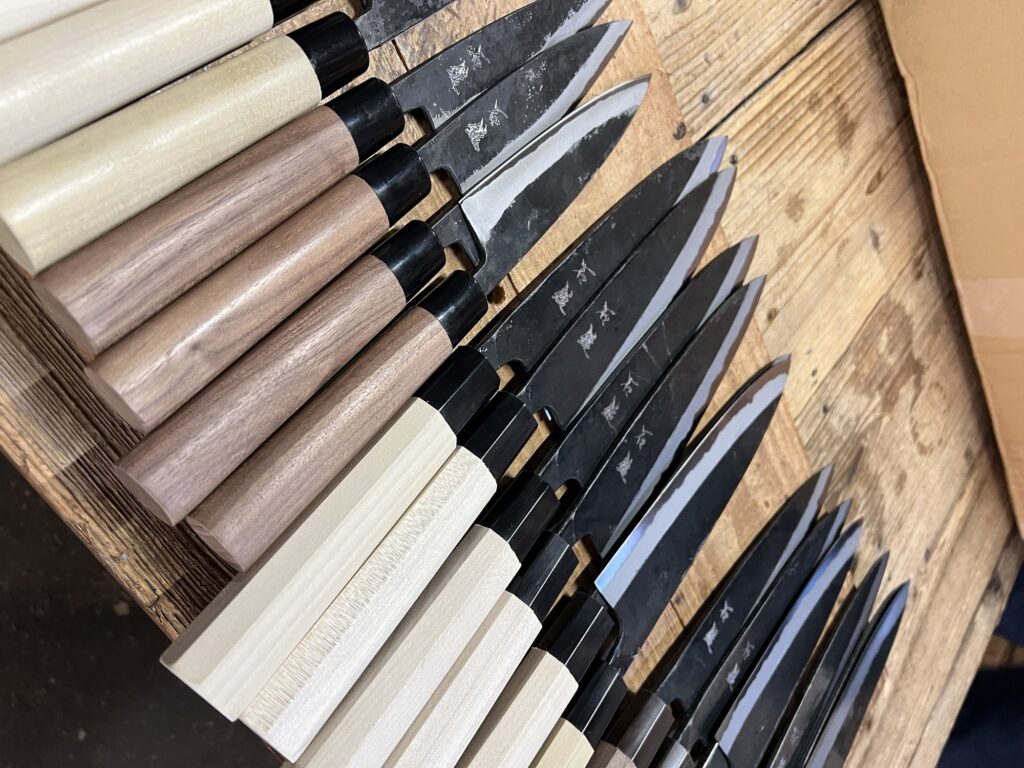
Kurouchi literally refers to the dark finish left on part of a forged blade.
During forging and heat treatment, a dark oxide scale forms on the steel. Instead of polishing the entire surface until it becomes bright and uniform, part of that dark surface is left visible while the cutting area is ground and sharpened.
The result is the familiar contrast between the dark upper blade and the exposed steel closer to the edge.
It looks rustic because, in a sense, it is.
Kurouchi is not Damascus decoration painted onto a blade. The dark appearance comes from the blade-making process itself.
👉 INTERNAL LINK: Link here to “Kurouchi Japanese Knives — What I Learned After Removing It”
Why Did Kurouchi Become So Common on Tosa Knives?
This is where I think we need to be careful.
I could not find a reliable historical source that simply states: “Kurouchi became common in Tosa because of this one reason.”
So I do not want to invent a history just because it makes a good story.
What we can establish is that Tosa cutlery developed strongly alongside agriculture and forestry, that practical working blades were extremely important to the region, and that free forging became a defining part of its manufacturing culture.
From that background, leaving part of the forged surface unpolished makes practical sense. It avoids the need to polish every part of a working blade purely for appearance while retaining the unmistakable character of forging.
That does not prove that Kurouchi originated in Tosa.
It almost certainly should not be described that way.
But it does help explain why Kurouchi and Tosa Knives feel so naturally connected.
👉 INTERNAL LINK: Link here to “Handmade Japanese Knives — Why No Two Are Exactly the Same”
From Practical Finish to Japanese Character

240mm Thick Deba Aogami #2 Kurouchi Walnut Handle
Something interesting happened to me today here in Australia.
I visited a café to show the owner some of our knives. When he saw one of the Kurouchi knives, he told me:
“I want to have this kind of Japanese-looking knife.”
That comment stayed with me.
A finish that historically makes perfect sense on a practical forged tool now communicates something completely different on the other side of the world.
It communicates Japan.
The uneven black surface, the visible contrast with the sharpened steel and the slightly rugged appearance tell a story before anyone even uses the knife.
For me, that is part of what makes Tosa Knives fascinating.
👉 INTERNAL LINK: 壮大 Sōdai | The Knife That Stops People Before They Even Pick It Up
Tosa Knives: Kurouchi Feels at Home in Tosa

180mm Kiritsuke Aogami #2 Kurouchi Walnut Octagonal Handle
I cannot say that Kurouchi was invented in Tosa, nor can I point to a single historical event that explains exactly why it became so strongly associated with Tosa blades.
But perhaps that is not the most important point.
Tosa cutlery grew from forests, farms, blacksmiths and people who needed reliable tools. Its tradition of free forging placed purpose before perfect uniformity.
Kurouchi fits that philosophy remarkably well.
What was once simply a practical way to finish a forged blade has also become part of the visual character that people around the world now recognise as distinctly Japanese.
And today, standing in a café in Australia and hearing someone say, “This is the kind of Japanese knife I want,” I was reminded that the old character of Tosa still has the power to speak for itself.
👉 Explore more:
https://blog.asaoyayaichi.com.au
👉 Visit our online store:
https://asaoyayaichi.com.au
Thank you for reading, and I hope to see you again in the next story.