I have worked as a professional chef for more than 25 years, and Japanese knives have been part of my working life for a long time. But since starting Asaoya Yaichi and learning more about how Japanese knives are actually made, I have realised something interesting: there are many Japanese knife terms that I simply did not know.
Using a knife every day and understanding how a blacksmith constructs one are two very different things.
So I decided to research some of these words myself. This is not a glossary written from the perspective of a blacksmith. It is a chef learning more about the tools he has used for decades — and sharing what he discovers along the way.
If you are looking for Japanese knives in Australia while reading this story, you can also visit our collection here.
👉 Visit Asaoya Yaichi: https://asaoyayaichi.com.au
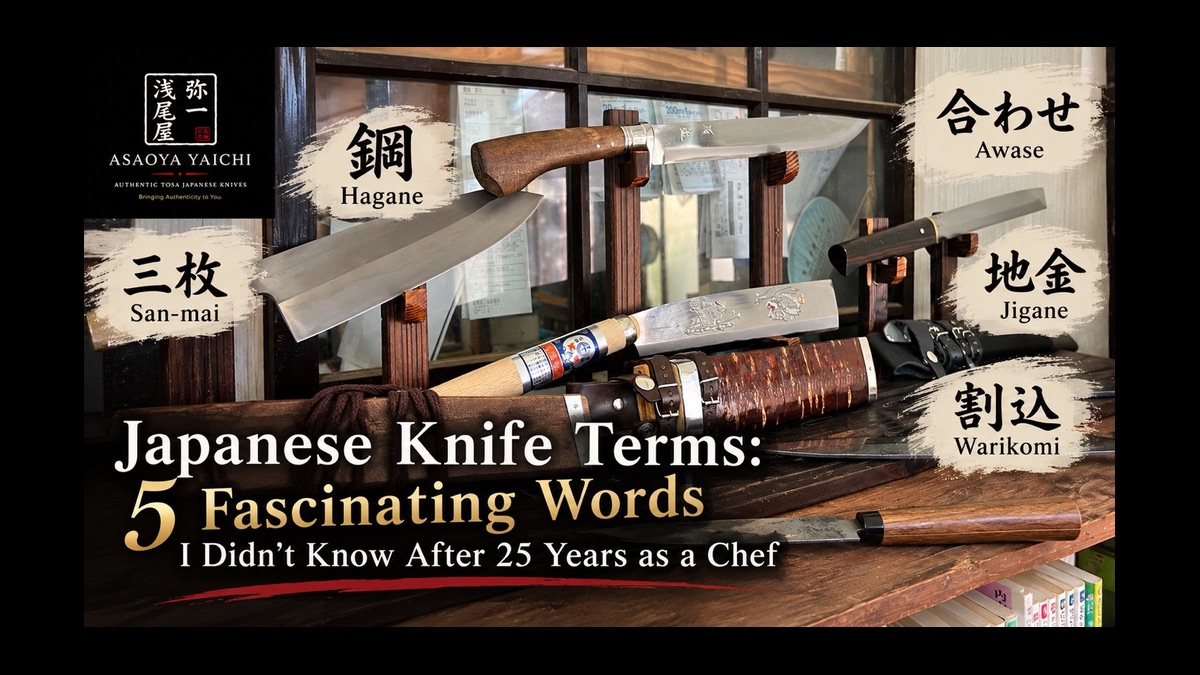
For the first part of this series, I chose five Japanese knife terms that are closely connected: Hagane, Jigane, Awase, San-mai and Warikomi.
Japanese Knife Terms #1: What Does Hagane Mean?

180mm Santoku Aogami #2 Green Micarta Handle with Turquoise Spacer
Hagane (鋼) means steel, but in discussions about laminated Japanese knives it commonly refers to the harder steel that forms the cutting edge.
This was interesting to me because, as a chef, I have normally thought about steel by names such as Aogami #2, Ginsan, VG10 or SG2. I thought about how the knife sharpened, how long the edge lasted and how it behaved during service.
Hagane approaches the subject from a different direction. It describes the role that hard steel plays within the construction of a laminated blade.
That made me look at familiar knives differently.
👉 INTERNAL LINK: Read my article about choosing Japanese knife steel after 25 years in professional kitchens.
Japanese Knife Terms #2: What Is Jigane?
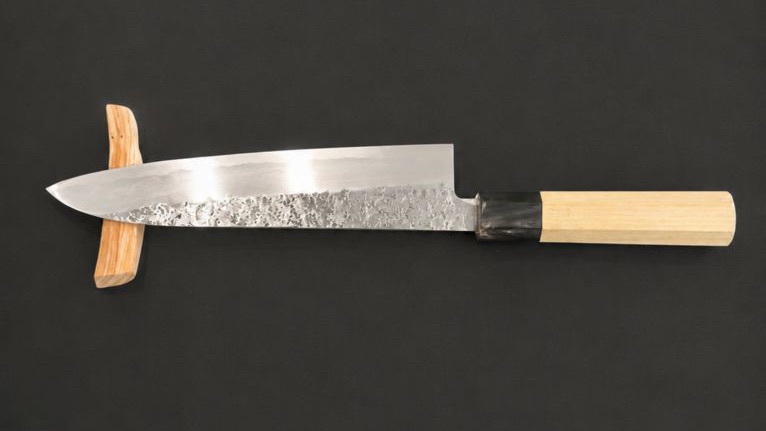
210mm Gyuto Ginsan Nashiji Forged Magnolia Octagonal Handle Buffalo Horn Ferrule
Jigane (地金 / 地鉄) was another term I had seen without really stopping to understand it.
In traditional laminated knife construction, jigane refers to the softer material supporting the harder hagane. Depending on the construction, this can be soft iron, mild steel or another softer cladding material.
The concept is surprisingly practical: the hard steel performs at the cutting edge, while the softer material supports it.
Once I understood this, some of the visual characteristics of traditional Japanese knives also started to make more sense.
👉 INTERNAL LINK: Read my guide to Japanese knife finishes, including Nashiji, Kurouchi, Damascus and Mirror finishes.
Understanding Awase as a Japanese Knife Term
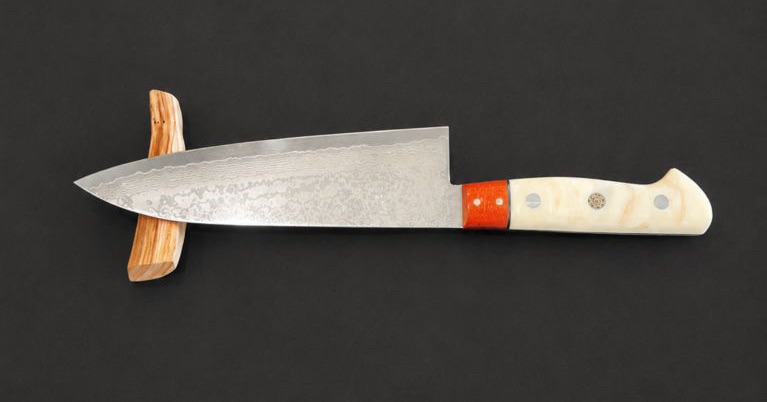
180mm Santoku VG10N 33 Layer Damascus Green Marble Handle Rainbow Spacer Orange
Awase (合わせ) broadly describes a laminated or joined construction in which different materials are combined rather than making the blade from one homogeneous piece of steel.
This was one of those Japanese knife terms that helped several other words suddenly connect.
Hagane and jigane are not simply two unrelated materials. In an awase knife, they work together as part of the blade’s construction.
That also helped me better understand why hand-forging should not simply be reduced to the image of someone hitting hot steel with a hammer. The construction itself matters.
👉 INTERNAL LINK: Read “Hand-Forged vs Machine-Made Japanese Knives” for more about how Japanese knives are produced.
Japanese Knife Terms: San-mai and Warikomi Are Not Exactly the Same

This is where the terminology became particularly interesting to me.
San-mai (三枚) literally refers to three layers. In a typical double-bevel construction, harder hagane forms the core, with softer cladding on either side.
Warikomi (割込) uses a different construction method. The softer body is split or opened and the harder steel is inserted into it.
I had previously seen these words in knife descriptions without giving much thought to why both existed. Researching them showed me that words that may look like technical marketing language can actually describe meaningful differences in how a blade is constructed.
👉 INTERNAL LINK: Read my article about Tosa knife history and how Japanese blade-making developed from traditional craftsmanship.
Why Japanese Knife Terms Matter When Buying Japanese Knives in Australia

180mm Kiritsuke Aogami #2 Kurouchi Walnut Octagonal Handle
Do you need to memorise Hagane, Jigane, Awase, San-mai and Warikomi before buying a good kitchen knife?
No.
I spent more than 25 years working in professional kitchens without knowing every one of these terms.
But now that I sell Japanese knives in Australia, I want to understand more than just how a knife feels on the cutting board. I want to understand why it was made that way, what the maker was trying to achieve and what the terminology in a product description actually means.
For me, learning these Japanese knife terms has become another part of understanding Japanese knives themselves.
And if you are currently comparing Japanese Knives Australia, terminology should not replace practical considerations such as what you cook, blade length, steel, maintenance and how the knife feels in use. It simply gives you another layer of knowledge when making that decision.
👉 INTERNAL LINK: Read “Japanese Knives Australia: 5 Powerful Choices I Would Make After 25 Years as a Professional Chef.”
There are still plenty of Japanese knife terms I do not know — Shinogi, Kireha, Urasuki, Koba and many others deserve a closer look.
So rather than pretending I already know them all, I am going to keep researching them.
That will be Part 2.
👉 Explore more:
https://blog.asaoyayaichi.com.au
👉 Visit our online store:
https://asaoyayaichi.com.au
Thank you for reading, and I hope to see you again in the next story.