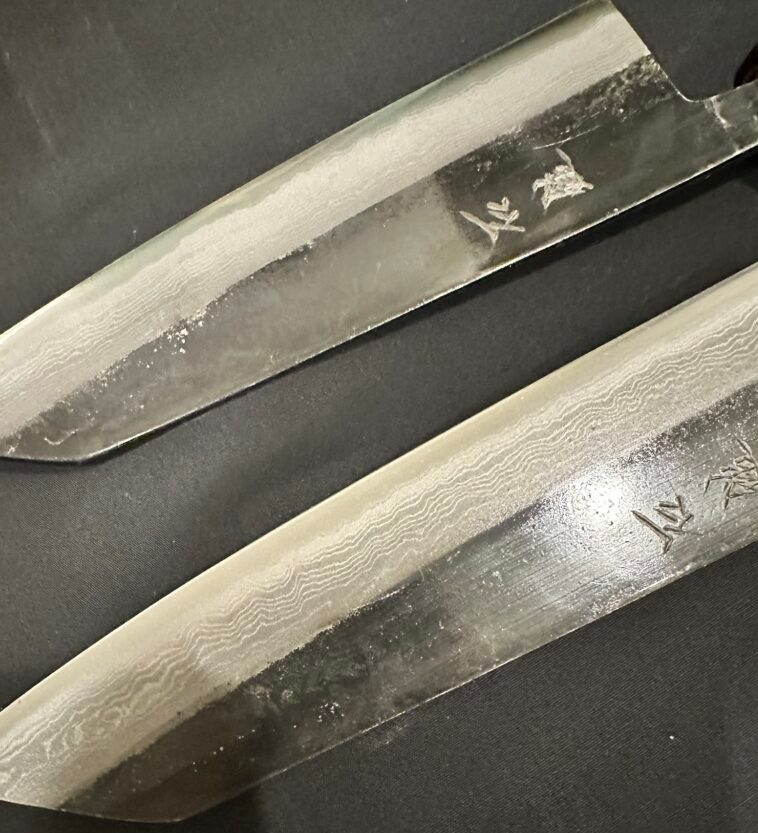
Kiritsuke Aogami #2 Kurouchi Walnut Octagonal Handle
Aogami and Shirogami are two traditional Japanese carbon steels that I only started learning about after entering the Japanese knife business.
I have worked as a professional chef for more than 25 years, but I have a confession to make.
Until I started selling Japanese knives, I didn’t even know what Aogami and Shirogami were.
To be honest, I didn’t know there were so many different types of stainless steel either. VG10, Ginsan, SG2… I had used knives for years without paying much attention to what the steel was actually called.
And even now, I’m still learning what makes each steel different.
As a chef, I had always judged a knife in a much simpler way. Does it cut well? How does it feel in my hand? How does it feel on the whetstone? And does it work well for the job I need it to do?
Then, after starting my knife business, I kept seeing the words Aogami and Shirogami.
Blue Paper Steel. White Paper Steel.
And one day I thought:
Why blue? Why white?
I honestly had no idea.
So I decided to look it up.
1. Why Are Aogami and Shirogami Called Blue and White Paper Steel?
The answer was much simpler than I expected.
The steel itself is not blue or white.
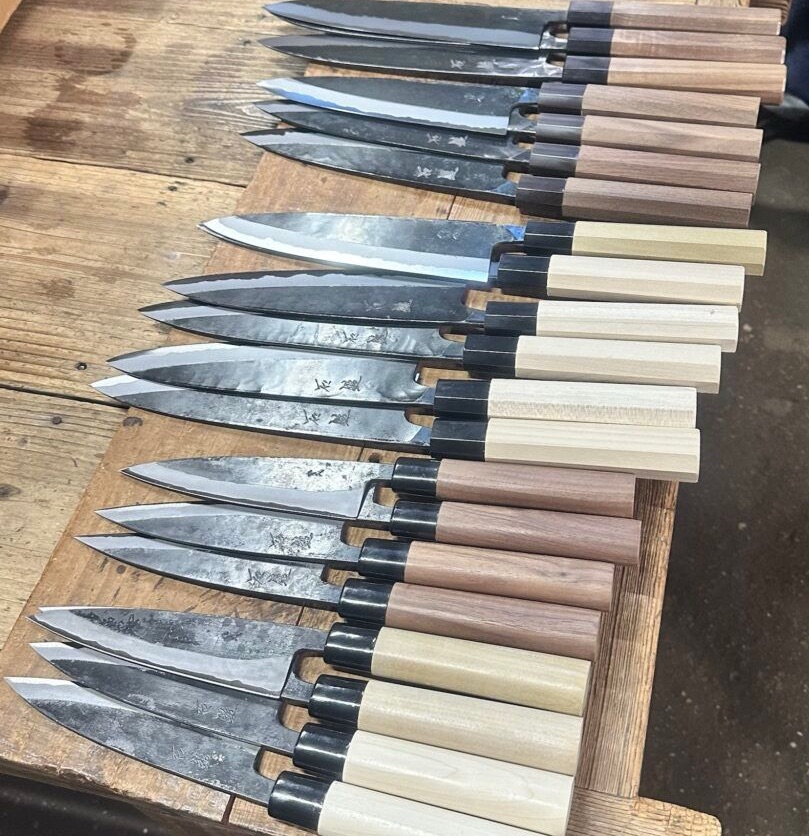
The names Aogami and Shirogami come from the coloured paper traditionally used to distinguish different grades of Yasugi Specialty Steel.
“Ao” means blue in Japanese, while “Shiro” means white.
That is why Aogami became known as Blue Paper Steel and Shirogami as White Paper Steel.
After more than 25 years of using knives, I had never once wondered about this.
Sometimes the simplest questions are the ones we forget to ask.
2. So, What Exactly Is Shirogami?
Once I understood the name, the next question was obvious.
What is actually different about the steel?
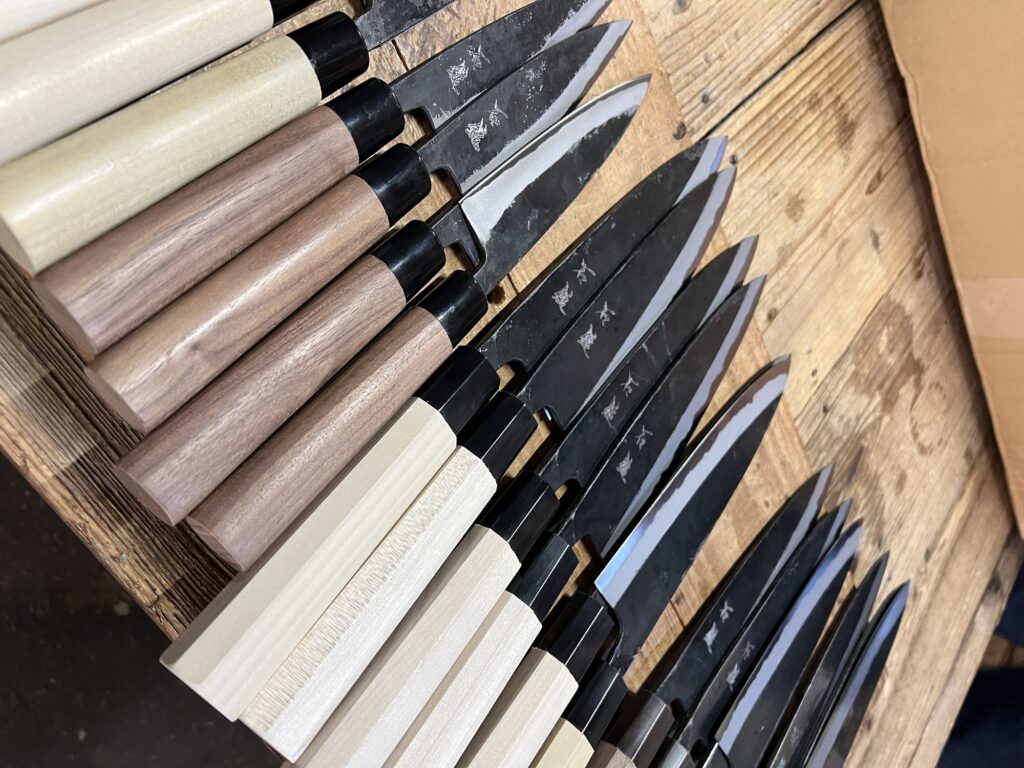
Shirogami is a high-purity carbon steel with tightly controlled impurities. Its relatively simple composition allows it to take a very fine edge, and it has a strong reputation for responding beautifully to whetstones.
Of course, it is still carbon steel.
That means moisture, acidic foods and poor maintenance can cause discolouration and eventually rust.
It can also develop a natural patina through normal use.
👉 INTERNAL LINK: Read more about Japanese knife patina:
https://blog.asaoyayaichi.com.au/japanese-knife-patina/
For someone used to stainless steel, this extra maintenance may seem inconvenient. For others, it is simply part of the character of a traditional carbon-steel knife.
3. How Is Aogami Different from Shirogami?
This is where things started getting more interesting for me.
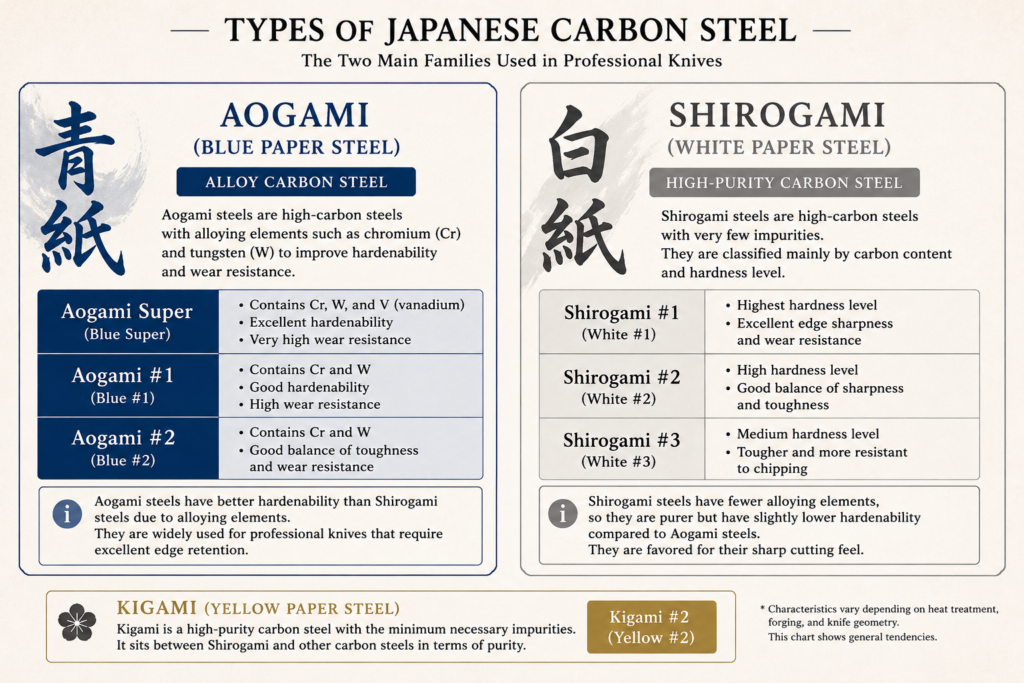
Aogami contains alloying elements such as chromium and tungsten in addition to carbon. These additions help increase wear resistance and edge retention.
In simple terms, Aogami is designed to maintain its cutting edge well.
The trade-off is that greater wear resistance can also mean more effort when sharpening compared with a simpler carbon steel such as Shirogami.
Before starting a knife business, I never thought about knives in terms of chromium, tungsten or carbon percentages.
I simply knew whether I liked using a knife or not.
Learning about the steel has given me another way to understand some of those differences.
4. Aogami #1, #2 and Aogami Super
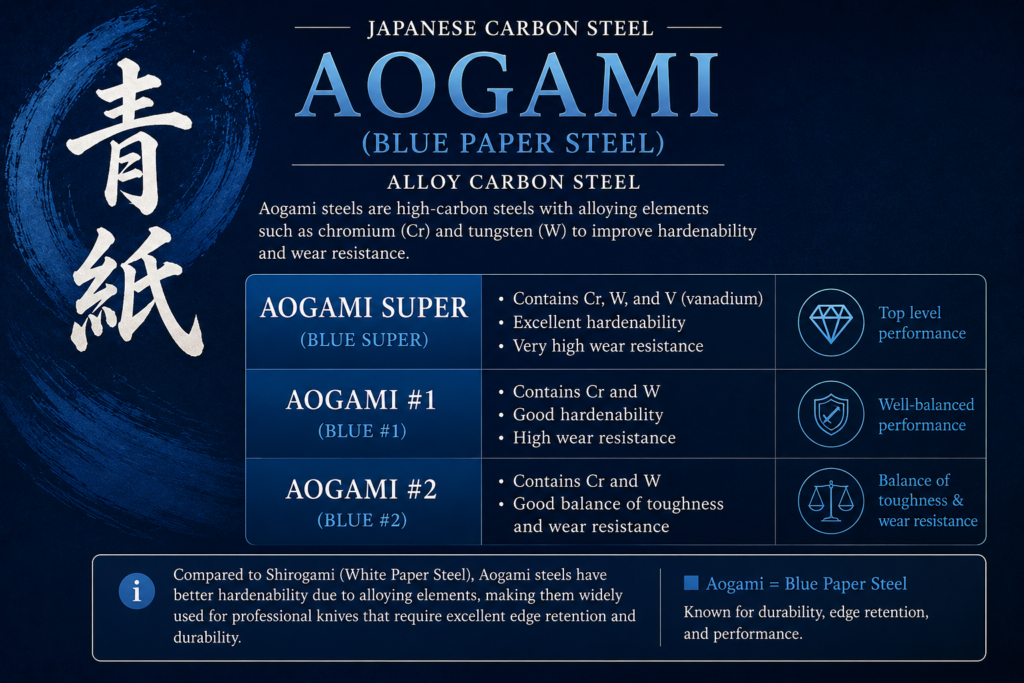
Then I discovered that Aogami itself was not just one steel.
There is Aogami #1, Aogami #2 and Aogami Super.
Very simply, the different grades have different carbon and alloy compositions. Aogami #1 has more carbon than #2, while Aogami Super uses additional alloying elements and is known for high hardness and excellent edge retention when properly heat treated.
At first, it is tempting to think that a higher specification must automatically mean a better knife.
But the more I learn about Japanese knives, the less I think that way.
The steel is only one part of the story.
Heat treatment, blade geometry, grinding, sharpening and the skill of the maker can all affect how the finished knife performs.
👉 INTERNAL LINK: Read more about Japanese knife hardness and HRC:
https://blog.asaoyayaichi.com.au/japanese-knife-hardness-hrc/
5. Shirogami Also Has Different Grades
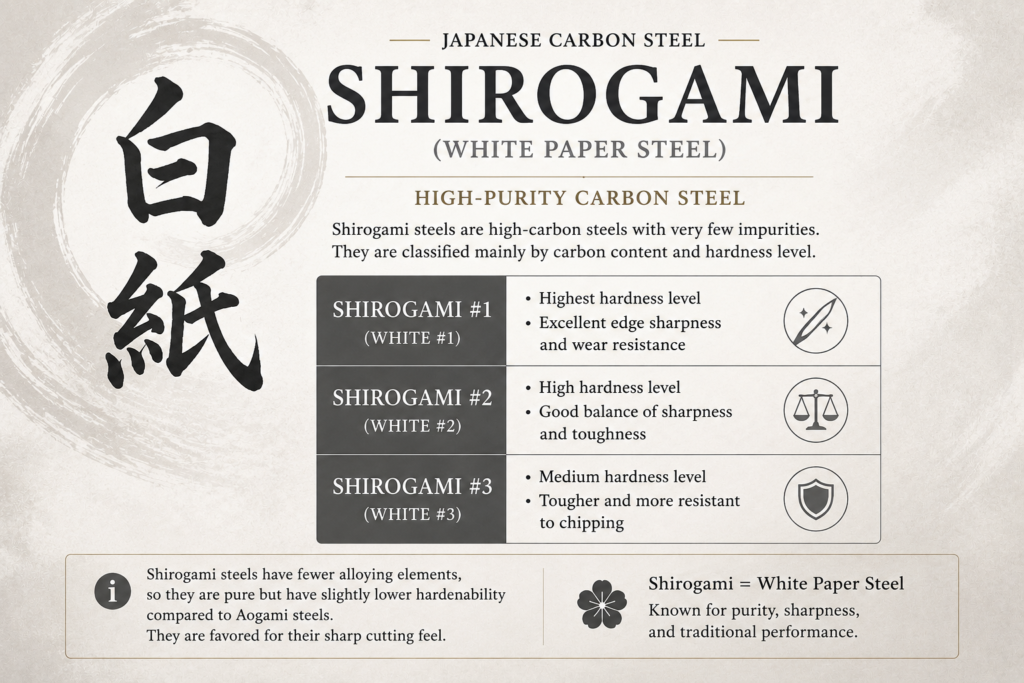
Then, of course, I learned that Shirogami also comes in different grades.
Shirogami #1, #2 and #3 have different carbon contents, with #1 containing more carbon than #2 and #3 containing less.
Again, I don’t think this means we can simply rank them from “best” to “worst.”
This is something I have come to understand since entering the knife business.
Two handmade Japanese knives using the same steel can still feel very different.
The maker, heat treatment, thickness, blade geometry, sharpening and even the intended purpose of the knife all matter.
👉 INTERNAL LINK: Why no two handmade Japanese knives are exactly the same:
https://blog.asaoyayaichi.com.au/handmade-japanese-knives/
6. Is Aogami Better Than Shirogami?
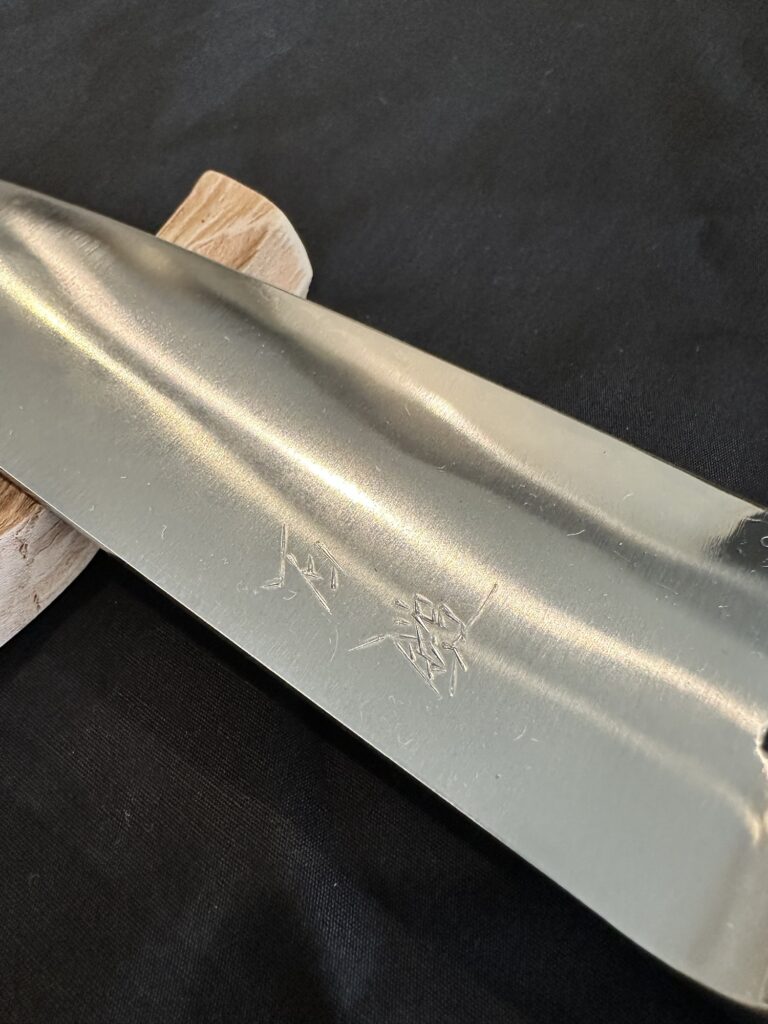
180mm Santoku Aogami #2 Green Micarta Handle with Turquoise Spacer
This was probably my biggest question when I first started learning about Aogami and Shirogami.
Which one is better?
After looking into it, I think that may be the wrong question.
Aogami is well known for edge retention and wear resistance. Shirogami is famous for its sharpening response and ability to take a very refined edge.
But a knife is something we actually use.
How often do you sharpen? What ingredients do you cut? How do you use your knife? Do you enjoy sharpening? How much maintenance are you comfortable with?
And most importantly, how does the knife actually feel when you use it?
👉 INTERNAL LINK: Read more about Kireaji — the feeling of sharpness:
https://blog.asaoyayaichi.com.au/japanese-knife-sharpness/
Specifications can explain part of a knife, but they cannot completely describe the experience of using one.
7. What I Learned About Aogami and Shirogami
The biggest thing I learned while researching Aogami and Shirogami was not actually about carbon percentages or alloying elements.
It was how much I still have to learn.
I have spent more than 25 years using knives professionally, but that does not mean I spent 25 years studying knife steel.
I was a chef.
I picked up a knife, used it, sharpened it, washed it, dried it and went back to work.
Only after starting my knife business did I begin paying much more attention to the steels behind the knives.
👉 INTERNAL LINK: Read more about Japanese knife balance:
https://blog.asaoyayaichi.com.au/japanese-knife-balance/
And I actually enjoy discovering these things now.
Aogami. Shirogami. VG10. Ginsan. SG2.
Names that once meant very little to me are gradually starting to make more sense.
This time, it started with an extremely simple question.
Why blue? Why white?
Now I know.
But learning about Aogami and Shirogami also reminded me that steel specifications are only part of what makes a Japanese knife interesting.
The maker matters. Heat treatment matters. Geometry matters. Sharpening matters.
And finally, the person holding the knife matters.
So I don’t think we need to decide that Aogami is simply better than Shirogami, or vice versa.
They are different steels with different characteristics.
And I’m still learning about both.
Maybe that is part of the fun.
👉 Explore more:
https://blog.asaoyayaichi.com.au
👉 Visit our online store:
https://asaoyayaichi.com.au
Thank you for reading, and I hope to see you again in the next story.