Choosing your first Japanese knife can be confusing. There are so many steels, shapes, sizes, brands and price ranges that it is easy to spend hours researching and still not know what to buy.
So let me make my answer simple.
If you are buying your first Japanese knife for general home cooking, I would start by looking at a 180mm Santoku or a 210mm Gyuto, preferably in an easy-to-maintain stainless steel such as VG10 or Ginsan.
That does not mean these are the “best” Japanese knives. It means they are practical places to start.
Interestingly, more than 25 years ago, my own first Japanese knives were quite similar to what I would still recommend today.
If you are looking for Japanese knives in Australia, you can also explore our current range here:
👉 Japanese Knives Australia — Explore our collection
Choosing Your First Japanese Knife: My Own First Choice
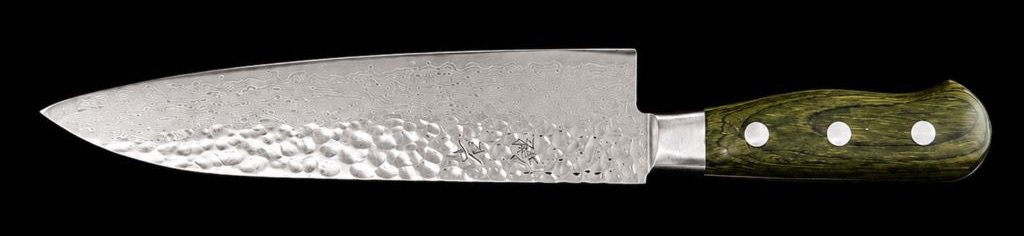
210mm Gyuto VG10 Polished Hammered 67 Layer Damascus Green Handle

135mm Petty VG10 Polished Hammered 67 Layer Damascus Green Handle
The first Japanese knives I bought for myself were a 210mm Damascus Gyuto and a Petty knife from the same series. If I remember correctly, the steel was probably VG10.
At the time, I certainly did not understand knife steels the way I do now. I was not comparing every specification or thinking deeply about hardness, edge retention or steel composition.
I simply bought knives that I wanted to use.
Looking back after more than 25 years in professional kitchens, however, I think the basic combination actually made a lot of sense.
A 210mm Gyuto can handle meat, fish and vegetables. The Petty takes care of smaller and more detailed jobs. Between those two knives, you can handle a huge amount of everyday kitchen work.
👉 INTERNAL LINK: 探究 Tankyū | What Does VG10 Actually Mean?
Should Your First Japanese Knife Be a Gyuto or Santoku?

210mm Gyuto Ginsan Nashiji Forged Magnolia Octagonal Handle Buffalo Horn Ferrule
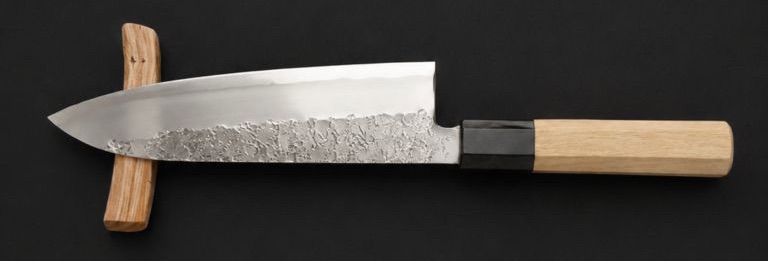
180mm Santoku Ginsan Nashiji Forged Magnolia Octagonal Handle Buffalo Horn
For someone choosing their first Japanese knife, this is probably one of the most useful questions to answer.
If you have enough bench space and are comfortable with a slightly longer blade, I think a 210mm Gyuto is an excellent starting point. The extra blade length becomes especially useful when cutting larger pieces of meat, fish or vegetables, because you can use a longer cutting stroke.
👉 INTERNAL LINK: [Gyuto vs Santoku — Which Japanese Knife Is Right for You?]
For a smaller home kitchen, or if 210mm simply feels too large, I would look at a 180mm Santoku.
A Santoku is compact, comfortable and capable of handling meat, fish and vegetables. For many home cooks, it may be all the knife they really need.
Neither one is automatically better.
The question is which one makes more sense in your kitchen.
Choosing Your First Japanese Knife Steel
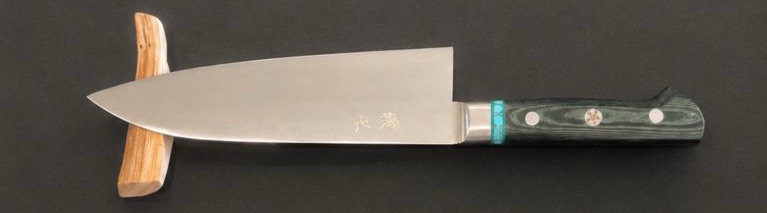
180mm Santoku Aogami #2 Green Micarta Handle with Turquoise Spacer
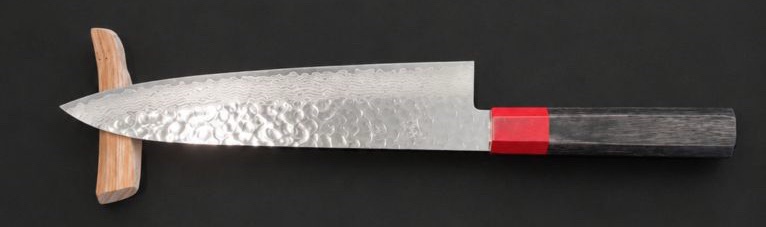
165mm Santoku A10 Damascus Black & Red Octagonal Handle
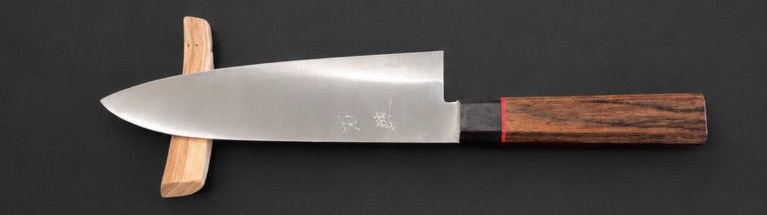
180mm Santoku SG2 Rosewood Octagonal Handle
Steel names can make buying a Japanese knife unnecessarily intimidating.
VG10, Ginsan, Blue #2, Blue Super, SG2 — the list goes on.
For a beginner, I would not start by asking which steel can become the sharpest.
I would ask: How much maintenance do you want?
For many first-time buyers, VG10 or Ginsan makes a lot of sense. Both offer excellent performance while being stainless and relatively easy to live with.
👉 INTERNAL LINK: [Japanese Knife Steel — Understanding the Different Steels Used in Japanese Knives]
I personally enjoy carbon steels such as Blue #2, especially for certain cutting jobs. But carbon steel requires more attention to moisture and maintenance.
That does not make it unsuitable for beginners. It simply means you should understand what you are buying.
👉 INTERNAL LINK:Aogami and Shirogami | 7 Fascinating Things I Learned About Blue and White Paper Steel
Choosing Your First Japanese Knife Does Not Mean Buying the Most Expensive One
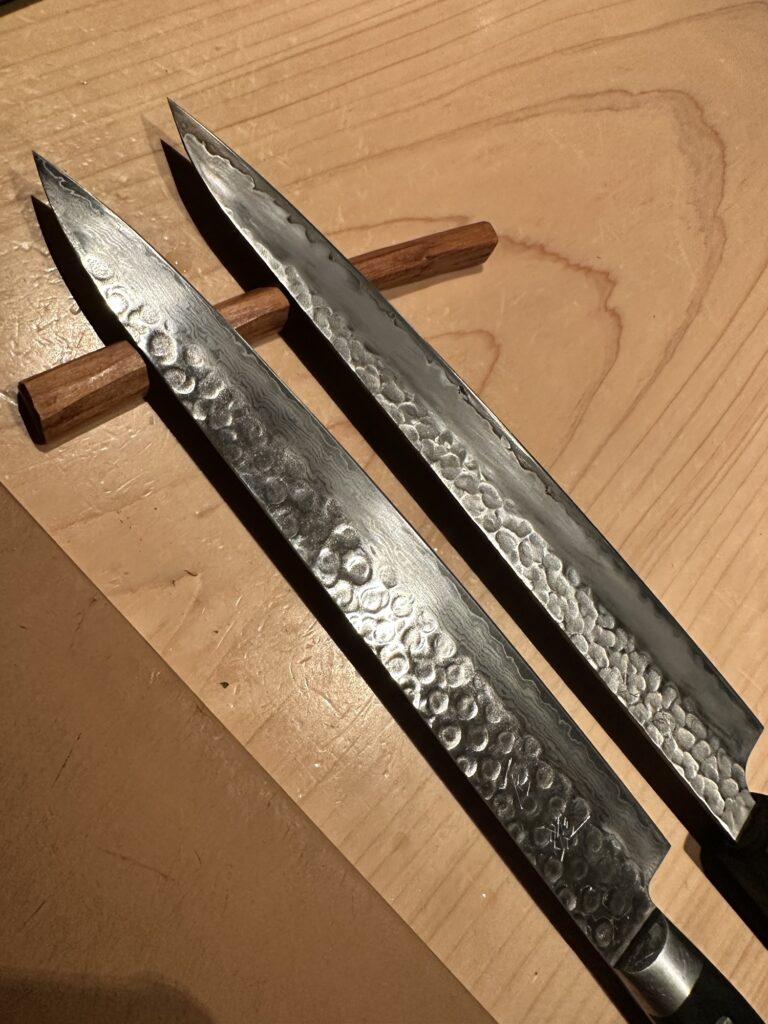
240mm Sujihiki VG10 Hammered 17 Layer Damascus Mahogany
There is another reason I do not think beginners should become too obsessed with specifications or prestige.
Years ago, I took one of my knives back to a knife shop to have it sharpened.
The person there almost laughed at it.
I still remember that experience.
Maybe, from his perspective, it was not a particularly special knife. But I had bought it, used it professionally and relied on it to do my job.
That experience taught me something I still believe today.
A knife does not need to impress another knife enthusiast. It needs to work for the person holding it.
After more than 25 years as a chef, I have used carbon steel, stainless steel, Yanagiba, Gyuto, Sujihiki and many other knives. Today, one of the knives I use most at the sushi counter is a VG10 Sujihiki.
Not because VG10 is the most prestigious steel.
It simply works for what I do.
👉 INTERNAL LINK: 真価 Shinka | 7 Powerful Truths About a New Japanese Knife’s Real Potential
What About a Petty as Your Second Japanese Knife?

120mm Petty Ginsan Nashiji Forged Magnolia Octagonal Handle Buffalo Horn Ferrule
Once you have your main knife, my next choice would probably be a Petty.
A Petty around 120–135mm is useful for smaller ingredients and detailed preparation where a 180mm or 210mm knife feels unnecessarily large.
Interestingly, this is also what I did with my first Japanese knives: a Gyuto and a Petty.
I did not understand it this way at the time, but looking back, they complemented each other extremely well.
My Advice for Choosing Your First Japanese Knife
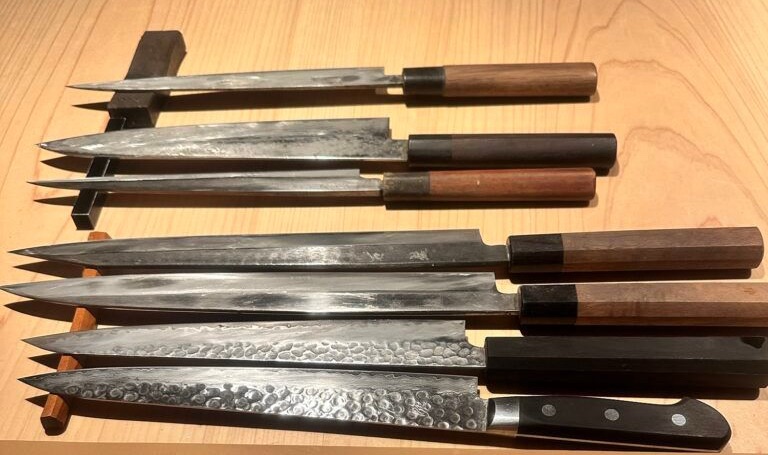
After more than 25 years in professional kitchens, my advice is actually simpler than it would have been when I was younger.
For general home cooking, start with a 180mm Santoku or 210mm Gyuto.
If you want easy maintenance, look seriously at VG10 or Ginsan.
Then, if you want a second knife, consider a 120–135mm Petty.
If you mainly prepare vegetables, a Nakiri may make more sense. If you regularly slice fish or meat in long clean strokes, you may eventually want to explore a Sujihiki.
But you do not need to start there.
When choosing your first Japanese knife, do not worry too much about owning the knife with the highest hardness, the most expensive steel or the most impressive specifications.
Start with a knife that fits your kitchen and the food you actually cook.
More than 25 years after buying my first 210mm Gyuto and Petty, that is still where I would begin.
👉 Explore more:
https://blog.asaoyayaichi.com.au
👉 Visit our online store:
https://asaoyayaichi.com.au
Thank you for reading, and I hope to see you again in the next story.
—————————————————
Where to See and Buy Our Knives
Our Partner Stores
Chanoyu — Nerang, Gold Coast

Visit Chanoyu and See Our Japanese Knives
If you are on the Gold Coast, we would love you to visit Chanoyu, a Japanese café in Nerang where you can see and purchase a selection of Asaoya Yaichi knives in person.
Chanoyu is a lovely place to slow down and enjoy Japanese-inspired food, excellent matcha, coffee and handmade desserts. Its warm, peaceful atmosphere makes it a pleasure to visit, whether you are stopping in for breakfast, lunch or something sweet. We are delighted that our knives have a place there.
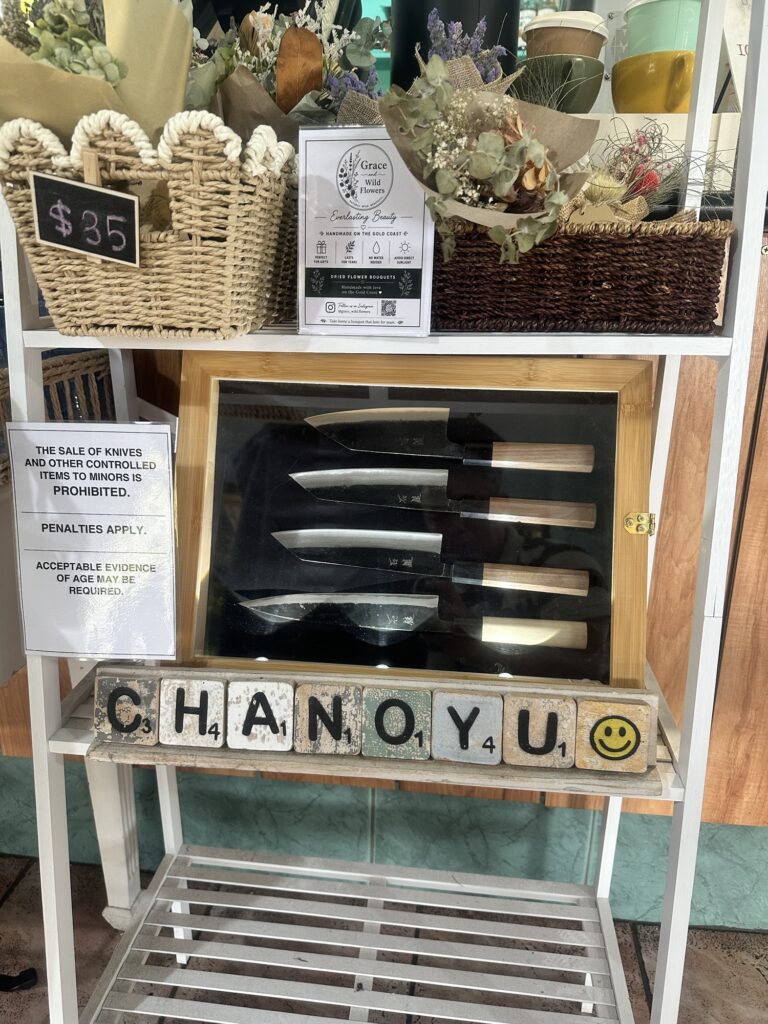
Visit Chanoyu: Shop 6A, 54–58 Nerang Street, Nerang QLD 4211
Opening hours: Monday to Saturday, 7:00 am–2:00 pm; closed Sunday
Website: https://www.chanoyucafe.com/
Instagram: https://www.instagram.com/chanoyugc/
The selection of knives on display may change. If you are interested in a particular Asaoya Yaichi knife, please contact us through https://asaoyayaichi.com.au before visiting, and we will help you check whether it is available at Chanoyu.