When people choose a Japanese knife, they often look first at the steel, hardness, blade length, handle material, or overall weight. These specifications are important, but there is another factor that can completely change how a knife feels in your hand: Japanese knife balance.
After more than 25 years of working as a professional chef, I have learned that the balance of a knife is not simply about whether it feels light or heavy. Two knives can have a similar weight and still feel completely different in use. Where that weight sits — toward the blade, around the center, or closer to the handle — can change the way you naturally move the knife through food.
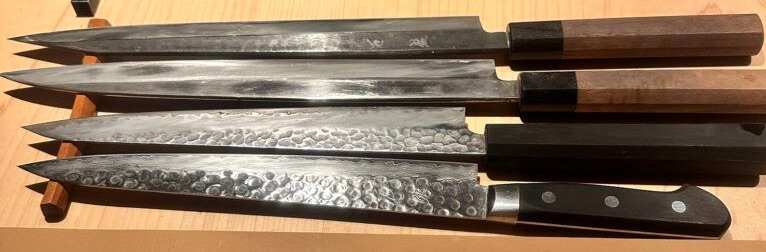
I currently use different knives with very different balance characteristics, including a lightweight Aogami #2 Sujihiki with an octagonal handle, a 240mm VG10 Hammered 17 Layer Damascus Sujihiki with a mahogany handle, and occasionally a traditional Yanagiba. None of them feels the same, but that does not mean one is necessarily better than the others.
For me, understanding Japanese knife balance is really about understanding how a knife wants to be used.
1. Japanese Knife Balance Is Not the Same as Knife Weight
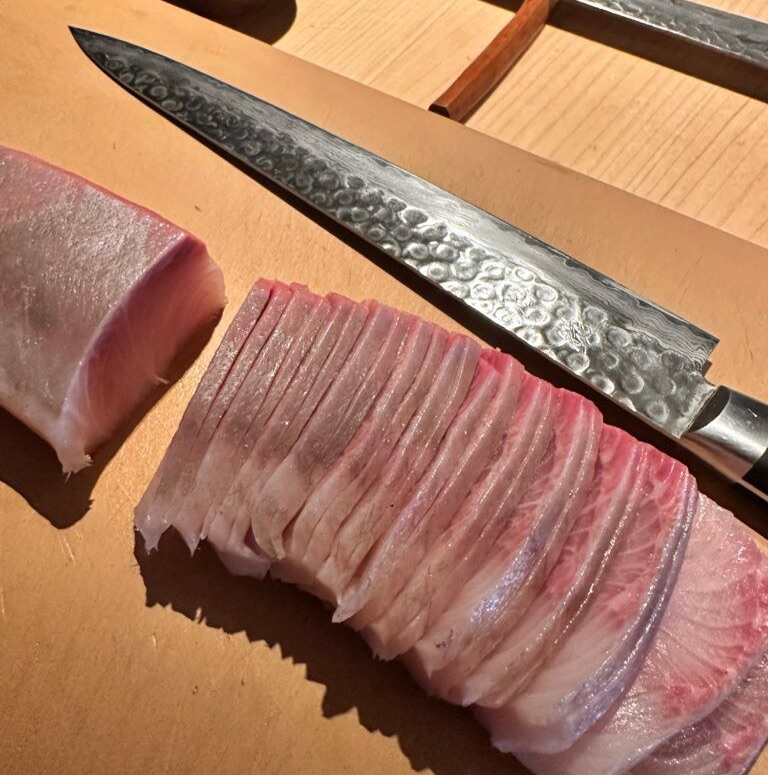
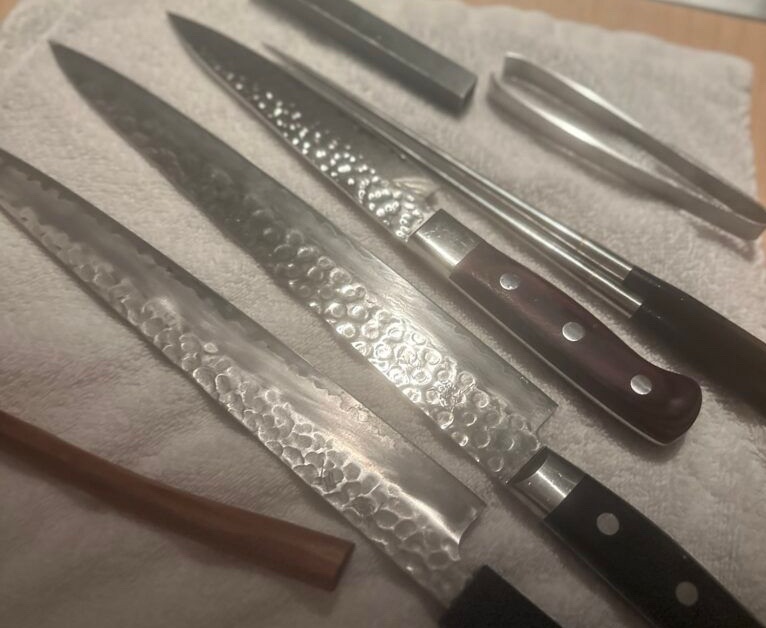
240mm Sujihiki VG10 Hammered 17 Layer Damascus Mahogany
One of the easiest mistakes to make is assuming that weight and balance are the same thing.
They are not.
A knife may be relatively heavy but still feel comfortable because its weight is distributed in a way that suits your cutting style. Another knife may be lighter overall, yet feel unfamiliar because its center of gravity sits somewhere you are not used to.
This is something that becomes much clearer when you actually work with different Japanese knives.
My 240mm VG10 Hammered 17 Layer Damascus Sujihiki with a mahogany handle, for example, is noticeably heavier than some of the other Sujihiki knives I use. However, I would not describe it as difficult to use.
The important difference is where I feel the weight.
Its balance feels more toward the handle, and because of that, I naturally use the long blade differently. Rather than concentrating the cutting action on one small area of the edge, I tend to make a longer drawing motion and use more of the entire blade.
The knife itself influences my technique.
That is why looking only at the number on a scale cannot tell you everything about how a knife will perform.
👉 INTERNAL LINK: Japanese Knife Handles | 7 Powerful Reasons the Right Handle Matters
2. A Lightweight Sujihiki Gives Me a Different Kind of Control
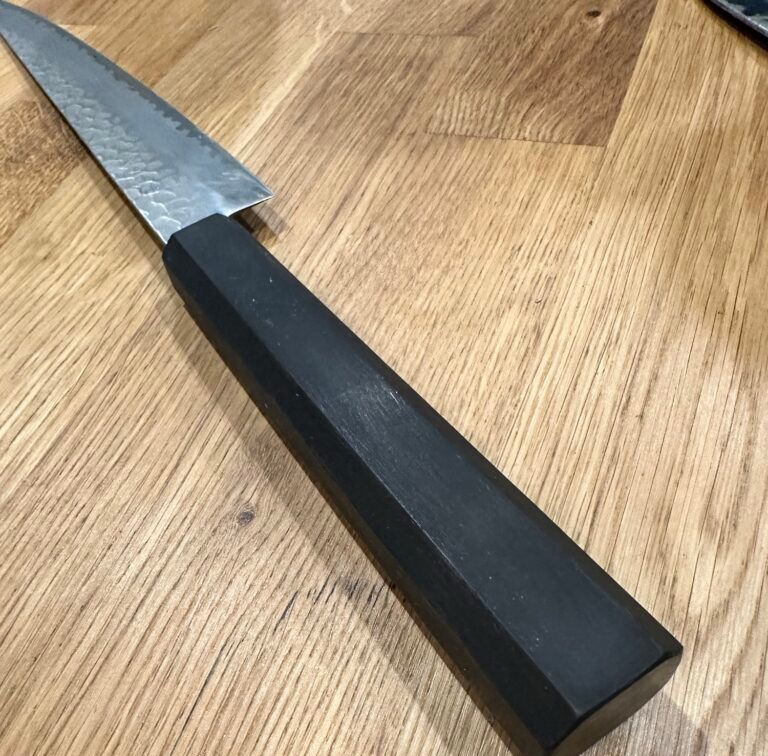
One of the knives I regularly use is an Aogami #2 Sujihiki fitted with a lightweight octagonal handle.
This knife feels very light in my hand, and I find it extremely easy to use.
Because there is less noticeable weight pulling the knife in either direction, I feel that I can control the blade very directly. Small adjustments are easy, and the knife responds quickly to the movement of my hand.
This is especially useful with a Sujihiki, where long, clean slicing movements are important.
But I would not say that this automatically makes it better than a heavier knife.
It simply gives me a different feeling.
The lightweight construction allows me to control the knife more actively, while a heavier knife can sometimes encourage me to use the weight and momentum of the knife itself.
Both approaches can work.
👉 INTERNAL LINK: Sujihiki Knives – Understanding the Japanese Slicing Knife
3. Japanese Knife Balance Can Change the Way You Cut
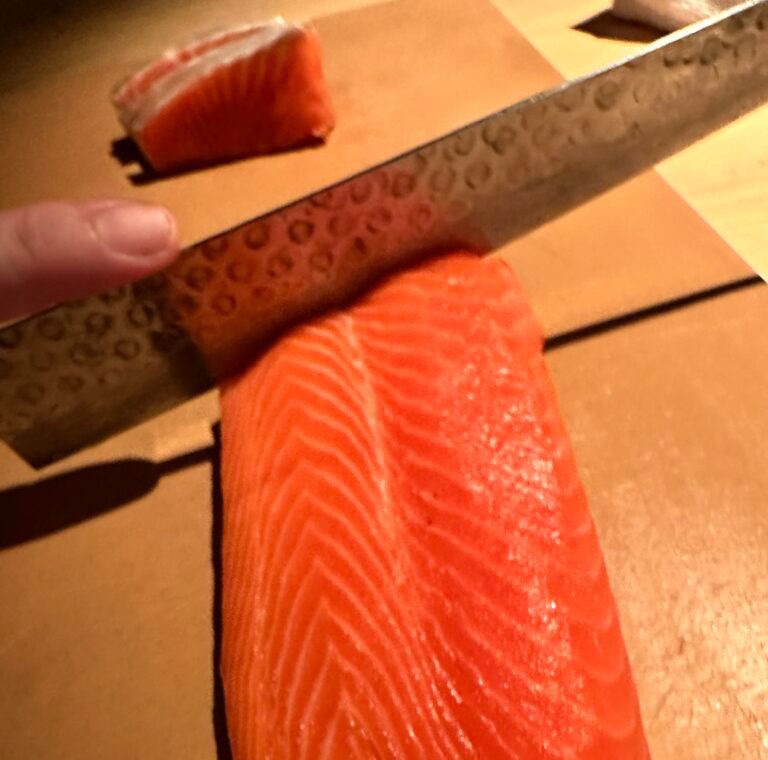
This is probably the most interesting thing about Japanese knife balance.
I do not consciously decide to use exactly the same cutting technique with every knife.
The knife itself changes my movement.
With my lightweight Aogami #2 Sujihiki, I feel that my hand controls almost everything. The knife follows my movement very easily.
With the 240mm VG10 Damascus Sujihiki, I notice the extra weight and the handle-biased balance. Because of that, I naturally make a longer slicing stroke and try to use the length of the blade efficiently.
Then there is the Yanagiba.
When I occasionally use a Yanagiba, the feeling changes again.
With this type of knife, I think less about actively controlling every part of the blade and more about allowing the knife’s own weight to contribute to the cut. I place the blade, begin the drawing motion, and let the weight of the knife help carry the edge through the food.
Of course, technique is still important. But the sensation is different.
Instead of forcing the blade through the ingredient, I feel as though I am allowing the knife to work with me.
That difference is difficult to understand from specifications alone.
👉 INTERNAL LINK: Japanese Knife Bevels | Single Bevel vs Double Bevel Explained
4. Blade-Heavy and Handle-Heavy Knives Are Not Automatically Good or Bad
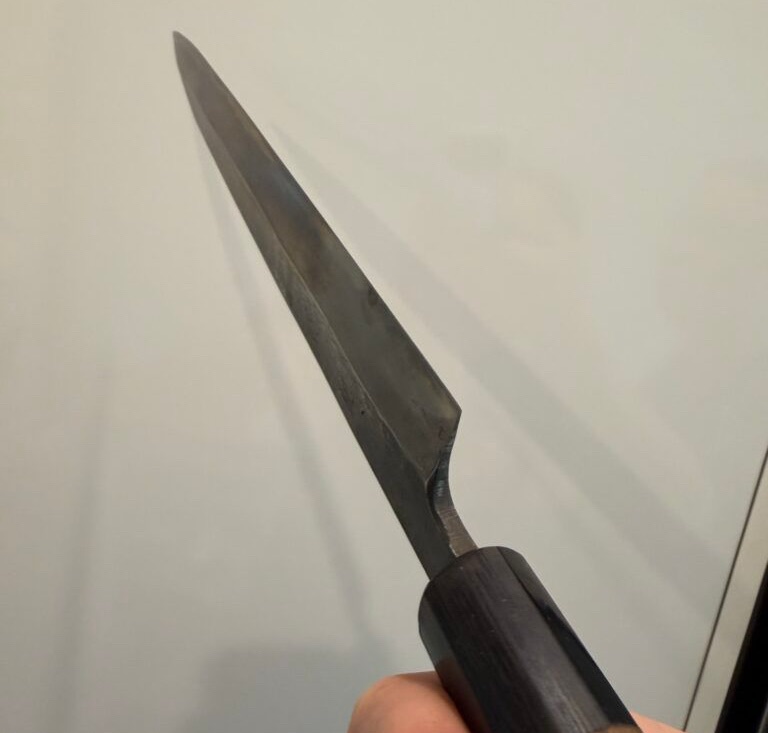
You will sometimes hear people describe a perfectly balanced knife as one where the balance point sits exactly around the heel or bolster area.
That can certainly feel comfortable.
But I do not believe there is one perfect balance point for every Japanese knife.
A blade-heavy knife can sometimes help when you want the mass of the blade to contribute to the cut. A handle-heavy knife can feel more controlled in the hand and encourage a different slicing movement.
A neutral balance can feel extremely natural for general-purpose work.
The important question is not simply:
“Where is the balance point?”
The better question is:
“How does this balance work with the way I use this knife?”
A Deba, Gyuto, Santoku, Sujihiki and Yanagiba are designed for different jobs. It would therefore make little sense to expect every one of them to have exactly the same ideal balance.
5. Handle Material Can Change Japanese Knife Balance More Than You Expect
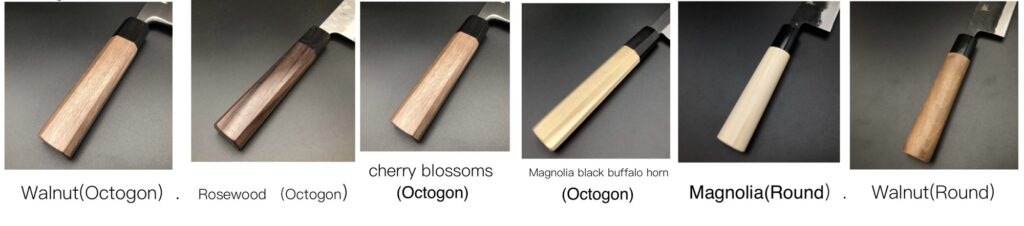
The handle plays an important role in Japanese knife balance.
Traditional Japanese handles can be made from many different materials, including magnolia, rosewood, walnut and mahogany, as well as modern materials such as Micarta.
Their shapes and construction can also vary considerably.
Even when two blades are similar, changing the handle can change the overall feeling of the knife.
I have experienced this directly.
My octagonal-handled Aogami #2 Sujihiki feels extremely light and responsive. My 240mm VG10 Damascus Sujihiki with its mahogany handle feels noticeably heavier and carries more weight toward my hand.
Both are Sujihiki.
Both are designed for slicing.
Yet they do not feel like the same tool.
This is one reason I believe handle choice should not be treated purely as a matter of appearance. A beautiful handle can completely transform the visual character of a Japanese knife, but its weight, shape and material can also affect how the knife behaves during actual work.
👉 INTERNAL LINK: Handmade Japanese Knives | 7 Fascinating Reasons No Two Are Ever Exactly the Same
6. The Right Balance Depends on the Job
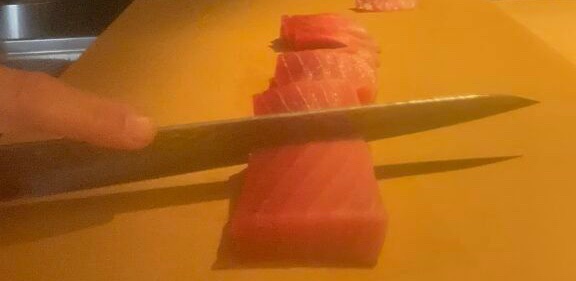
There is another reason I hesitate to describe one type of Japanese knife balance as perfect.
Different jobs require different movements.
When slicing sashimi with a long knife, I want to use the length of the blade and complete the cut with as few unnecessary movements as possible.
When using a general-purpose Gyuto, the movement may be completely different.
When working with a heavier knife such as a Deba, weight can become part of the tool’s character rather than something that needs to be eliminated.
This is also why buying the lightest possible knife is not necessarily the answer.
Lightness can be wonderful.
I personally enjoy the feeling of my lightweight octagonal-handled Sujihiki very much.
But weight can also have a purpose.
Sometimes the mass of a knife provides stability. Sometimes it helps the blade move naturally through the cut. Sometimes a little extra weight simply feels reassuring in the hand.
The important thing is how the knife, your hand, the ingredient and your cutting technique work together.
👉 INTERNAL LINK: The True Value of Japanese Knives | 7 Reasons They Are Worth the Investment
7. Specifications Cannot Tell You Everything About a Japanese Knife
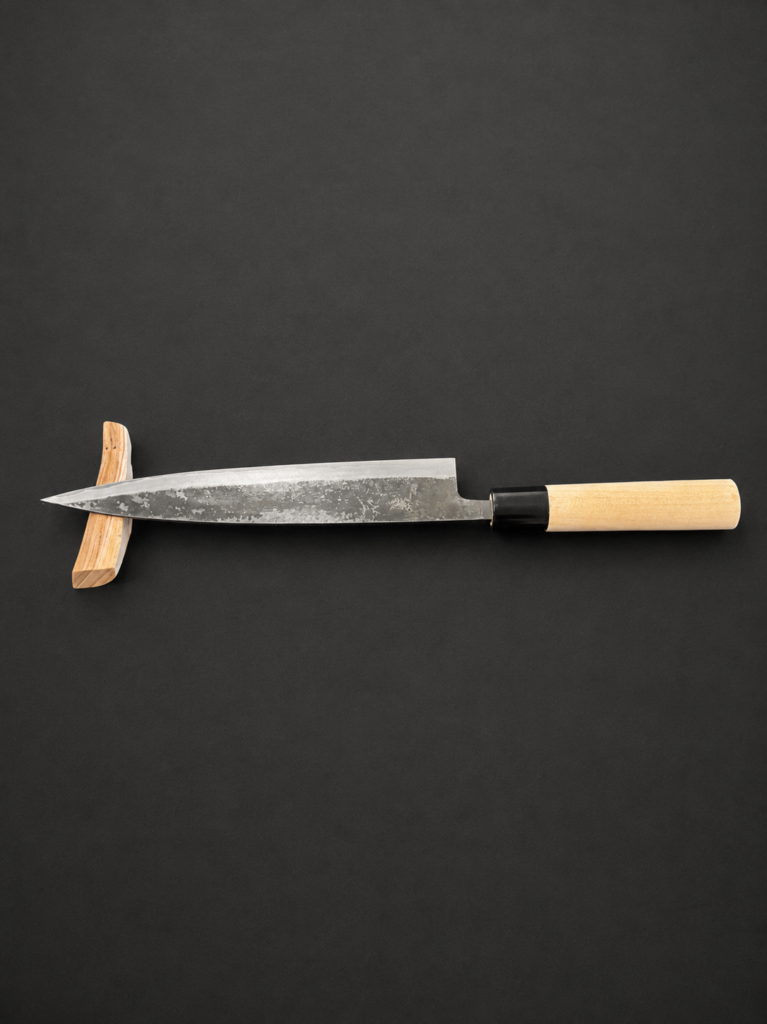
210mm Sujihiki Aogami #2 Kurouchi Magnolia Handle
This may be the biggest lesson I have learned from using different knives professionally.
Specifications are useful.
Steel type matters. Hardness matters. Blade length matters. Handle material matters. Weight matters.
But specifications cannot completely describe how a knife feels.
You can read:
240mm.
VG10.
17-layer Damascus.
Mahogany handle.
You can even know the exact weight.
But none of those numbers can fully explain what happens when you hold that knife and begin slicing with it.
The same is true of my lightweight Aogami #2 Sujihiki.
On paper, someone might simply see a long carbon-steel slicing knife with a Japanese handle.
In my hand, however, what I notice immediately is how light and controllable it feels.
And when I pick up a Yanagiba, I experience something different again. I naturally allow more of the knife’s own weight to participate in the slicing motion.
That experience cannot easily be reduced to a specification sheet.
Japanese Knife Balance Is Personal
After more than 25 years of professional cooking, I do not believe there is one mathematical formula for the perfect Japanese knife balance.
I also do not believe that lighter automatically means better.
My lightweight Aogami #2 Sujihiki is extremely comfortable and easy for me to control.
My 240mm VG10 Hammered 17 Layer Damascus Sujihiki with a mahogany handle is heavier and feels more weighted toward the handle, yet I still enjoy using it. It simply encourages me to use the long blade differently and make full use of its length.
And with a Yanagiba, I often feel that the weight of the knife itself becomes part of the slicing technique.
Three knives.
Three different feelings.
Three slightly different ways of cutting.
That is what makes Japanese knives interesting.
The best knife is not necessarily the lightest knife, the heaviest knife, or even the knife with the most perfectly centred balance point.
It is the knife whose balance works naturally with your hand, your technique and the job you are asking it to do.
Sometimes you only understand that when you actually start cutting.
👉 Explore more:
https://blog.asaoyayaichi.com.au
👉 Visit our online store:
https://asaoyayaichi.com.au
Thank you for reading, and I hope to see you again in the next story.