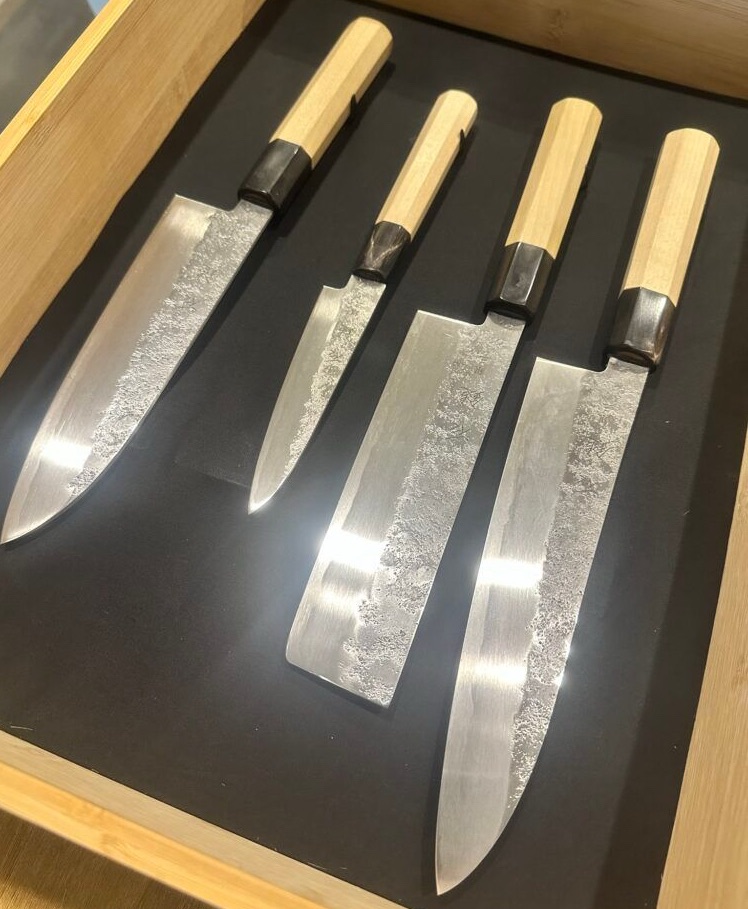
Ginsan Nashiji Forged Magnolia Octagonal Handle Buffalo Horn
When people choose a Japanese knife, the conversation often begins with shape, appearance or price. But sooner or later, steel becomes part of the decision. VG10 vs Ginsan is an especially interesting comparison because both are stainless Japanese knife steels, yet they appeal to buyers for slightly different reasons.
Since starting Asaoya Yaichi and showing our knives to people in Australia, I have noticed something interesting. When I visit knife shops and introduce our range, Ginsan often attracts attention. I cannot say from my experience alone that Ginsan is more popular than VG10 across Australia, but the reaction has certainly made me curious about why knowledgeable knife buyers seem interested in it.
👉 INTERNAL LINK: 銀三 | Ginsan Japanese Knife : 7 Surprising Things I Learned About Silver #3 Steel
VG10 vs Ginsan: Why Ginsan Gets Attention
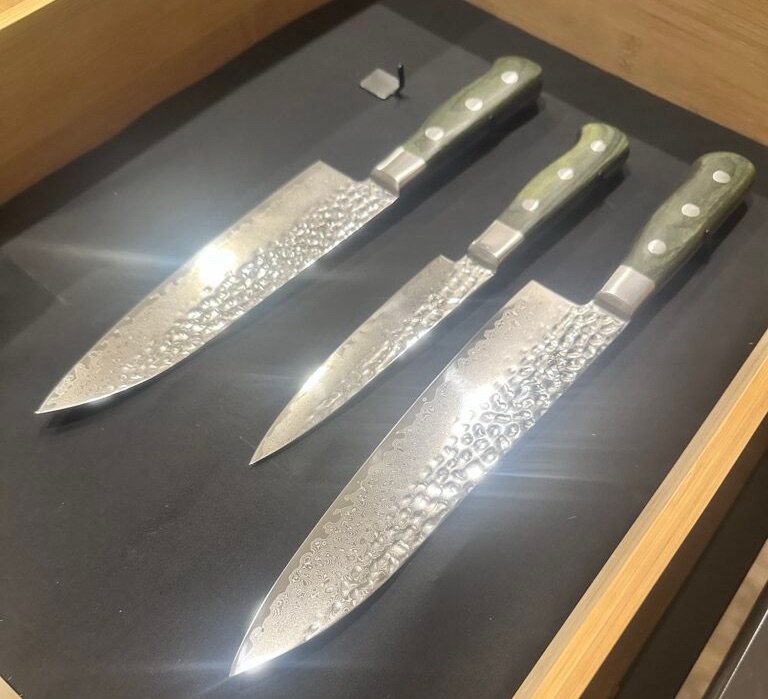
VG10 Polished Hammered 67 Layer Damascus Green Handle
Ginsan, also known as Silver #3 or Gin-3, is a Japanese stainless steel known for combining corrosion resistance with the ability to take a very fine edge. It is often appreciated by people who want some characteristics associated with traditional Japanese carbon steels without the same level of concern about rust.
I need to make one thing clear: I have not personally used a Ginsan knife extensively in a professional kitchen, so I will not pretend to give you a long-term chef’s review of the steel.
What I can talk about is what I see.
The Ginsan knives we carry through Ishizuchi have a beautiful Nashiji finish. They feel substantial, traditional and unmistakably Japanese. I have also been told by our contact at Ishizuchi that they are particular about the quality of the Ginsan used for this series.
What exactly defines “good Ginsan” involves more than simply the steel name. Heat treatment, forging, grinding and blade geometry can all influence the finished knife.
👉 INTERNAL LINK: Monozukuri | Where Japanese Craftsmanship Meets Quiet Beauty
VG10 vs Ginsan Is Also About the Knife, Not Just the Steel
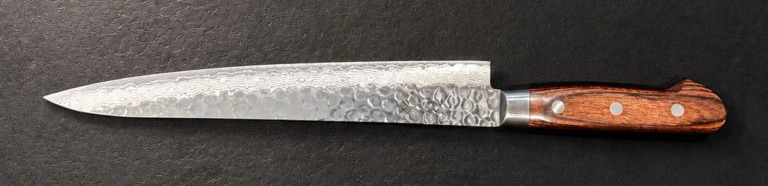
240mm Sujihiki VG10 Hammered 17 Layer Damascus Mahogany
This is something I think buyers sometimes overlook.
A knife is not simply a piece of VG10 or Ginsan. The steel is only part of the finished product.
Our Ginsan range currently includes Santoku, Gyuto, Petty and Nakiri. Because they share the same Nashiji aesthetic, seeing several of them together makes you want to build a matching set.
Personally, though, I would change one thing.
Instead of the Santoku, I would love to have a Sujihiki in the same series. For the way I work as a professional chef, a Ginsan Gyuto, Petty, Nakiri and Sujihiki would make an extremely attractive and practical set.
That is simply my preference after more than 25 years in professional kitchens, rather than a rule about what everyone should own.
👉 INTERNAL LINK: 真価 Shinka | 7 Powerful Truths About a New Japanese Knife’s Real Potential.
VG10 vs Ginsan: My Real Experience With VG10

Ishizuchi Kanamono Manufactory
This is where my perspective changes because VG10 is a steel I actually use.
Our VG10 collection at Asaoya Yaichi currently includes Gyuto, Santoku and Petty knives with distinctive green handles. The blades have a Damascus finish, giving them a modern appearance while still retaining the character of a Japanese knife.
They also look excellent together as a set.
In fact, we have already sold one of the VG10 Petty knives. It was only one knife, but as someone building a small Japanese knife business in Australia, seeing that first knife from the series sell genuinely made me happy.
👉 INTERNAL LINK: Add your article about whether an expensive Japanese knife is really worth it here.
My everyday experience with VG10 has also been very positive.
With proper sharpening and maintenance, I can get my VG10 extremely sharp. I use VG10 regularly in a professional kitchen, and with normal care I have personally never had a problem with rust.
Of course, stainless does not mean maintenance-free. I still believe a good knife should be washed, dried and looked after properly.
We also carry a VG10 Sujihiki from a different series, so customers who prefer a slicing knife still have that option.
Which Should You Choose After Comparing VG10 vs Ginsan?
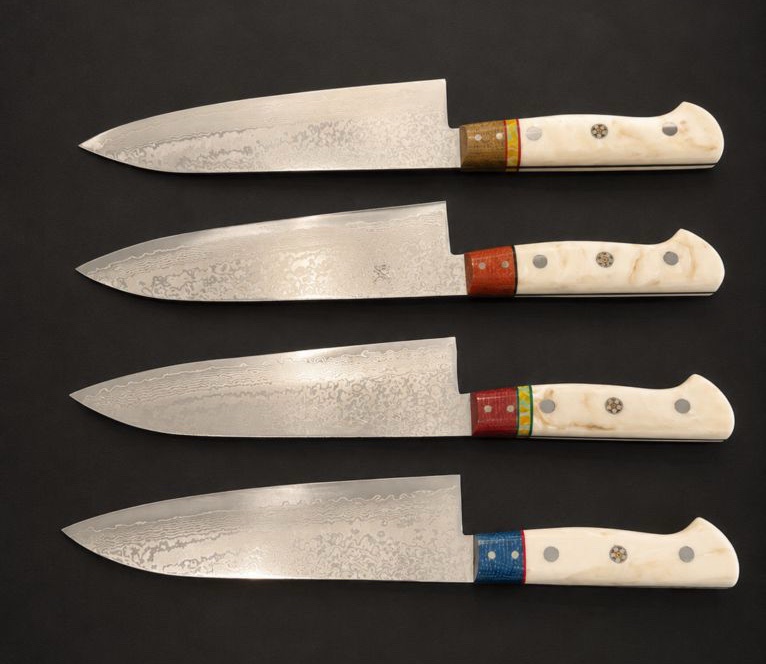
180mm Santoku VG10N 33 Layer Damascus Green Marble Handle Rainbow Spacer
I do not think VG10 vs Ginsan needs a simple winner.
Ginsan interests me because of the reaction I have seen from knife people in Australia, its traditional Nashiji appearance and its reputation for taking a fine edge while remaining stainless.
VG10 interests me for a different reason: I already trust it.
I have used it, sharpened it and worked with it in a real professional kitchen. Properly maintained, it can become extremely sharp while remaining practical for everyday work.
👉 INTERNAL LINK: Wabi-Sabi | Experience the Quiet Beauty of This Handcrafted Santoku Knife
Perhaps that is the most useful way to look at VG10 vs Ginsan.
Ginsan is the steel I am increasingly interested in learning more about.
VG10 is the steel I already know I can depend on.
And sometimes choosing a Japanese knife is not about finding the steel that wins on paper. It is about finding the knife that makes you want to pick it up, sharpen it, use it and keep it for years.
👉 Explore more:
https://blog.asaoyayaichi.com.au
👉 Visit our online store:
https://asaoyayaichi.com.au
Thank you for reading, and I hope to see you again in the next story.