タグ: Aogami

  • Choosing Your First Japanese Knife: 5 Essential Lessons from a Chef

    Choosing Your First Japanese Knife: 5 Essential Lessons from a Chef

    Ishizuchi Kanamono Manufactory

    Choosing your first Japanese knife can be confusing. There are so many steels, shapes, sizes, brands and price ranges that it is easy to spend hours researching and still not know what to buy.

    So let me make my answer simple.

    If you are buying your first Japanese knife for general home cooking, I would start by looking at a 180mm Santoku or a 210mm Gyuto, preferably in an easy-to-maintain stainless steel such as VG10 or Ginsan.

    That does not mean these are the “best” Japanese knives. It means they are practical places to start.

    Interestingly, more than 25 years ago, my own first Japanese knives were quite similar to what I would still recommend today.

    If you are looking for Japanese knives in Australia, you can also explore our current range here:

    👉 Japanese Knives Australia — Explore our collection

    Choosing Your First Japanese Knife: My Own First Choice
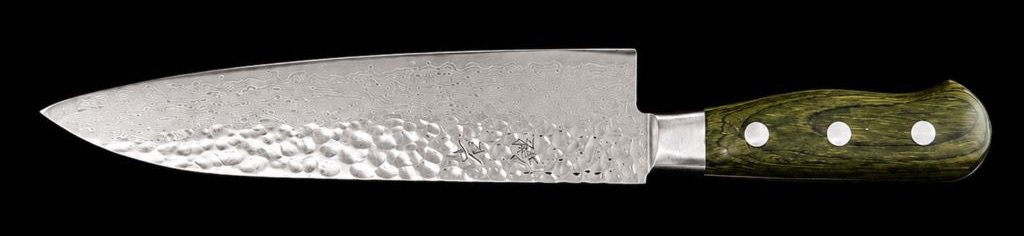

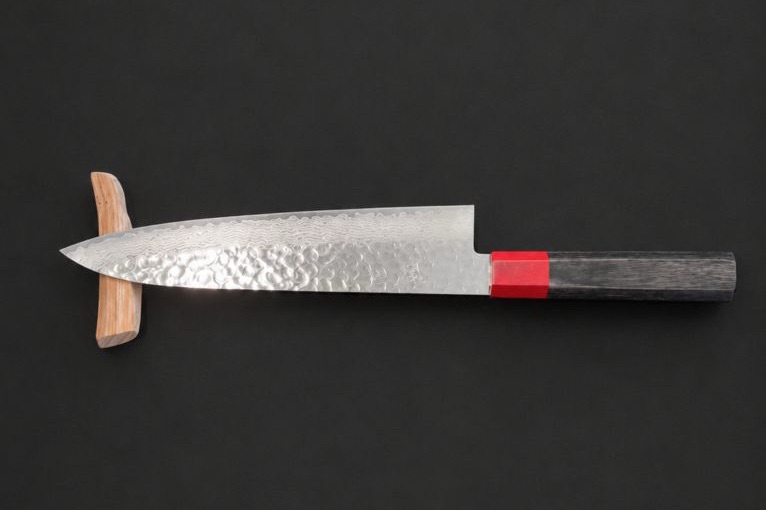
    210mm Gyuto VG10 Polished Hammered 67 Layer Damascus Green Handle

    135mm Petty VG10 Polished Hammered 67 Layer Damascus Green Handle

    The first Japanese knives I bought for myself were a 210mm Damascus Gyuto and a Petty knife from the same series. If I remember correctly, the steel was probably VG10.

    At the time, I certainly did not understand knife steels the way I do now. I was not comparing every specification or thinking deeply about hardness, edge retention or steel composition.

    I simply bought knives that I wanted to use.

    Looking back after more than 25 years in professional kitchens, however, I think the basic combination actually made a lot of sense.

    A 210mm Gyuto can handle meat, fish and vegetables. The Petty takes care of smaller and more detailed jobs. Between those two knives, you can handle a huge amount of everyday kitchen work.

    👉 INTERNAL LINK: 探究 Tankyū | What Does VG10 Actually Mean?

    Should Your First Japanese Knife Be a Gyuto or Santoku?


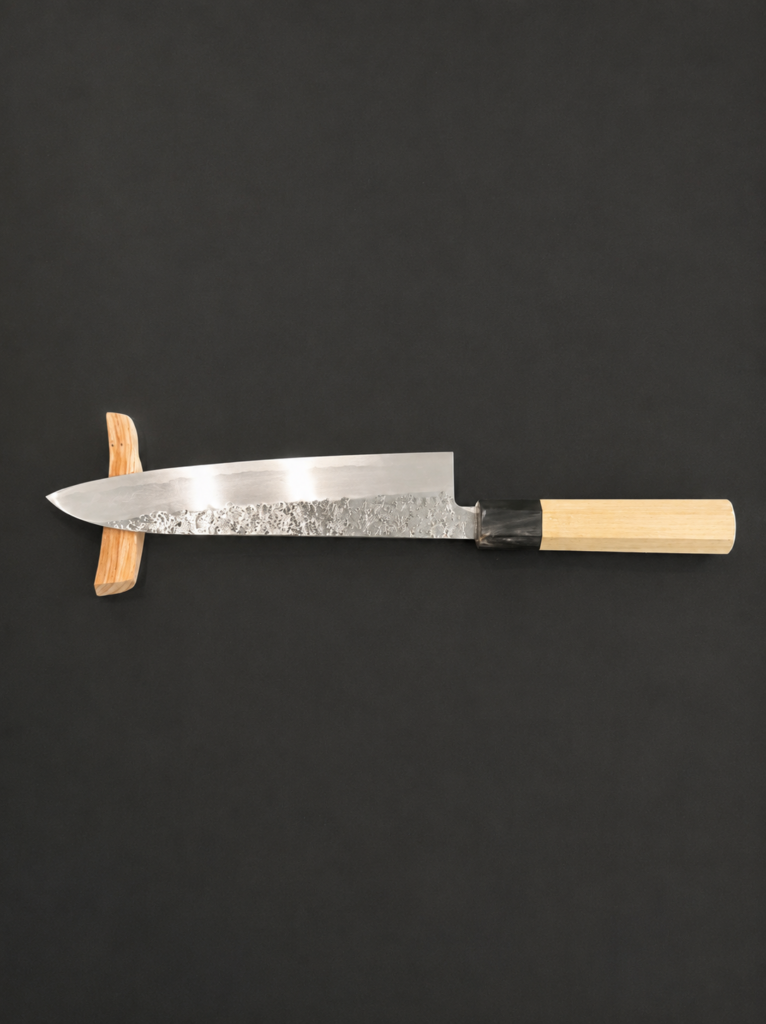
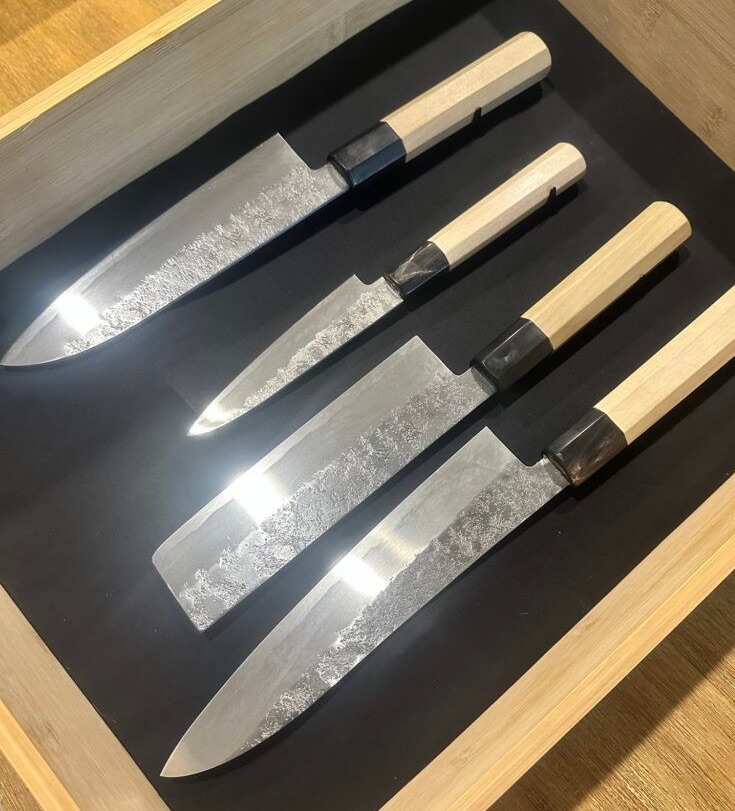
    210mm Gyuto Ginsan Nashiji Forged Magnolia Octagonal Handle Buffalo Horn Ferrule
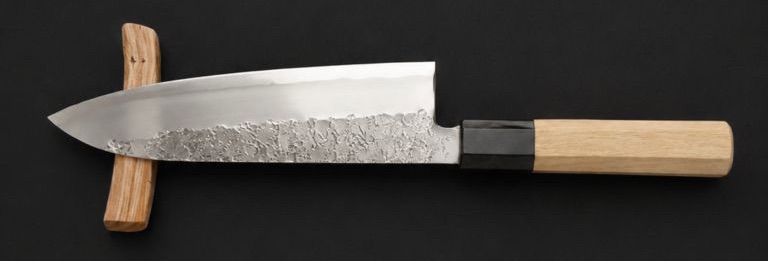
    180mm Santoku Ginsan Nashiji Forged Magnolia Octagonal Handle Buffalo Horn

    For someone choosing their first Japanese knife, this is probably one of the most useful questions to answer.

    If you have enough bench space and are comfortable with a slightly longer blade, I think a 210mm Gyuto is an excellent starting point. The extra blade length becomes especially useful when cutting larger pieces of meat, fish or vegetables, because you can use a longer cutting stroke.

    👉 INTERNAL LINK: [Gyuto vs Santoku — Which Japanese Knife Is Right for You?]

    For a smaller home kitchen, or if 210mm simply feels too large, I would look at a 180mm Santoku.

    A Santoku is compact, comfortable and capable of handling meat, fish and vegetables. For many home cooks, it may be all the knife they really need.

    Neither one is automatically better.

    The question is which one makes more sense in your kitchen.

    Choosing Your First Japanese Knife Steel
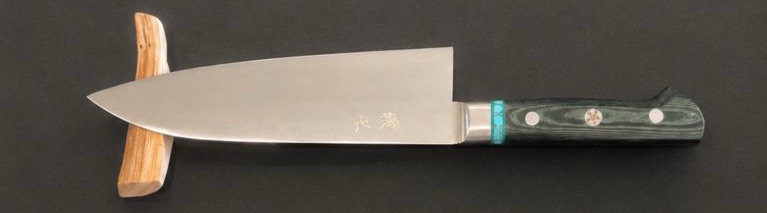

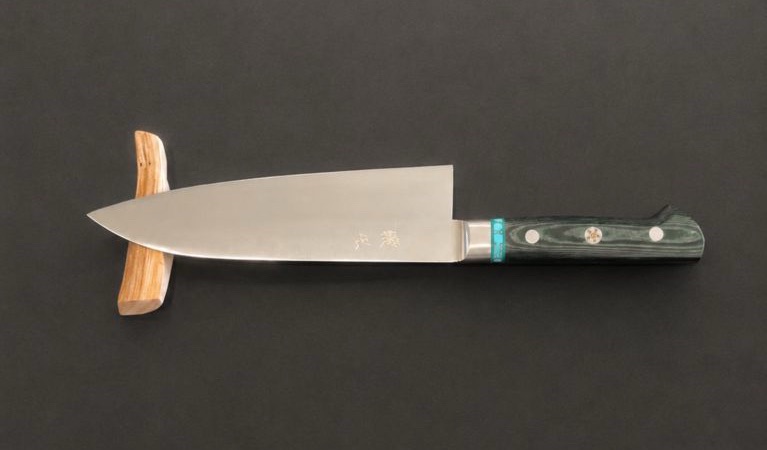
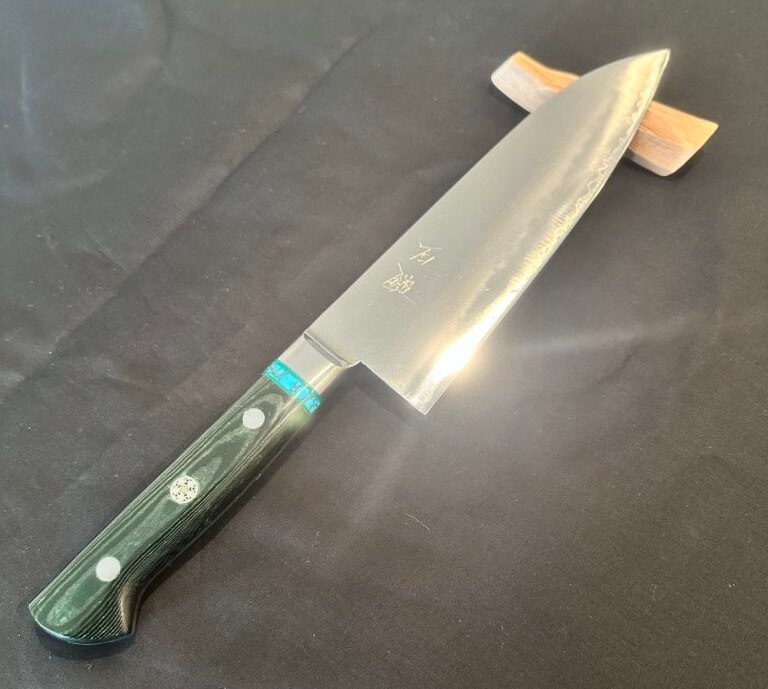
    180mm Santoku Aogami #2 Green Micarta Handle with Turquoise Spacer
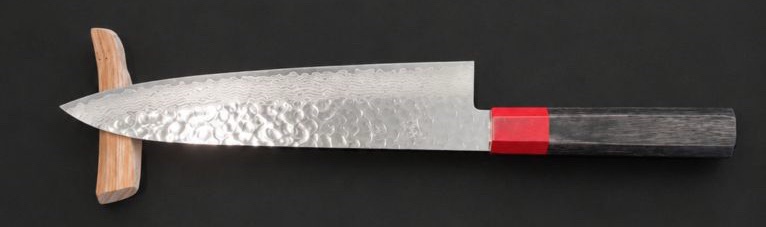
    165mm Santoku A10 Damascus Black & Red Octagonal Handle
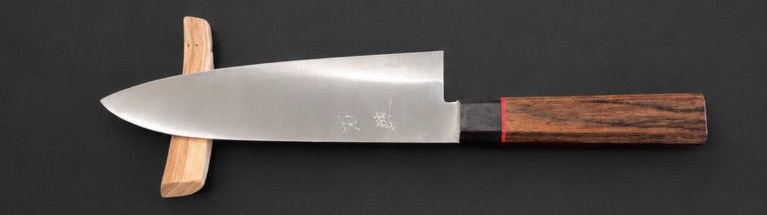
    180mm Santoku SG2 Rosewood Octagonal Handle

    Steel names can make buying a Japanese knife unnecessarily intimidating.

    VG10, Ginsan, Blue #2, Blue Super, SG2 — the list goes on.

    For a beginner, I would not start by asking which steel can become the sharpest.

    I would ask: How much maintenance do you want?

    For many first-time buyers, VG10 or Ginsan makes a lot of sense. Both offer excellent performance while being stainless and relatively easy to live with.

    👉 INTERNAL LINK: [Japanese Knife Steel — Understanding the Different Steels Used in Japanese Knives]

    I personally enjoy carbon steels such as Blue #2, especially for certain cutting jobs. But carbon steel requires more attention to moisture and maintenance.

    That does not make it unsuitable for beginners. It simply means you should understand what you are buying.

    👉 INTERNAL LINK:Aogami and Shirogami | 7 Fascinating Things I Learned About Blue and White Paper Steel

    Choosing Your First Japanese Knife Does Not Mean Buying the Most Expensive One
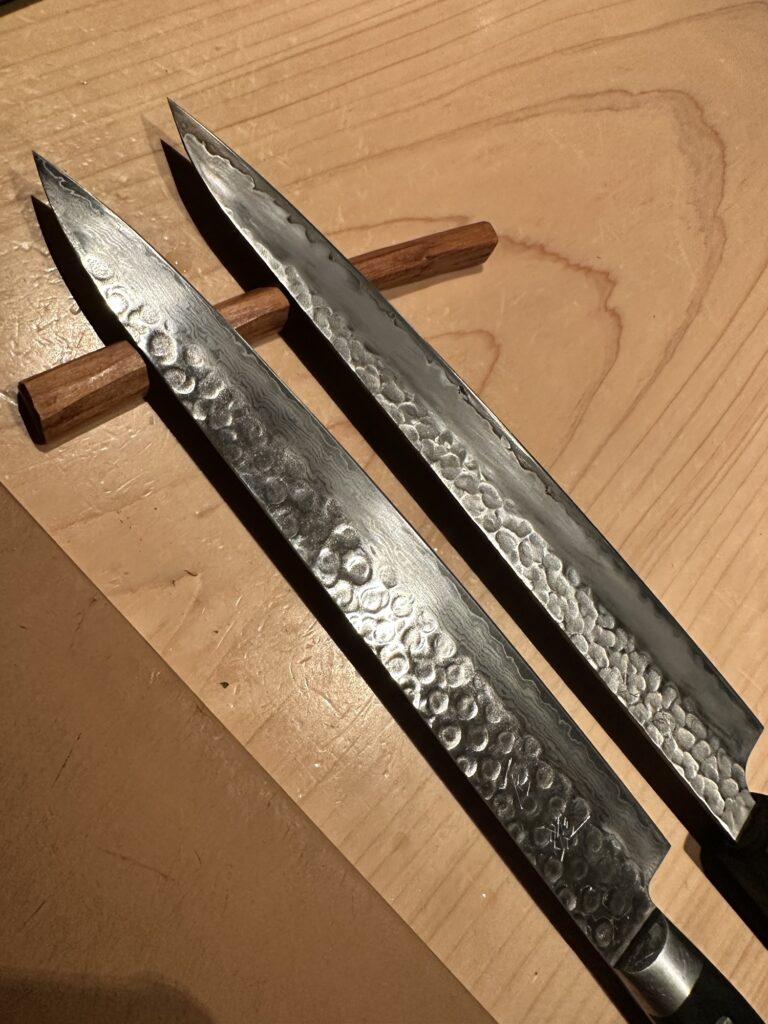

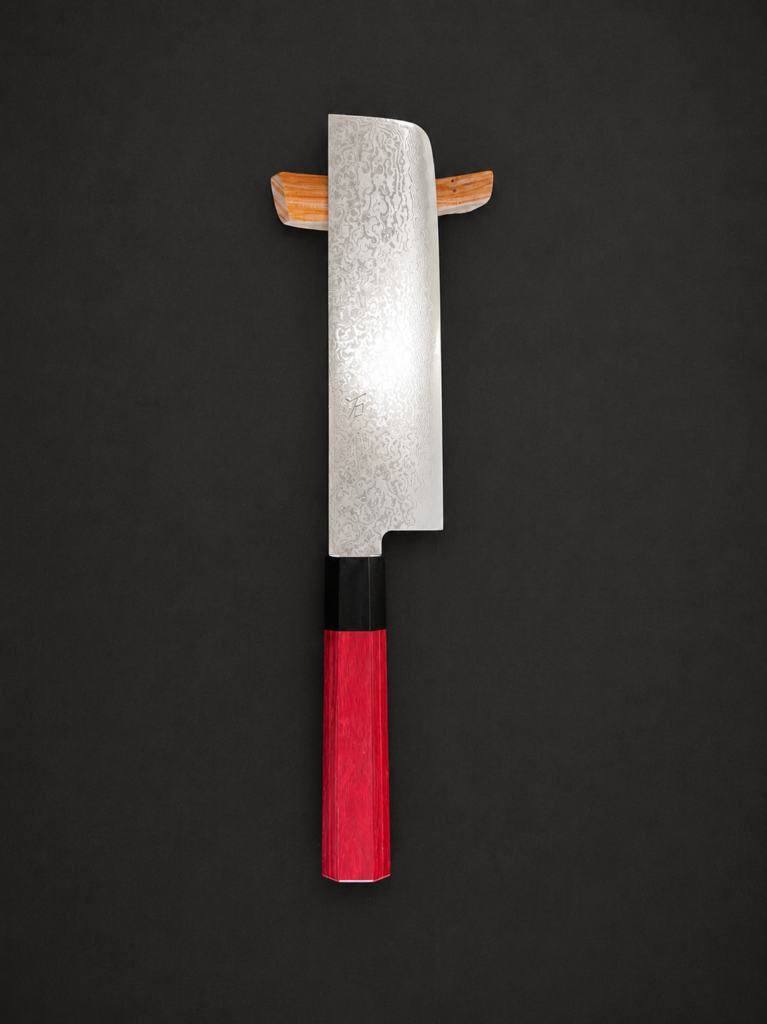
    240mm Sujihiki VG10 Hammered 17 Layer Damascus Mahogany

    There is another reason I do not think beginners should become too obsessed with specifications or prestige.

    Years ago, I took one of my knives back to a knife shop to have it sharpened.

    The person there almost laughed at it.

    I still remember that experience.

    Maybe, from his perspective, it was not a particularly special knife. But I had bought it, used it professionally and relied on it to do my job.

    That experience taught me something I still believe today.

    A knife does not need to impress another knife enthusiast. It needs to work for the person holding it.

    After more than 25 years as a chef, I have used carbon steel, stainless steel, Yanagiba, Gyuto, Sujihiki and many other knives. Today, one of the knives I use most at the sushi counter is a VG10 Sujihiki.

    Not because VG10 is the most prestigious steel.

    It simply works for what I do.

    👉 INTERNAL LINK: 真価 Shinka | 7 Powerful Truths About a New Japanese Knife’s Real Potential

    What About a Petty as Your Second Japanese Knife?


    120mm Petty Ginsan Nashiji Forged Magnolia Octagonal Handle Buffalo Horn Ferrule

    Once you have your main knife, my next choice would probably be a Petty.

    A Petty around 120–135mm is useful for smaller ingredients and detailed preparation where a 180mm or 210mm knife feels unnecessarily large.

    Interestingly, this is also what I did with my first Japanese knives: a Gyuto and a Petty.

    I did not understand it this way at the time, but looking back, they complemented each other extremely well.

    My Advice for Choosing Your First Japanese Knife
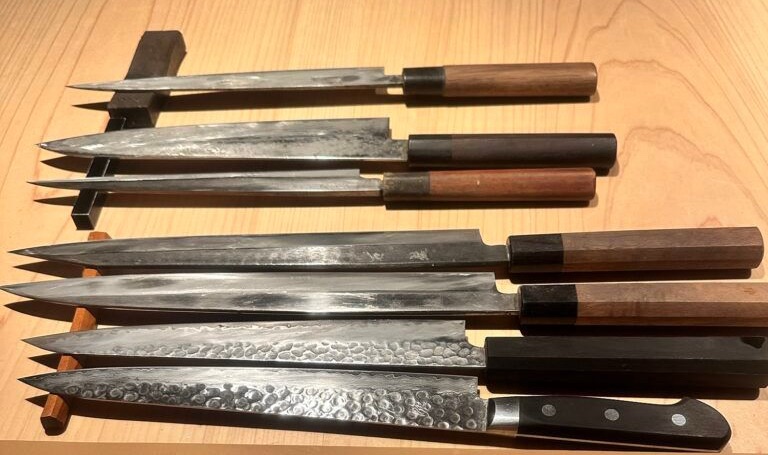
    After more than 25 years in professional kitchens, my advice is actually simpler than it would have been when I was younger.

    For general home cooking, start with a 180mm Santoku or 210mm Gyuto.

    If you want easy maintenance, look seriously at VG10 or Ginsan.

    Then, if you want a second knife, consider a 120–135mm Petty.

    If you mainly prepare vegetables, a Nakiri may make more sense. If you regularly slice fish or meat in long clean strokes, you may eventually want to explore a Sujihiki.

    But you do not need to start there.

    When choosing your first Japanese knife, do not worry too much about owning the knife with the highest hardness, the most expensive steel or the most impressive specifications.

    Start with a knife that fits your kitchen and the food you actually cook.

    More than 25 years after buying my first 210mm Gyuto and Petty, that is still where I would begin.

    👉 Explore more:
    https://blog.asaoyayaichi.com.au

    👉 Visit our online store:
    https://asaoyayaichi.com.au

    Thank you for reading, and I hope to see you again in the next story.

    —————————————————​

    Where to See and Buy Our Knives

    Our Partner Stores

    Chanoyu — Nerang, Gold Coast

    Visit Chanoyu and See Our Japanese Knives

    If you are on the Gold Coast, we would love you to visit Chanoyu, a Japanese café in Nerang where you can see and purchase a selection of Asaoya Yaichi knives in person.

    Chanoyu is a lovely place to slow down and enjoy Japanese-inspired food, excellent matcha, coffee and handmade desserts. Its warm, peaceful atmosphere makes it a pleasure to visit, whether you are stopping in for breakfast, lunch or something sweet. We are delighted that our knives have a place there.
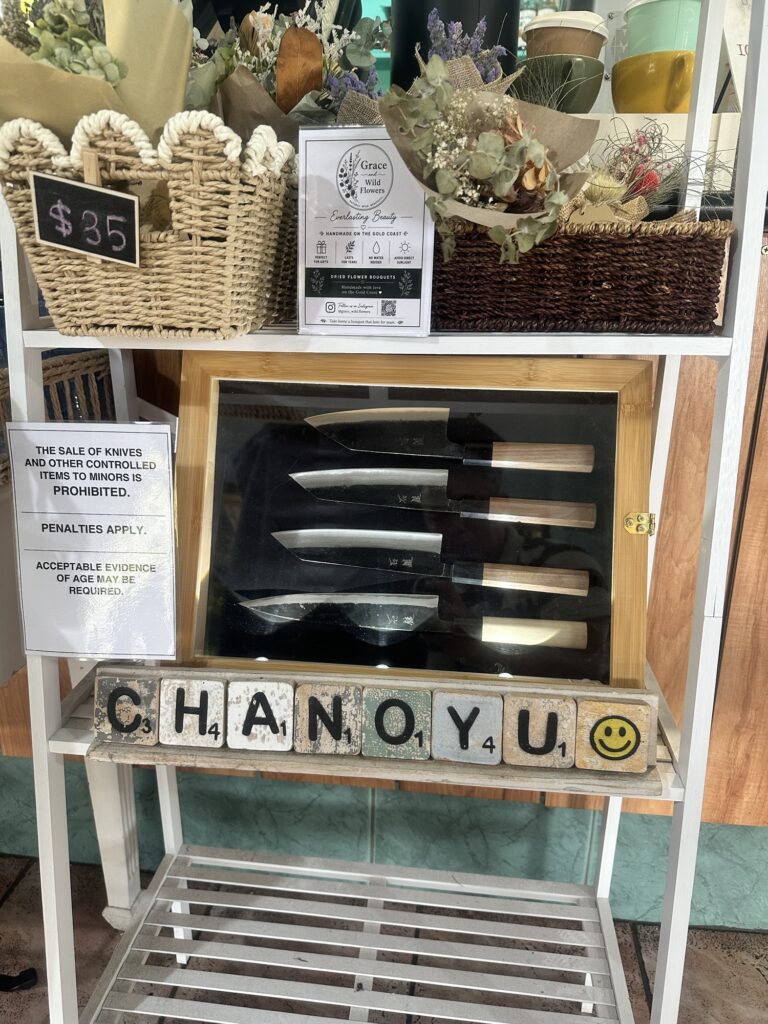
    Visit Chanoyu: Shop 6A, 54–58 Nerang Street, Nerang QLD 4211

    Opening hours: Monday to Saturday, 7:00 am–2:00 pm; closed Sunday

    Website: https://www.chanoyucafe.com/

    Instagram: https://www.instagram.com/chanoyugc/

    The selection of knives on display may change. If you are interested in a particular Asaoya Yaichi knife, please contact us through https://asaoyayaichi.com.au before visiting, and we will help you check whether it is available at Chanoyu.
  • Japanese Knife Steel: 5 Powerful Lessons I Learned After 25 Years as a Chef

    Japanese Knife Steel: 5 Powerful Lessons I Learned After 25 Years as a Chef

    Ishizuchi Kanamono Manufactory

    For most of my 25 years working as a professional chef, I honestly did not care much about Japanese knife steel.

    I knew my knives felt different, but I rarely thought about the reason. Some held their edge longer. Some could lose their initial sharpness but still somehow get me through a busy service. Others became frustrating once the edge started to fade. Some were easy to sharpen, while others required more patience. And, of course, some rusted much more easily than others.

    I noticed all of these differences long before I understood the steels behind them.

    It was only after starting Asaoya Yaichi and learning more seriously about Japanese knives that those years of experience began to connect with what I was learning about steel.

    If you are looking for Japanese knives in Australia, understanding these differences can make choosing your next knife much easier.

    👉 Visit the Asaoya Yaichi online store to explore our Japanese knives in Australia.

    Japanese Knife Steel Was Never My Priority in the Kitchen


    165mm Santoku A10 Damascus Black & Red Octagonal Handle

    As a working chef, I was interested in practical results.

    Does it cut well? How long can I use it before sharpening? Can I keep using it when the edge starts to fade? How quickly can I bring the edge back?

    I did not stand in the kitchen thinking about carbon percentages or steel specifications.

    Looking back, however, I realise I had been learning about Japanese knife steel through my hands for years without knowing it.

    👉 INTERNAL LINK: Hand-Forged vs Machine-Made Knives

    Learning more about knife making also taught me that steel is only part of the story. Heat treatment, blade geometry, sharpening and construction all influence how a knife performs.

    Learning Japanese Knife Steel Finally Explained My Preferences


    180mm Santoku Aogami #2 Green Micarta Handle with Turquoise Spacer

    Once I started selling Japanese knives, I needed to understand what I was actually selling.

    That changed the way I looked at my own knives.

    Suddenly, experiences from many years in professional kitchens started making sense. Today I know that I personally enjoy using Aogami #2 and Aogami Super. They suit the way I work and, importantly, the way I sharpen.

    That does not mean I believe they are the best steels for everyone.

    👉 INTERNAL LINK: Is an Expensive Japanese Knife Really Worth It?

    Specifications and price can tell us something about a knife, but they cannot completely describe what it will feel like after months or years of real kitchen use.

    Choosing Japanese Knife Steel for Japanese Knives in Australia


    210mm Gyuto Ginsan Nashiji Forged Magnolia Octagonal Handle Buffalo Horn Ferrule

    This becomes particularly important when choosing Japanese knives in Australia.

    As a professional chef, I use my knives constantly. With carbon steel, I wash the blade, dry it and continue using it regularly. Patina develops, but personally I have not found rust particularly difficult to manage during everyday professional use.

    Home use can be very different.

    You might use a carbon-steel knife tonight and then not touch it again for several days. If moisture remains on the blade during that time, rust can appear surprisingly quickly.

    That is one reason stainless steels such as VG10 or Ginsan can make a lot of sense for people who want a Japanese knife without constantly thinking about maintenance.

    👉 INTERNAL LINK: Japanese Knife Rust Removal: 5 Powerful Reasons I Keep a Sabitoru Fine in My Knife Kit

    Stainless does not mean completely rust-proof, but it is generally more forgiving.

    This is also why there is no single answer when someone asks me which steel they should choose.

    Japanese Knife Steel and What I Feel at the Sharpening Stone


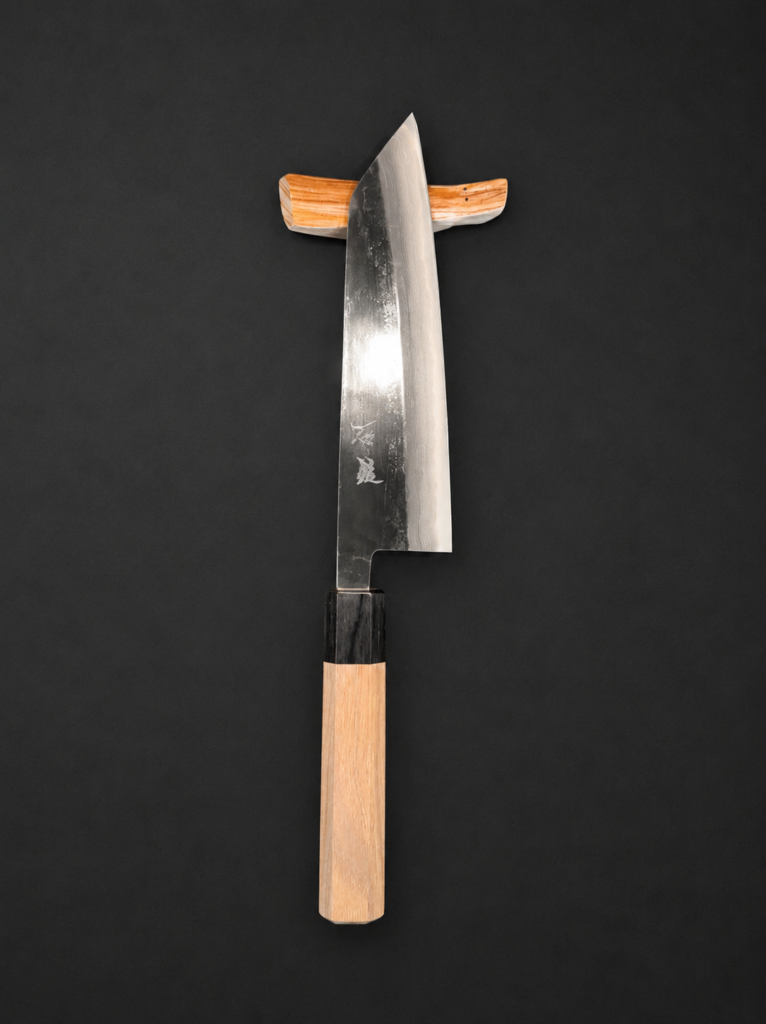
    180mm Kiritsuke Aogami #2 Kurouchi Walnut Octagonal Handle

    There is another difference I have noticed over the years: sharpening.

    This is my personal experience rather than a rule for every knife, but when some stainless knives become very dull, I find they can become frustrating.

    I can usually bring them back to a reasonably sharp edge without too much trouble. But getting that edge back to the extremely sharp condition I personally want can sometimes require patience.

    With Aogami carbon steels, I often feel that I can bring the edge back more naturally.

    Of course, this depends on much more than simply whether a knife is carbon or stainless. Hardness, heat treatment, blade geometry and sharpening stones all matter.

    That is why I prefer talking about what I have actually experienced rather than saying one steel is universally better.

    👉 INTERNAL LINK: 切付 | Japanese Knife for Chefs: 1 Powerful Choice After 25 Years in Professional Kitchens

    Japanese Knives Australia: Steel Is Only the Beginning


    165mm Usuba A8 Hammered Damascus Black & Red Octagonal Handle

    If you are searching for Japanese knives in Australia, I would not start by asking, “What is the best steel?”

    I would start with different questions.

    How often do you cook? Do you sharpen your own knives? Are you comfortable drying a carbon-steel blade immediately after use? Do you want something easy to maintain? What shape and length actually suit the food you prepare?

    Understanding Japanese knife steel helps answer those questions, but steel should not become the only reason you choose a knife.

    I recently wrote about the Japanese knives I would personally choose after more than 25 years in professional kitchens. That article looks beyond steel and considers the complete knife from the perspective of actual use.

    👉 IMPORTANT INTERNAL LINK: Japanese Knives Australia: 5 Powerful Choices I Would Make After 25 Years as a Professional Chef

    For me, that is the real value of finally learning about steel.

    Twenty-five years ago, I could tell you whether I liked a knife. I just could not always explain why.

    Today, I understand much better why Aogami #2 and Aogami Super suit me, why stainless steel can be a better choice for many people, and why the most impressive steel name does not automatically make the best knife for the person holding it.

    If you are choosing Japanese knives in Australia, learn about the steel—but choose the knife according to the way you actually cook.

    👉 Explore more:
    https://blog.asaoyayaichi.com.au

    👉 Visit our online store:
    https://asaoyayaichi.com.au

    Thank you for reading, and I hope to see you again in the next story.

  • Japanese Knives Australia: 5 Powerful Choices I Would Make After 25 Years as a Professional Chef

    Japanese Knives Australia: 5 Powerful Choices I Would Make After 25 Years as a Professional Chef

    Asaoya Yaichi

    When people search for Japanese Knives Australia, they are often faced with an enormous choice of steels, shapes, finishes and prices. After more than 25 years working in professional kitchens in Japan and Australia, I look at knives a little differently. I am less interested in what sounds impressive on paper and more interested in what I would actually want beside me during a long day in the kitchen.

    If you are looking for Japanese knives in Australia, you can also explore the current Asaoya Yaichi collection here:

    👉 Visit our online store:
    https://asaoyayaichi.com.au

    For me, a good knife collection should not simply look beautiful. Each knife should have a purpose, feel comfortable in the hand and be something I genuinely want to use.

    Japanese Knives Australia: My First Choice Would Be Ginsan Nashiji


    Ginsan Nashiji Forged Magnolia Octagonal Handle Buffalo Horn

    If I were building a professional set from the current Asaoya Yaichi range, I would seriously consider starting with Ginsan steel with a Nashiji finish.

    Ideally, I would like a Gyuto, Petty, Nakiri and Santoku in this combination.

    Ginsan, also known as Silver #3, offers an excellent balance for professional work. I like the idea of having the performance and sharpening characteristics associated with a quality Japanese knife while gaining the practical advantage of stainless steel.

    The Nashiji finish is another reason I like this combination. Its subtle, textured appearance has character without being overly decorative. For me, these are knives that can look beautiful while still feeling like serious working tools.

    👉 INTERNAL LINK: Add a link here to the existing Ginsan steel article.

    The Nashiji finish itself also has an interesting place in Japanese knife making.

    Japanese Knives Australia and the Practical Appeal of VG10


    VG10 Polished Hammered 67 Layer Damascus Green Handle

    Another set I would be very comfortable using is our VG10 series with green handles.

    A Gyuto, Petty and Santoku would already cover a huge amount of everyday kitchen work. VG10 is familiar to many people looking for Japanese knives in Australia, and from my experience, a properly sharpened VG10 knife can perform extremely well.

    I currently use a VG10 Sujihiki myself, and that experience is part of why I do not judge a knife only by the reputation or price of its steel. Sharpening, geometry and how the knife is actually used matter enormously.

    👉 INTERNAL LINK: Add a link here to Monozukuri | Where Japanese Craftsmanship Meets Quiet Beauty

    My Personal Choice: Aogami #2 with Turquoise


    180mm Santoku Aogami #2 Green Micarta Handle with Turquoise Spacer

    Then there is the choice that is harder for me to ignore personally: Aogami #2 with a turquoise handle.

    I have used carbon steel extensively during my career, and I still have a particular appreciation for Aogami #2. It requires more care than stainless steel, but for someone comfortable maintaining carbon steel, it can be extremely rewarding.

    The turquoise detail also gives the knife a personality of its own. If I were choosing purely according to my own taste rather than trying to create the most practical matching set, this would be very difficult for me to leave behind.

    Carbon steel is not automatically the right choice for everyone, which is why understanding maintenance is important.

    👉 INTERNAL LINK: Add a link here to Samurai Century | The Finest Expression of Tosa Knife Craftsmanship, Passed Down Since the Age of the Chōsokabe Clan

    The 180mm Kurouchi Kiritsuke Is Still Hard to Beat


    180mm Kiritsuke Aogami #2 Kurouchi Walnut Octagonal Handle

    Purely from the perspective of usability, I also keep coming back to the 180mm Kurouchi Kiritsuke.

    I have written about this knife before because the size and shape make sense to me as a chef. At 180mm, it is large enough to handle serious preparation while remaining compact and controllable.

    For someone exploring Japanese Knives Australia and wanting one versatile knife rather than immediately building a complete set, this style deserves consideration.

    👉 INTERNAL LINK: Add a link here to “切付 | Japanese Knife for Chefs: 1 Powerful Choice After 25 Years in Professional Kitchens.”

    Japanese Knives Australia: Building a More Complete Professional Range

    Ishizuchi Kanamono Manufactory

    Looking at the Asaoya Yaichi range as a professional chef, I think we already have a very strong foundation. Gyuto, Santoku, Petty and Nakiri give both professional chefs and home cooks plenty of practical choices across Ginsan, VG10 and carbon steels.

    But I do not consider the collection finished.

    One area I particularly want to expand is traditional Japanese slicing knives. Yanagiba and Takohiki are important knives for sashimi and specialised fish work, and these are areas where I would like Asaoya Yaichi to offer more choice in the future.

    My goal is not to build the biggest collection of Japanese knives in Australia simply for the sake of having more products. I would rather develop a carefully selected range of knives that I can look at after more than 25 years in professional kitchens and genuinely say: I would use these myself.

    That principle will continue to guide how Asaoya Yaichi grows.

    👉 Explore more:
    https://blog.asaoyayaichi.com.au

    👉 Visit our online store:
    https://asaoyayaichi.com.au

    Thank you for reading, and I hope to see you again in the next story.

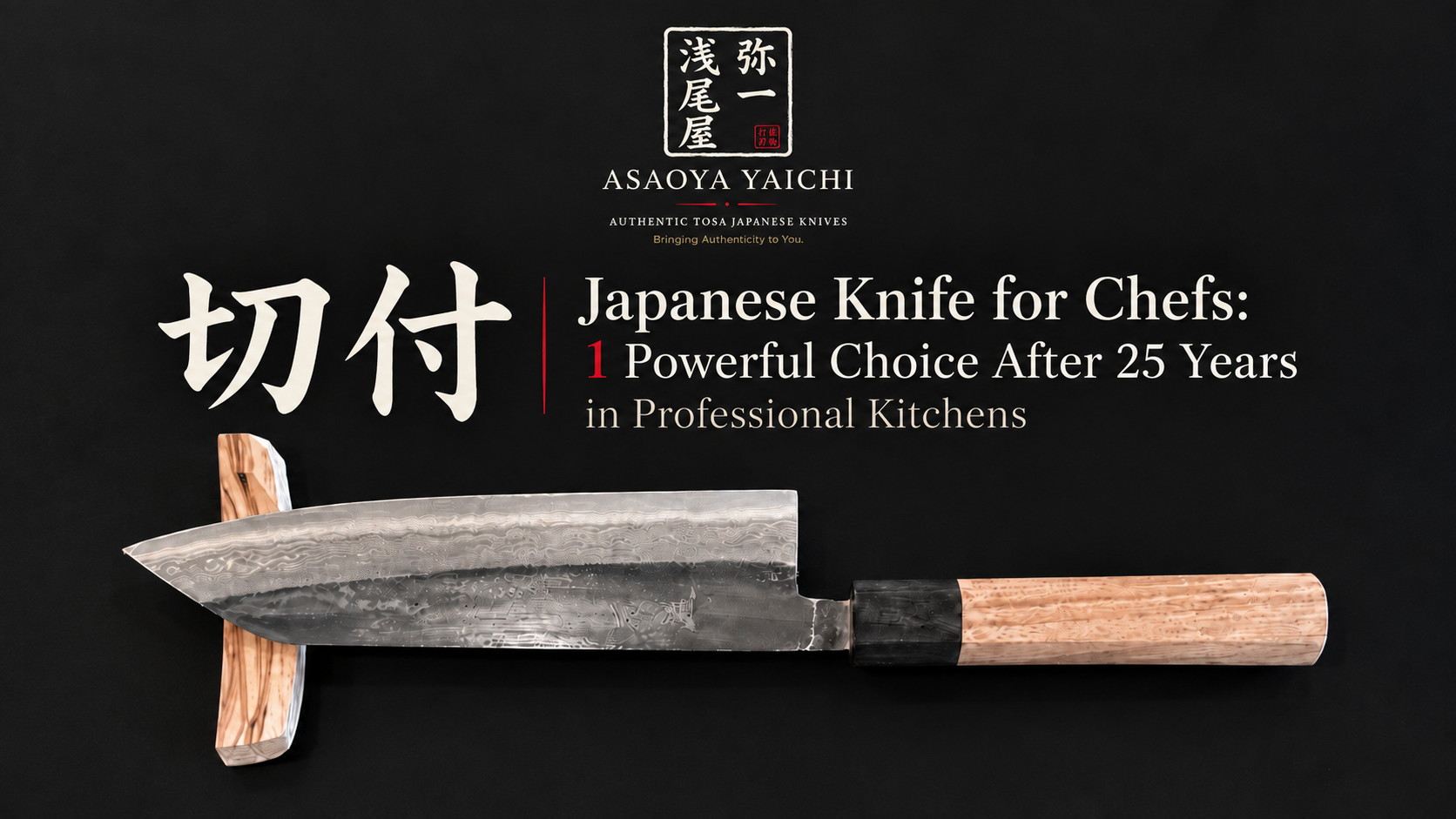
  • 切付 | Japanese Knife for Chefs: 1 Powerful Choice After 25 Years in Professional Kitchens

    切付 | Japanese Knife for Chefs: 1 Powerful Choice After 25 Years in Professional Kitchens

    Ishizuchi Kanamono Manufactory

    If I could own only one Japanese knife for chefs, what would I choose?

    After more than 25 years working in professional kitchens, I have used many different knives for many different jobs. Gyuto, Santoku, Sujihiki, Yanagiba, Deba and other specialised Japanese knives all have their own strengths. If I had the space and freedom to choose, I would always prefer using the right knife for each task.

    But what if I could keep only one?

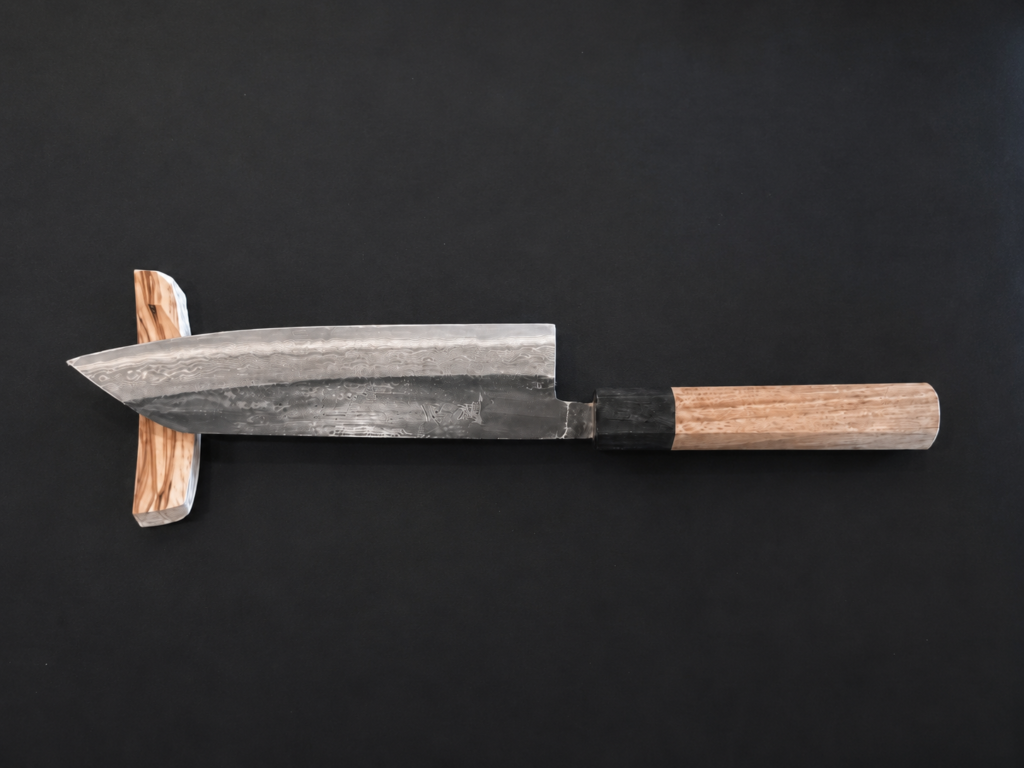
    From the knives we currently carry at Asaoya Yaichi, my choice would be a 180mm Kiritsuke.

    Not because it is the best knife for every individual job. It isn’t. I would choose it because its combination of size, blade width and pointed tip allows it to handle an unusually wide range of kitchen work.

    That is what I would want from my only knife.

    Why I Would Choose a 180mm Japanese Knife for Chefs


    180mm Kiritsuke Aogami #2 Kurouchi Walnut Octagonal Handle

    A 180mm blade sits in a very useful position between compact home-kitchen knives and longer professional blades.

    For vegetables, the Kiritsuke has enough blade height and width to feel stable when cutting harder ingredients such as daikon. Compared with a narrow Sujihiki, I find a wider blade much easier when I need to apply controlled downward pressure through a firm vegetable.

    At the same time, 180mm is still compact enough to remain agile.

    This balance is important. If I can own only one Japanese knife for chefs, I don’t want something that excels at one specialised task while becoming inconvenient for everything else.

    👉 INTERNAL LINK: Read our article about why Santoku knives became one of Japan’s most practical kitchen knives.

    The Kiritsuke Tip Changes What One Knife Can Do


    165mm Kiritsuke Aogami #2 Kurouchi Walnut Octagonal Handle

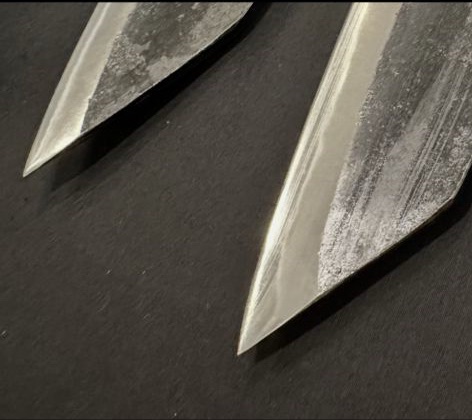
    The feature that really makes me choose the Kiritsuke is its pointed tip.

    A sharp, accessible tip can be extremely useful when working with fish. Of course, if I were preparing fish every day and could choose a dedicated knife, I would use a Deba. But that isn’t the question here.

    The question is what I would use if I had only one knife.

    When breaking down a fish, a precise tip can help with detailed cuts around fins, bones and joints. When removing a fish head, rather than trying to force a blade directly through heavy bone, I prefer finding the natural joint and cutting through it cleanly. A pointed Kiritsuke tip gives me the control needed for that kind of work.

    👉 INTERNAL LINK: Discover the history of Tosa knives and how Japanese blades developed alongside specialised kitchen work.

    Can This Japanese Knife for Chefs Handle Sashimi?

    Asaoya Yaichi

    For sashimi, I would normally prefer a longer Yanagiba or Sujihiki. Their long blades allow cleaner slicing with fewer movements.

    However, again, we are choosing only one knife.

    A 180mm Kiritsuke still gives me a relatively fine, pointed blade that can perform controlled slicing. For preparing a modest amount of sashimi at home or in situations where a dedicated sashimi knife is unavailable, I would be comfortable using it.

    The pointed tip also gives me more control over small, precise cuts than I would get from a more rounded blade profile.

    👉 INTERNAL LINK: Read what 25 years in professional kitchens taught me about carbon steel and sashimi.

    Why the Pointed Tip Also Works Well With Meat

    The same characteristic becomes useful when preparing meat.

    When trimming sinew, connective tissue or silver skin, I often want to get the tip underneath the tissue first and then guide the edge along it. A pointed Kiritsuke makes that movement natural.

    A Sujihiki would be excellent for trimming and slicing meat, but its narrow blade would not be my first choice for harder vegetables or general chopping.

    This is exactly why choosing one knife changes the decision.

    👉 INTERNAL LINK: See why the first edge of an expensive Japanese knife doesn’t always reveal its true potential.

    The Best Japanese Knife for Chefs Is Not Always the Most Specialised

    Japanese knife culture has developed highly specialised tools for good reason. A Deba is better suited to serious fish work. A Yanagiba is superior for traditional sashimi slicing. A Sujihiki gives me more blade length for slicing meat.

    I wouldn’t pretend that a 180mm Kiritsuke replaces all of them.

    But if someone took away my knife roll tomorrow and told me I could choose just one Japanese knife for chefs, I wouldn’t choose the knife that performs one job perfectly.

    I would choose the knife that allows me to perform the greatest number of jobs well.

    After more than 25 years in kitchens, that distinction matters to me.

    👉 INTERNAL LINK: Learn the difference between hand-forged and machine-made Japanese knives and why construction is only part of choosing the right knife.

    My One Japanese Knife After 25 Years as a Chef

    Ishizuchi Kurouchi Kurisuke

    So my choice is simple: a 180mm Kiritsuke.

    It gives me enough blade width for vegetables, enough length for everyday slicing, a pointed tip for fish work and detailed preparation, and the precision I want when trimming meat.

    Would it always be the perfect knife?

    No.

    But perfection at one task isn’t what I am looking for in this experiment. I am looking for versatility.

    And if I could walk into a kitchen tomorrow with only one Japanese knife in my hand, the 180mm Kiritsuke is the one I would want to carry.

    After 25 years, sometimes the best knife isn’t the one that can do one thing better than everything else.

    It’s the one that lets you keep cooking.

    👉 Explore more:
    https://blog.asaoyayaichi.com.au

    👉 Visit our online store:
    https://asaoyayaichi.com.au

    Thank you for reading, and I hope to see you again in the next story.

  • Tosa Knives and Kurouchi — Why the Black Finish Became So Common

    Tosa Knives and Kurouchi — Why the Black Finish Became So Common

    Ishizuchi Kanamono Manufactory

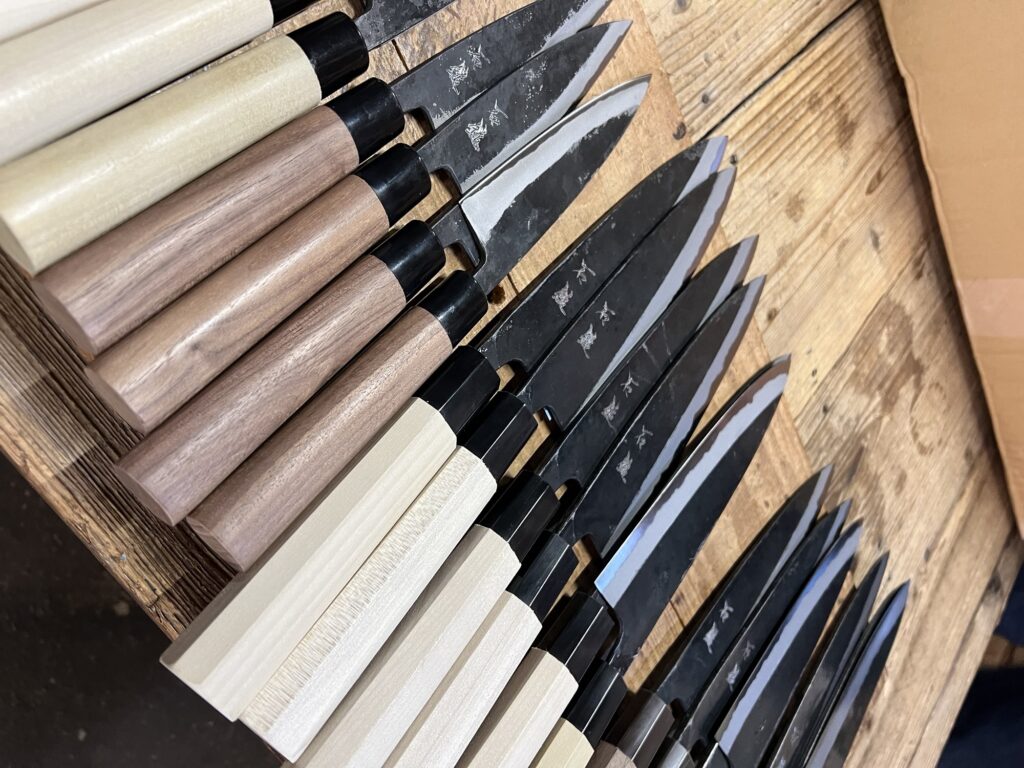
    Tosa Knives are often easy to recognise. Among polished Japanese knives, Damascus patterns and mirror finishes, many traditional Tosa knives have a much rougher appearance: a dark, almost black surface left above the cutting edge.

    This finish is called Kurouchi (黒打ち).

    Today, Kurouchi has become something many people associate with traditional Japanese knives. But while researching the history of Tosa Knives, I became curious about a more specific question: why does Kurouchi seem to fit Tosa knives so naturally?

    The answer is not as simple as I first expected.

    Tosa Knives Began as Tools for Working People


    From Agricultural Tools to Kitchen Knives

    To understand Kurouchi, we first need to understand where Tosa Knives came from.

    Kochi Prefecture has one of Japan’s strongest historical connections with forestry. Surrounded by mountains and forests, the region developed a long tradition of producing tools for agriculture and forestry.

    Tosa blacksmiths were not historically making only kitchen knives. They produced sickles, hatchets, saws and many other cutting tools required by farmers and forestry workers.

    According to Kochi City, records from the Chosokabe land survey of 1590 indicate that there were 399 blacksmiths in the region. Demand for agricultural and forestry blades later increased during the Edo period as these industries developed.

    These were working tools.

    They needed to cut well, survive hard use and remain practical.

    👉 INTERNAL LINK: Link here to “The History of Tosa Knives”

    That practical background is important when looking at the appearance of traditional Tosa blades.

    Tosa Knives and the Tradition of Free Forging

    One of the defining characteristics of Tosa cutlery is a technique known as Jiyu Tanzo (自由鍛造), or free forging.

    Rather than simply cutting a standard shape from sheet steel, Tosa blacksmiths traditionally forged blades according to their intended purpose. Different regions, working conditions and users could require different dimensions and shapes.

    Kochi Prefecture still describes this free-forging tradition as one of the defining characteristics of Tosa cutlery.

    In other words, the blade begins with its purpose.

    Its shape follows what the user needs.

    That philosophy helps explain why the sometimes rugged appearance of traditional Tosa Knives does not feel out of place. These blades developed from a culture where function mattered enormously.

    👉 INTERNAL LINK: Link here to “What Makes Tosa Knives Different from Other Japanese Knives”

    What Is Kurouchi on Tosa Knives?


    165mm Kiritsuke Thick Deba Aogami #2 Kurouchi Walnut Octagonal Handle

    Kurouchi literally refers to the dark finish left on part of a forged blade.

    During forging and heat treatment, a dark oxide scale forms on the steel. Instead of polishing the entire surface until it becomes bright and uniform, part of that dark surface is left visible while the cutting area is ground and sharpened.

    The result is the familiar contrast between the dark upper blade and the exposed steel closer to the edge.

    It looks rustic because, in a sense, it is.

    Kurouchi is not Damascus decoration painted onto a blade. The dark appearance comes from the blade-making process itself.

    👉 INTERNAL LINK: Link here to “Kurouchi Japanese Knives — What I Learned After Removing It”

    Why Did Kurouchi Become So Common on Tosa Knives?

    This is where I think we need to be careful.

    I could not find a reliable historical source that simply states: “Kurouchi became common in Tosa because of this one reason.”

    So I do not want to invent a history just because it makes a good story.

    What we can establish is that Tosa cutlery developed strongly alongside agriculture and forestry, that practical working blades were extremely important to the region, and that free forging became a defining part of its manufacturing culture.

    From that background, leaving part of the forged surface unpolished makes practical sense. It avoids the need to polish every part of a working blade purely for appearance while retaining the unmistakable character of forging.

    That does not prove that Kurouchi originated in Tosa.

    It almost certainly should not be described that way.

    But it does help explain why Kurouchi and Tosa Knives feel so naturally connected.

    👉 INTERNAL LINK: Link here to “Handmade Japanese Knives — Why No Two Are Exactly the Same”

    From Practical Finish to Japanese Character


    240mm Thick Deba Aogami #2 Kurouchi Walnut Handle

    Something interesting happened to me today here in Australia.

    I visited a café to show the owner some of our knives. When he saw one of the Kurouchi knives, he told me:

    “I want to have this kind of Japanese-looking knife.”

    That comment stayed with me.

    A finish that historically makes perfect sense on a practical forged tool now communicates something completely different on the other side of the world.

    It communicates Japan.

    The uneven black surface, the visible contrast with the sharpened steel and the slightly rugged appearance tell a story before anyone even uses the knife.

    For me, that is part of what makes Tosa Knives fascinating.

    👉 INTERNAL LINK: 壮大 Sōdai | The Knife That Stops People Before They Even Pick It Up

    Tosa Knives: Kurouchi Feels at Home in Tosa


    180mm Kiritsuke Aogami #2 Kurouchi Walnut Octagonal Handle

    I cannot say that Kurouchi was invented in Tosa, nor can I point to a single historical event that explains exactly why it became so strongly associated with Tosa blades.

    But perhaps that is not the most important point.

    Tosa cutlery grew from forests, farms, blacksmiths and people who needed reliable tools. Its tradition of free forging placed purpose before perfect uniformity.

    Kurouchi fits that philosophy remarkably well.

    What was once simply a practical way to finish a forged blade has also become part of the visual character that people around the world now recognise as distinctly Japanese.

    And today, standing in a café in Australia and hearing someone say, “This is the kind of Japanese knife I want,” I was reminded that the old character of Tosa still has the power to speak for itself.

    👉 Explore more:
    https://blog.asaoyayaichi.com.au

    👉 Visit our online store:
    https://asaoyayaichi.com.au

    Thank you for reading, and I hope to see you again in the next story.

  • Aogami and Shirogami | 7 Fascinating Things I Learned About Blue and White Paper Steel

    Aogami and Shirogami | 7 Fascinating Things I Learned About Blue and White Paper Steel


    Kiritsuke Aogami #2 Kurouchi Walnut Octagonal Handle

    Aogami and Shirogami are two traditional Japanese carbon steels that I only started learning about after entering the Japanese knife business.

    I have worked as a professional chef for more than 25 years, but I have a confession to make.

    Until I started selling Japanese knives, I didn’t even know what Aogami and Shirogami were.

    To be honest, I didn’t know there were so many different types of stainless steel either. VG10, Ginsan, SG2… I had used knives for years without paying much attention to what the steel was actually called.

    And even now, I’m still learning what makes each steel different.

    As a chef, I had always judged a knife in a much simpler way. Does it cut well? How does it feel in my hand? How does it feel on the whetstone? And does it work well for the job I need it to do?

    Then, after starting my knife business, I kept seeing the words Aogami and Shirogami.

    Blue Paper Steel. White Paper Steel.

    And one day I thought:

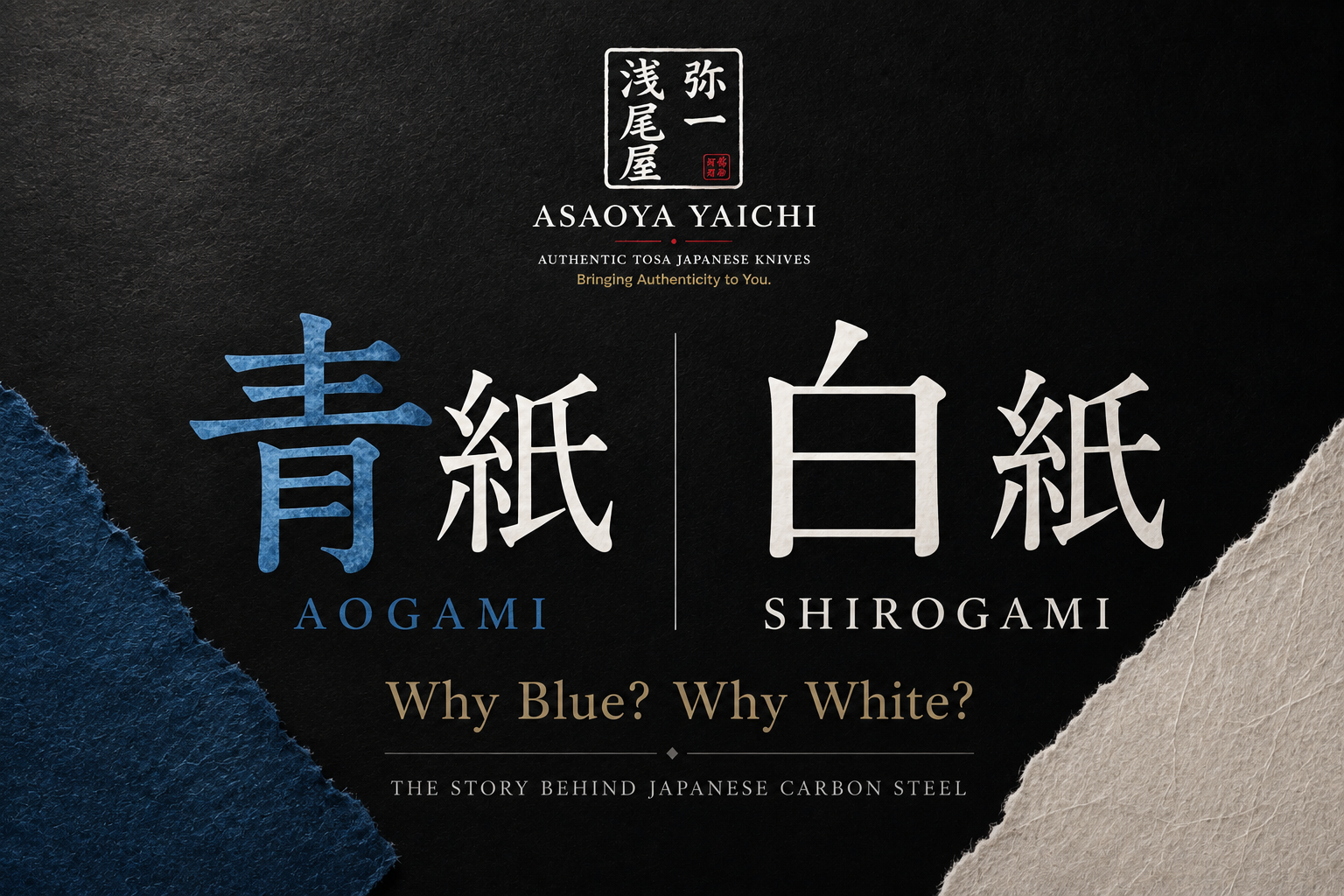
    Why blue? Why white?

    I honestly had no idea.

    So I decided to look it up.

    1. Why Are Aogami and Shirogami Called Blue and White Paper Steel?

    Ishizuchi Kanamono Manufactory

    The answer was much simpler than I expected.

    The steel itself is not blue or white.

    The names Aogami and Shirogami come from the coloured paper traditionally used to distinguish different grades of Yasugi Specialty Steel.

    “Ao” means blue in Japanese, while “Shiro” means white.

    That is why Aogami became known as Blue Paper Steel and Shirogami as White Paper Steel.

    After more than 25 years of using knives, I had never once wondered about this.

    Sometimes the simplest questions are the ones we forget to ask.

    2. So, What Exactly Is Shirogami?

    Once I understood the name, the next question was obvious.

    What is actually different about the steel?

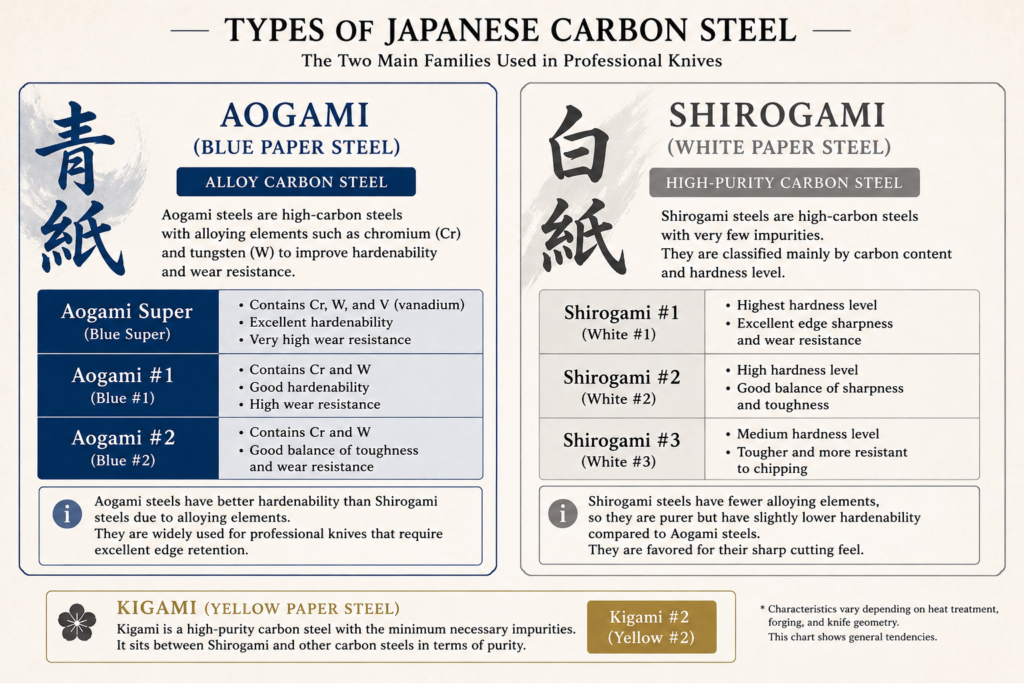
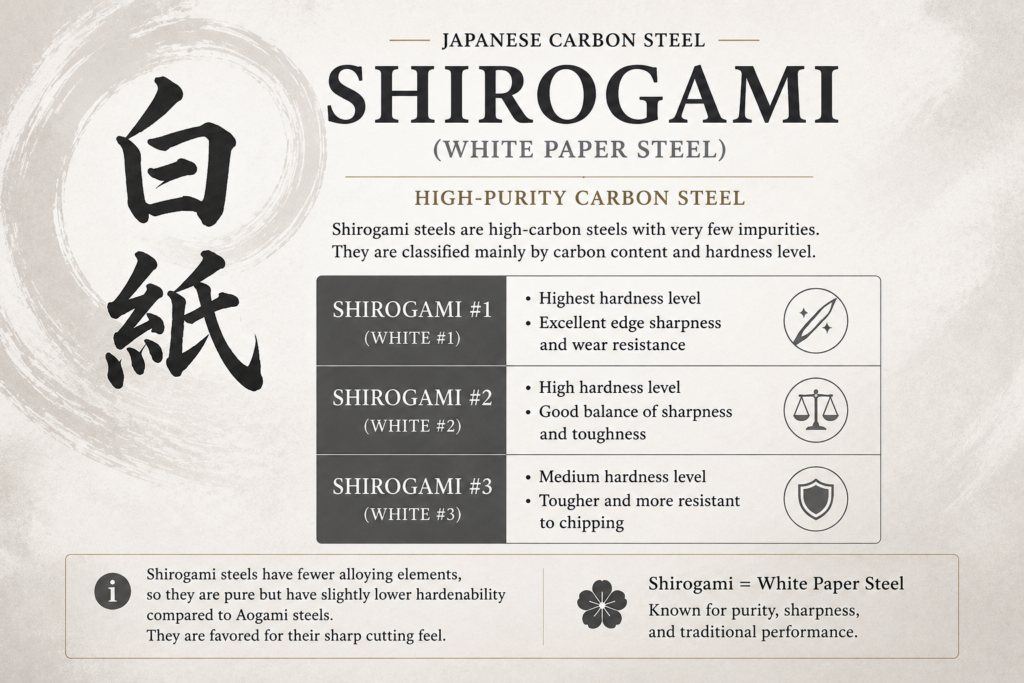
    Shirogami is a high-purity carbon steel with tightly controlled impurities. Its relatively simple composition allows it to take a very fine edge, and it has a strong reputation for responding beautifully to whetstones.

    Of course, it is still carbon steel.

    That means moisture, acidic foods and poor maintenance can cause discolouration and eventually rust.

    It can also develop a natural patina through normal use.

    👉 INTERNAL LINK: Read more about Japanese knife patina:
    https://blog.asaoyayaichi.com.au/japanese-knife-patina/

    For someone used to stainless steel, this extra maintenance may seem inconvenient. For others, it is simply part of the character of a traditional carbon-steel knife.

    3. How Is Aogami Different from Shirogami?

    This is where things started getting more interesting for me.

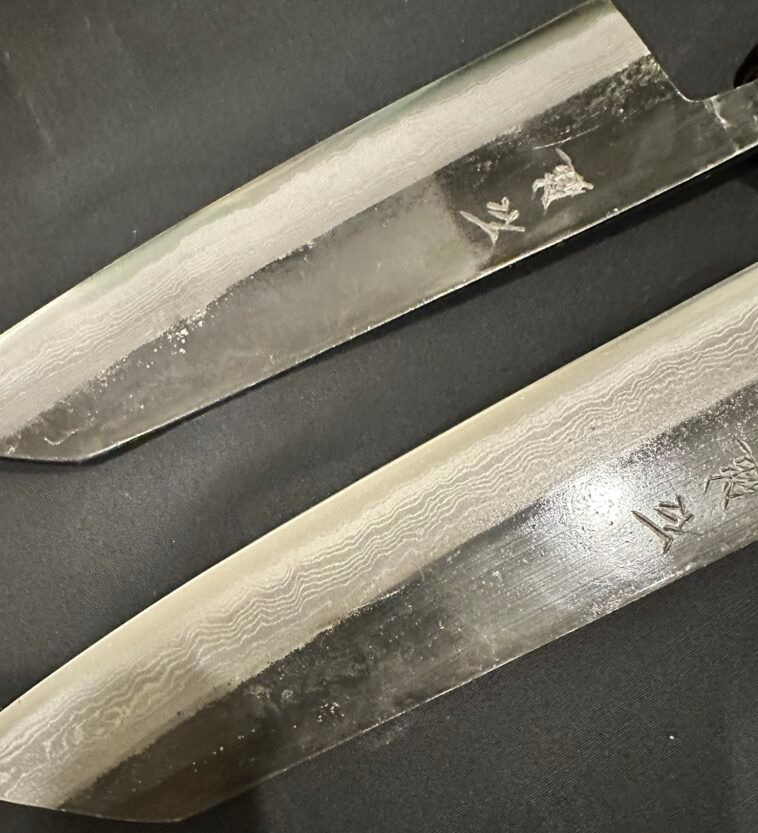
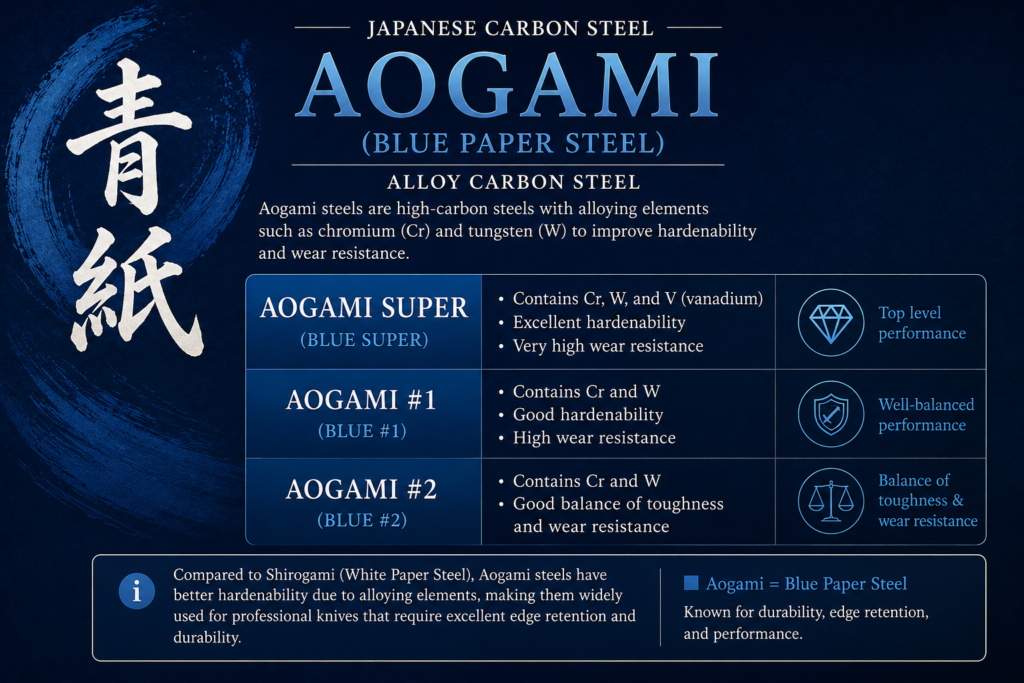
    Aogami contains alloying elements such as chromium and tungsten in addition to carbon. These additions help increase wear resistance and edge retention.

    In simple terms, Aogami is designed to maintain its cutting edge well.

    The trade-off is that greater wear resistance can also mean more effort when sharpening compared with a simpler carbon steel such as Shirogami.

    Before starting a knife business, I never thought about knives in terms of chromium, tungsten or carbon percentages.

    I simply knew whether I liked using a knife or not.

    Learning about the steel has given me another way to understand some of those differences.

    4. Aogami #1, #2 and Aogami Super

    Then I discovered that Aogami itself was not just one steel.

    There is Aogami #1, Aogami #2 and Aogami Super.

    Very simply, the different grades have different carbon and alloy compositions. Aogami #1 has more carbon than #2, while Aogami Super uses additional alloying elements and is known for high hardness and excellent edge retention when properly heat treated.

    At first, it is tempting to think that a higher specification must automatically mean a better knife.

    But the more I learn about Japanese knives, the less I think that way.

    The steel is only one part of the story.

    Heat treatment, blade geometry, grinding, sharpening and the skill of the maker can all affect how the finished knife performs.

    👉 INTERNAL LINK: Read more about Japanese knife hardness and HRC:
    https://blog.asaoyayaichi.com.au/japanese-knife-hardness-hrc/

    5. Shirogami Also Has Different Grades

    Then, of course, I learned that Shirogami also comes in different grades.

    Shirogami #1, #2 and #3 have different carbon contents, with #1 containing more carbon than #2 and #3 containing less.

    Again, I don’t think this means we can simply rank them from “best” to “worst.”

    This is something I have come to understand since entering the knife business.

    Two handmade Japanese knives using the same steel can still feel very different.

    The maker, heat treatment, thickness, blade geometry, sharpening and even the intended purpose of the knife all matter.

    👉 INTERNAL LINK: Why no two handmade Japanese knives are exactly the same:
    https://blog.asaoyayaichi.com.au/handmade-japanese-knives/

    6. Is Aogami Better Than Shirogami?


    180mm Santoku Aogami #2 Green Micarta Handle with Turquoise Spacer

    This was probably my biggest question when I first started learning about Aogami and Shirogami.

    Which one is better?

    After looking into it, I think that may be the wrong question.

    Aogami is well known for edge retention and wear resistance. Shirogami is famous for its sharpening response and ability to take a very refined edge.

    But a knife is something we actually use.

    How often do you sharpen? What ingredients do you cut? How do you use your knife? Do you enjoy sharpening? How much maintenance are you comfortable with?

    And most importantly, how does the knife actually feel when you use it?

    👉 INTERNAL LINK: Read more about Kireaji — the feeling of sharpness:
    https://blog.asaoyayaichi.com.au/japanese-knife-sharpness/

    Specifications can explain part of a knife, but they cannot completely describe the experience of using one.

    7. What I Learned About Aogami and Shirogami

    The biggest thing I learned while researching Aogami and Shirogami was not actually about carbon percentages or alloying elements.

    It was how much I still have to learn.

    I have spent more than 25 years using knives professionally, but that does not mean I spent 25 years studying knife steel.

    I was a chef.

    I picked up a knife, used it, sharpened it, washed it, dried it and went back to work.

    Only after starting my knife business did I begin paying much more attention to the steels behind the knives.

    👉 INTERNAL LINK: Read more about Japanese knife balance:
    https://blog.asaoyayaichi.com.au/japanese-knife-balance/

    And I actually enjoy discovering these things now.

    Aogami. Shirogami. VG10. Ginsan. SG2.

    Names that once meant very little to me are gradually starting to make more sense.

    This time, it started with an extremely simple question.

    Why blue? Why white?

    Now I know.

    But learning about Aogami and Shirogami also reminded me that steel specifications are only part of what makes a Japanese knife interesting.

    The maker matters. Heat treatment matters. Geometry matters. Sharpening matters.

    And finally, the person holding the knife matters.

    So I don’t think we need to decide that Aogami is simply better than Shirogami, or vice versa.

    They are different steels with different characteristics.

    And I’m still learning about both.

    Maybe that is part of the fun.

    👉 Explore more:
    https://blog.asaoyayaichi.com.au

    👉 Visit our online store:
    https://asaoyayaichi.com.au

    Thank you for reading, and I hope to see you again in the next story.