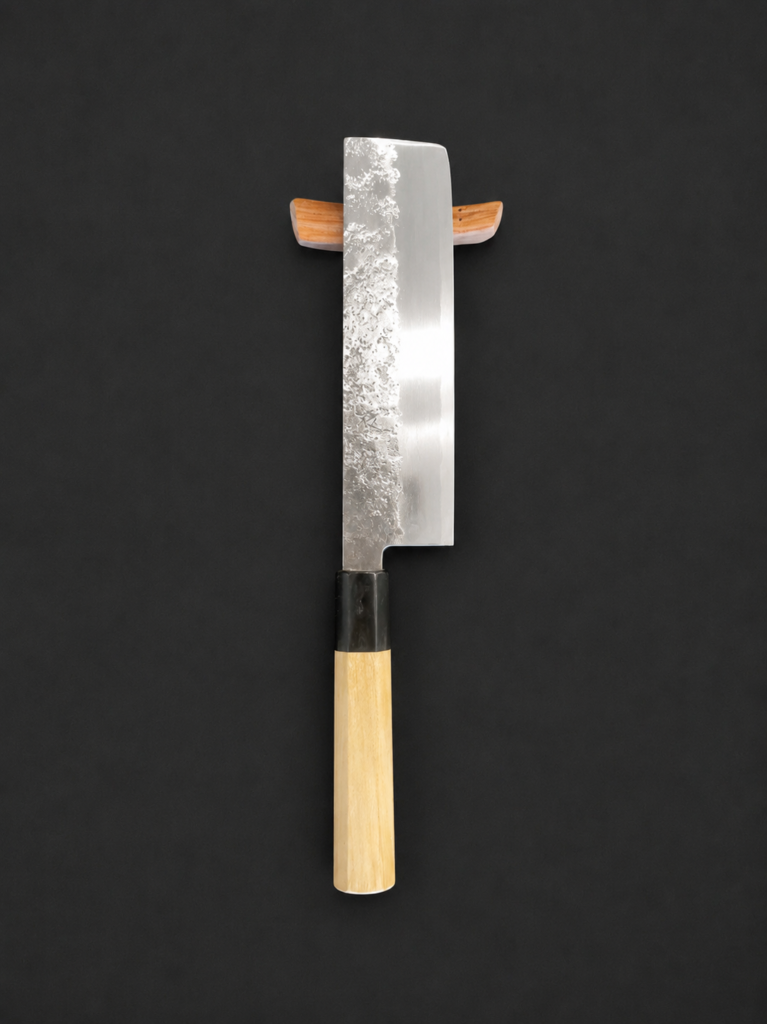
165mm Nakiri Ginsan Nashiji Forged Magnolia Octagonal Handle Buffalo Horn Ferrule
Nakiri vs Santoku is a comparison I think about differently after more than 25 years as a professional chef. Both cut vegetables. I notice the difference when I want a straight line or turn a daikon for katsuramuki. Then the edge shape becomes something I can feel. The same vegetable can make two knives feel surprisingly different in my hands when the goal is a precise shape rather than speed.
If you are looking at Japanese knives in Australia, you can explore the knives I have selected for Asaoya Yaichi here: https://asaoyayaichi.com.au. Before choosing a shape, I would think about the work you actually do on your cutting board.
Nakiri vs Santoku: Straight Cuts on the Board
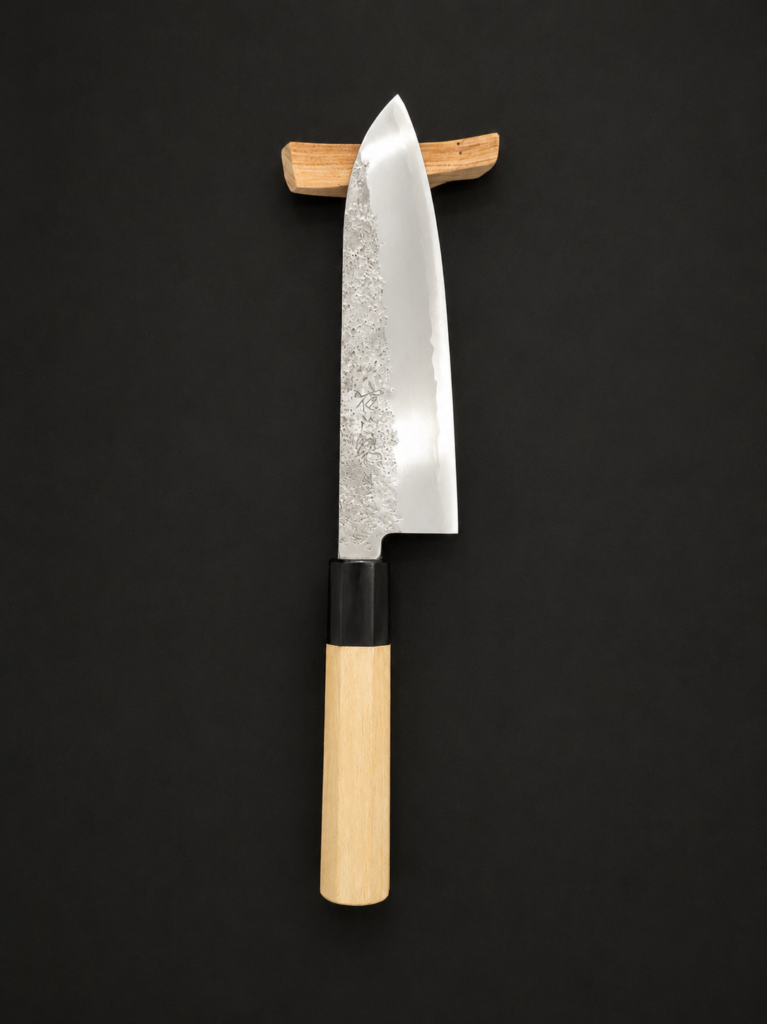
180mm Santoku Ginsan Nashiji Forged Magnolia Octagonal Handle Buffalo Horn
When I cut a vegetable into neat rectangular strips, a nakiri’s relatively straight edge gives me a clear line to follow. I can use a controlled push cut and watch where the edge meets the board. With short, rectangular pieces, even a slight change in the direction of a cut is easy to see. I find myself paying attention to the line all the way through the vegetable.
A santoku can certainly make the same cuts. I have used santoku knives for vegetable preparation throughout my career. But some curve more toward the tip, and I may adjust my motion to keep a series of cuts consistent.
The knife does not make the strips straight by itself. My preparation, grip, sharpening and cutting technique matter too. Still, that straight edge is why I might choose a nakiri when a tidy result matters.
👉 Read my beginner’s guide to choosing a Japanese knife.
Blade thickness also changes how a knife moves through a vegetable. A straight outline alone cannot tell me whether a particular knife will feel good in use.
👉 See what I learned about Japanese knife thickness.
Katsuramuki Makes Me Notice the Blade Shape
Nakiri vs Santoku for Katsuramuki
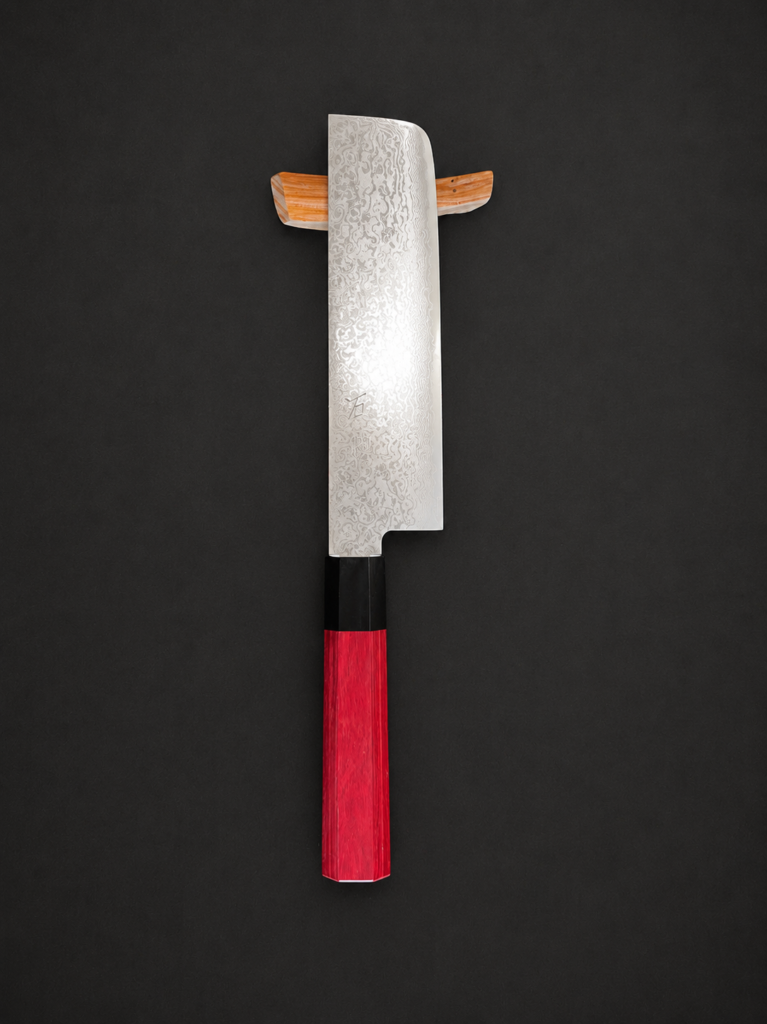
165mm Usuba A8 Hammered Damascus Black & Red Octagonal Handle
Katsuramuki means turning a vegetable, often a daikon, while peeling off a long, thin sheet. I watch the edge, turn the vegetable and try to keep an even thickness. It demands control.
In my experience, the straighter edge of a nakiri is easier to follow during this work. When I use a more curved section of a santoku, the peel can start to wander or curve away from the line I want. That is the practical difference I feel. Once a long peel starts moving away from my intended line, correcting it without breaking the sheet becomes difficult. A santoku can still do katsuramuki.
In fact, the straighter section near the heel of some santoku knives can also be used for peeling. The result depends on the individual knife and the way it is handled. For traditional, highly refined vegetable work, a single-bevel usuba is another specialised choice. A nakiri is generally double bevel, so I would not present it as a substitute for every technique an usuba is designed to perform.
👉 Read my guide to single and double bevel Japanese knives.
Nakiri vs Santoku When There Is Room for Only One
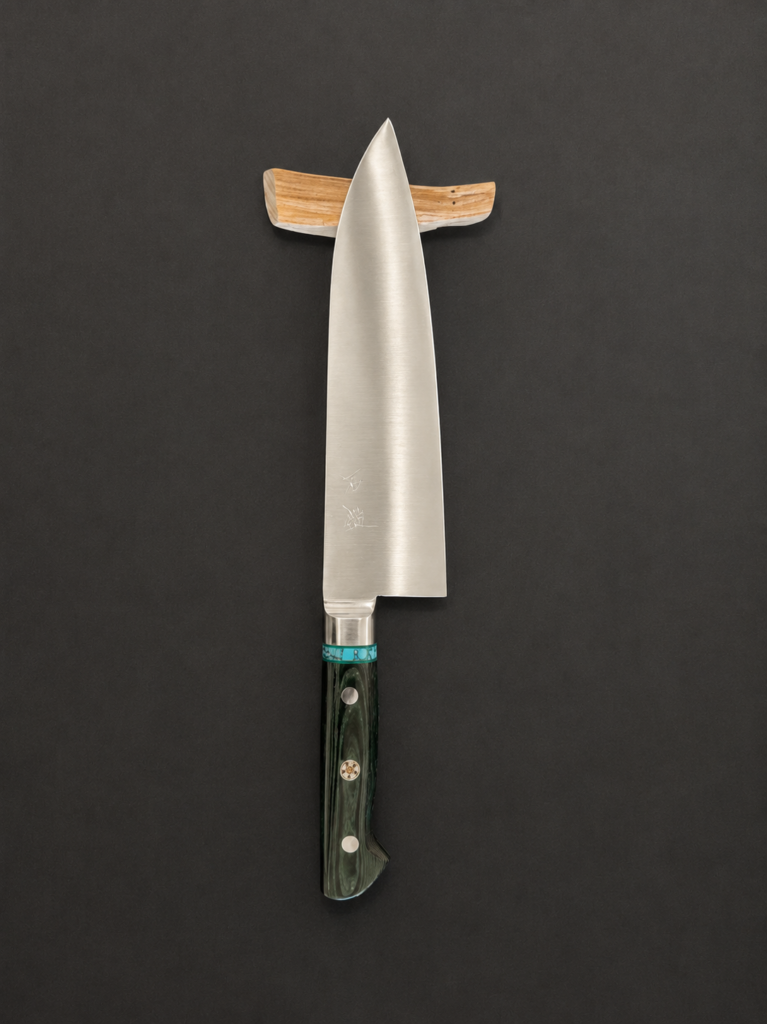
180mm Santoku Aogami #2 Green Micarta Handle with Turquoise Spacer
The straight edge has a real purpose, but a kitchen does not consist of daikon and rectangular vegetable cuts alone. I might prepare onions and greens, then portion boneless meat or fish for the same meal. A santoku makes sense for that changing workload. Its pointed tip helps with some detail work, while the blade moves between ingredients.
If someone in Australia asked me to recommend just one Japanese knife for everyday home cooking, I would usually start by discussing a santoku or a gyuto. The choice depends on board space, ingredients and cutting style. A nakiri becomes more interesting when vegetable preparation is a regular part of their cooking and they value the way its straight edge behaves.
👉 Read my Santoku vs Gyuto comparison for another everyday-knife decision.
I notice the nakiri’s advantage when making straight strips or holding a line during katsuramuki. Someone preparing a wide range of meals may value the santoku’s flexibility more. The name of the knife alone cannot tell me which one belongs in a particular kitchen. I also consider the actual blade, its weight and the person holding it.
That is how I would choose between them: by the cut in front of me, not by a label on the knife. If you are still weighing up different shapes, I have written more about the knives I would choose for Australian kitchens.
👉 Explore more:
https://blog.asaoyayaichi.com.au
👉 Visit our online store:
https://asaoyayaichi.com.au
Thank you for reading, and I hope to see you again in the next story.
——————————————-—
Where to See and Buy Our Knives
Our Partner Stores
Chanoyu — Nerang, Gold Coast

Visit Chanoyu and See Our Japanese Knives
If you are on the Gold Coast, we would love you to visit Chanoyu, a Japanese café in Nerang where you can see and purchase a selection of Asaoya Yaichi knives in person.
Chanoyu is a lovely place to slow down and enjoy Japanese-inspired food, excellent matcha, coffee and handmade desserts. Its warm, peaceful atmosphere makes it a pleasure to visit, whether you are stopping in for breakfast, lunch or something sweet. We are delighted that our knives have a place there.

Visit Chanoyu: Shop 6A, 54–58 Nerang Street, Nerang QLD 4211
Opening hours: Monday to Saturday, 7:00 am–2:00 pm; closed Sunday
Website: https://www.chanoyucafe.com/
Instagram: https://www.instagram.com/chanoyugc/
The selection of knives on display may change. If you are interested in a particular Asaoya Yaichi knife, please contact us through https://asaoyayaichi.com.au before visiting, and we will help you check whether it is available at Chanoyu.