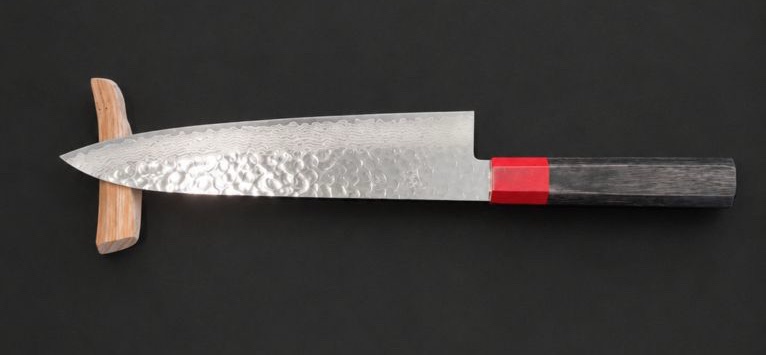
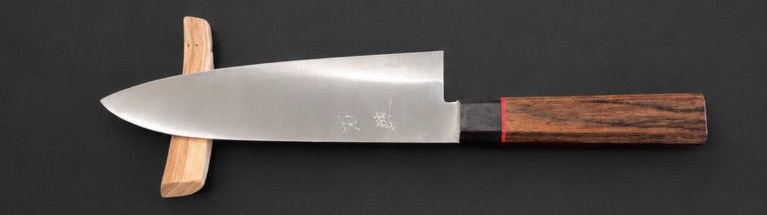
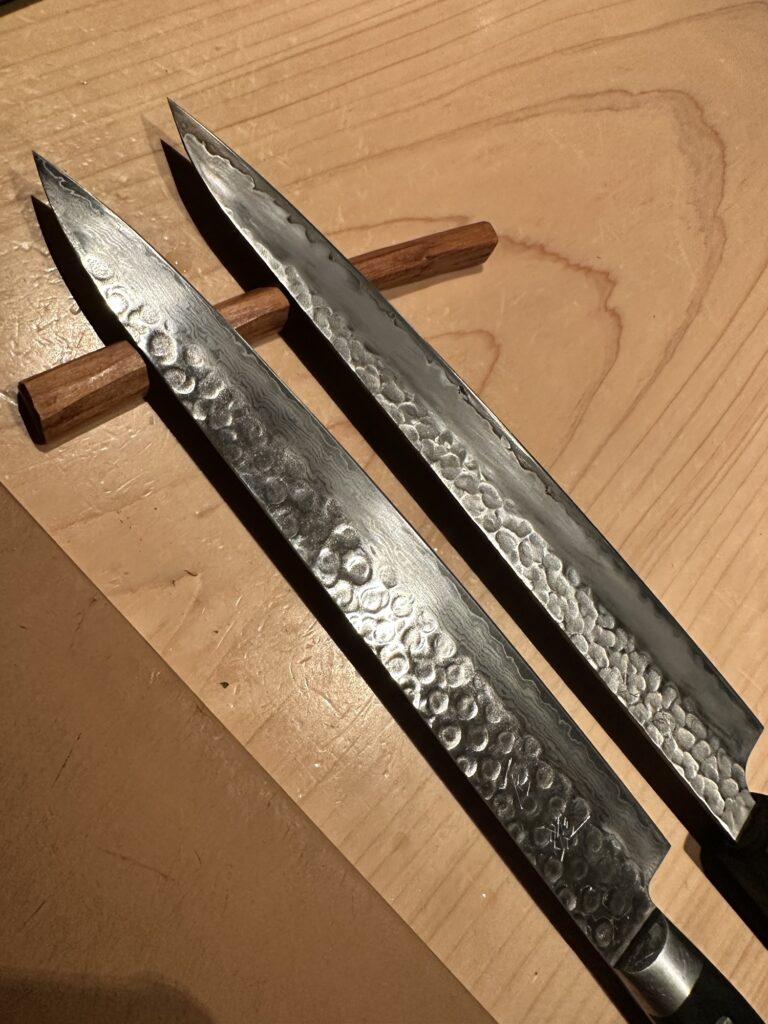
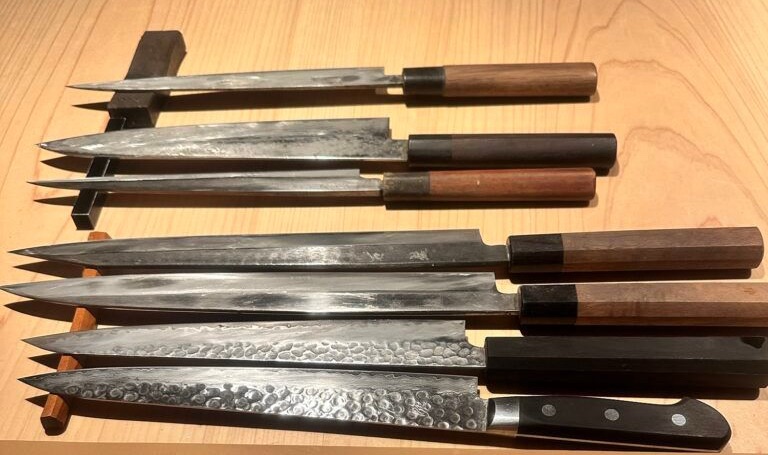
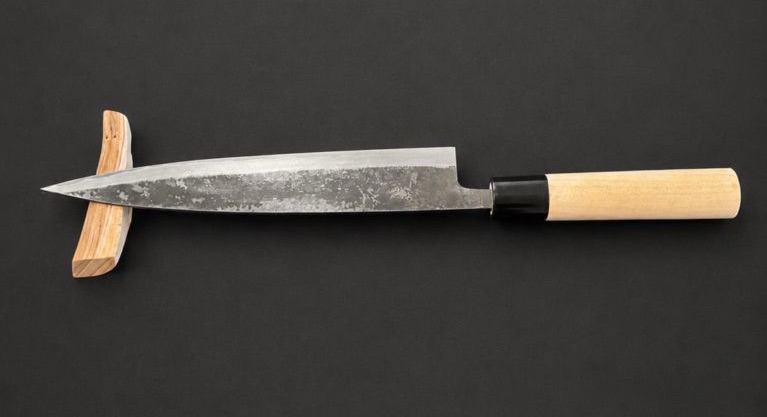
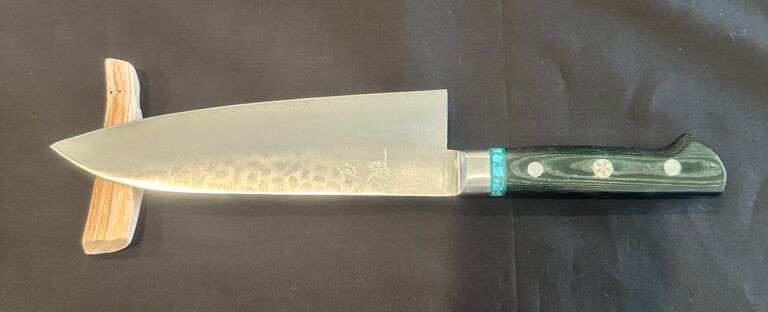
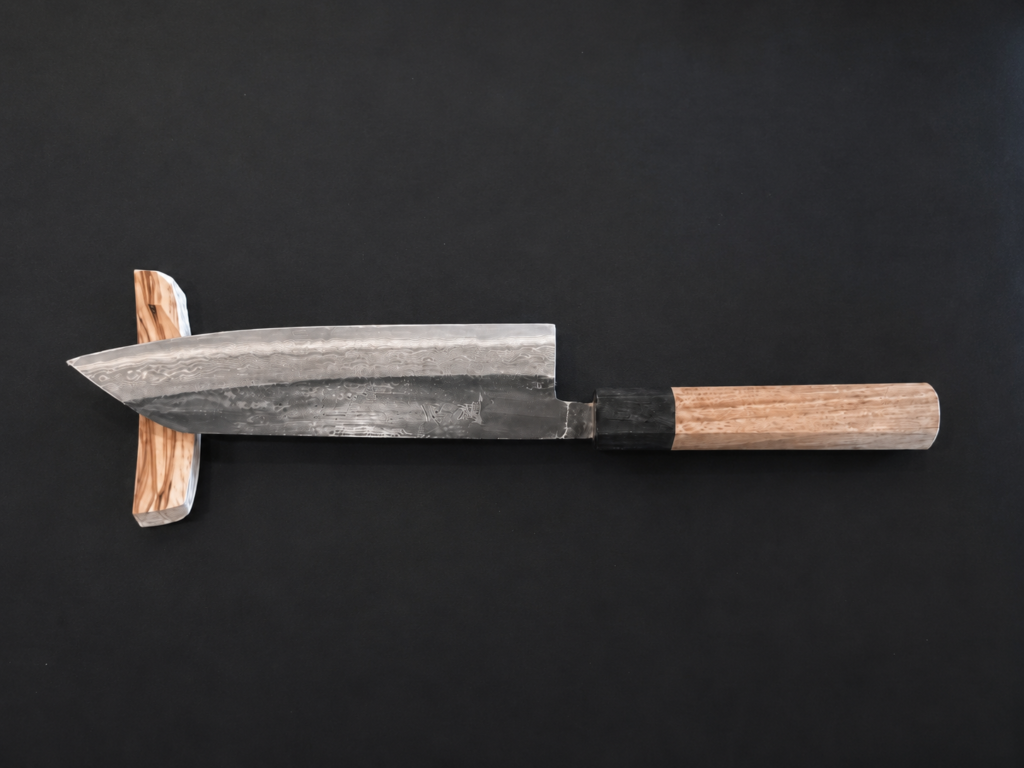
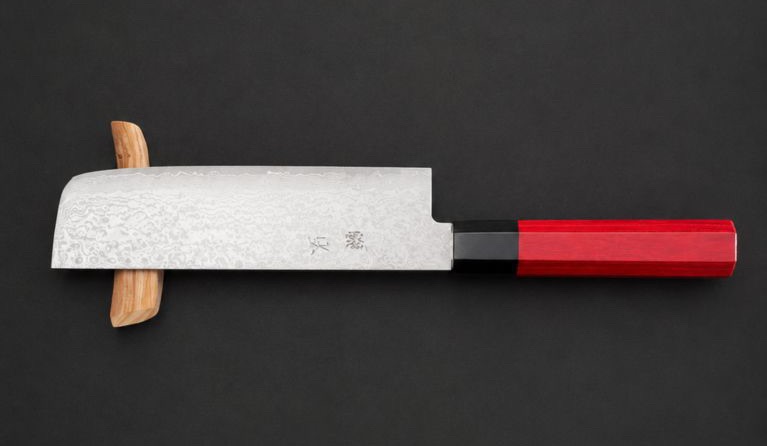
If you’re looking to buy Japanese knives in Australia, you’ve probably noticed there’s no shortage of places selling them these days. From specialist knife shops to large kitchenware retailers, there are plenty of options.
But where a knife comes from, how it reaches Australia, and who’s choosing what goes on the shelves can make a difference.
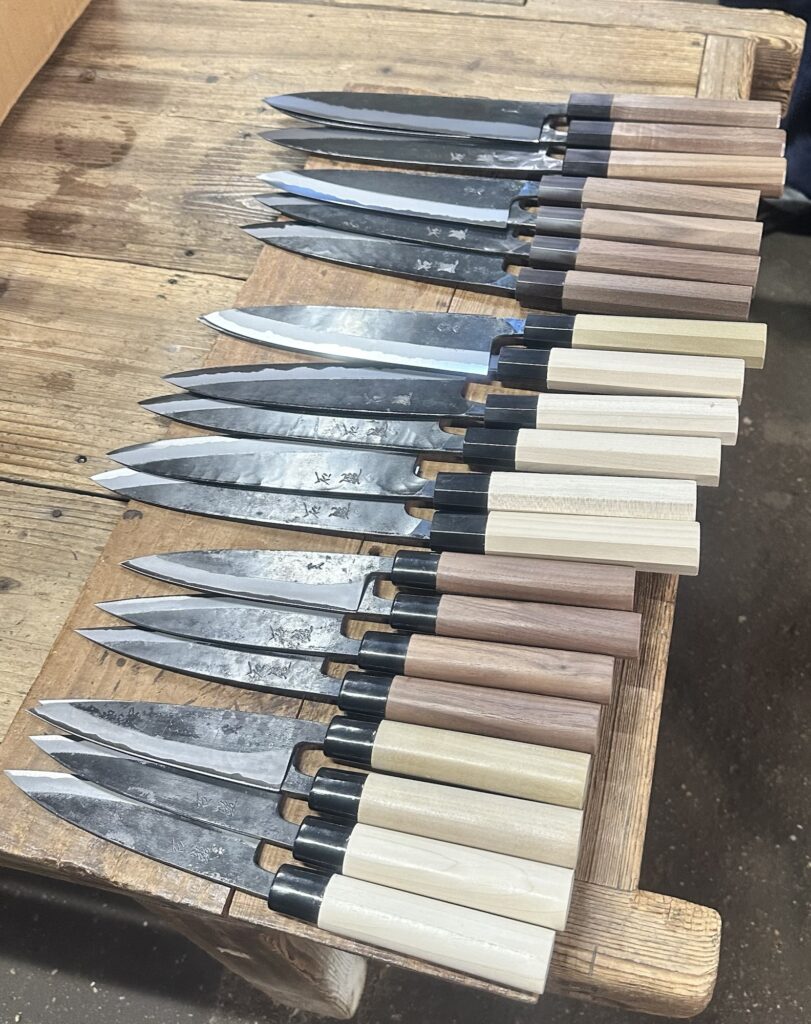
At Asaoya Yaichi, we import our Japanese knives directly from Ishizuchi Kanamono Seisakusho in Kochi, Japan. We also operate primarily online, keeping our running costs down so we can offer quality knives at competitive prices.
We’re currently running our Christmas Sale, with selected knives available at reduced prices. If you’ve been considering buying a Japanese knife, it’s worth having a look.
When you buy an imported product, you’re not just paying for the product itself. You’re also paying for everything involved in getting it from the manufacturer to the customer.
Depending on the supply chain, a knife might pass through several businesses before reaching a retail shop. Each stage can add costs.
We take a more direct approach.
By sourcing our knives directly from Ishizuchi Kanamono Seisakusho, we avoid unnecessary intermediaries and maintain a direct relationship with our supplier in Japan.
That relationship matters to me because I want to know where our knives come from and have confidence in the products we’re selling.
It also gives us greater control over how we source our knives and what we choose to offer Australian customers.
Why Selling Japanese Knives Australia Online Makes Sense
Running a physical shop comes with considerable expenses. There’s rent, electricity, shop fittings, staffing and the everyday costs of keeping the doors open.
Those expenses eventually have to be covered by the business.
At Asaoya Yaichi, we’ve chosen a different approach.
We don’t operate a traditional retail shop. Instead, we focus on selling online, which allows us to keep our overheads relatively low.
Combined with direct importing, this gives us the opportunity to offer prices we’re confident are competitive in the Australian market.
We’re not trying to claim that every knife we sell is the cheapest available. That’s not the point.
What matters is giving customers access to well-made Japanese knives at fair prices, without adding costs that don’t need to be there.
For anyone comparing Japanese knives in Australia, I think that’s worth considering.
Choosing Japanese Knives After 25 Years in Professional Kitchens
I’ve spent more than 25 years working in professional kitchens, and one thing I’ve learnt is that an expensive knife isn’t necessarily the right knife.
I’ve used different knives over the years, and I’ve developed my own preferences about what works well in a busy kitchen.
A knife needs to feel comfortable, hold a useful edge and suit the work you’re doing.
There’s little point spending hundreds of dollars on something that looks impressive but doesn’t feel right when you actually use it.
That’s the experience I bring to Asaoya Yaichi.
I’m interested in knives that offer a sensible balance of performance, quality and price.
Whether someone is cooking at home or working professionally, I want them to feel they’ve bought something they’ll enjoy using for years.
Steel is another consideration. Different steels offer different combinations of edge retention, sharpening characteristics and maintenance requirements.
If you’re shopping for Japanese knives in Australia, take your time comparing what’s available.
Think about the type of cooking you do, the size of knife you’re comfortable with and how much maintenance you’re prepared to give it.
And consider the business you’re buying from.
At Asaoya Yaichi, we’re proud to offer Japanese knives sourced directly from Japan, selected with practical kitchen experience and priced with our customers in mind.
Our Christmas Sale is currently underway, with discounts on selected knives while existing stock lasts.
If you’ve been thinking about upgrading your kitchen knife or buying one as a gift, now is a good time to explore the range.
Thank you for reading, and I hope to see you again in the next story.
—————————————————
Where to See and Buy Our Knives
Our Partner Stores
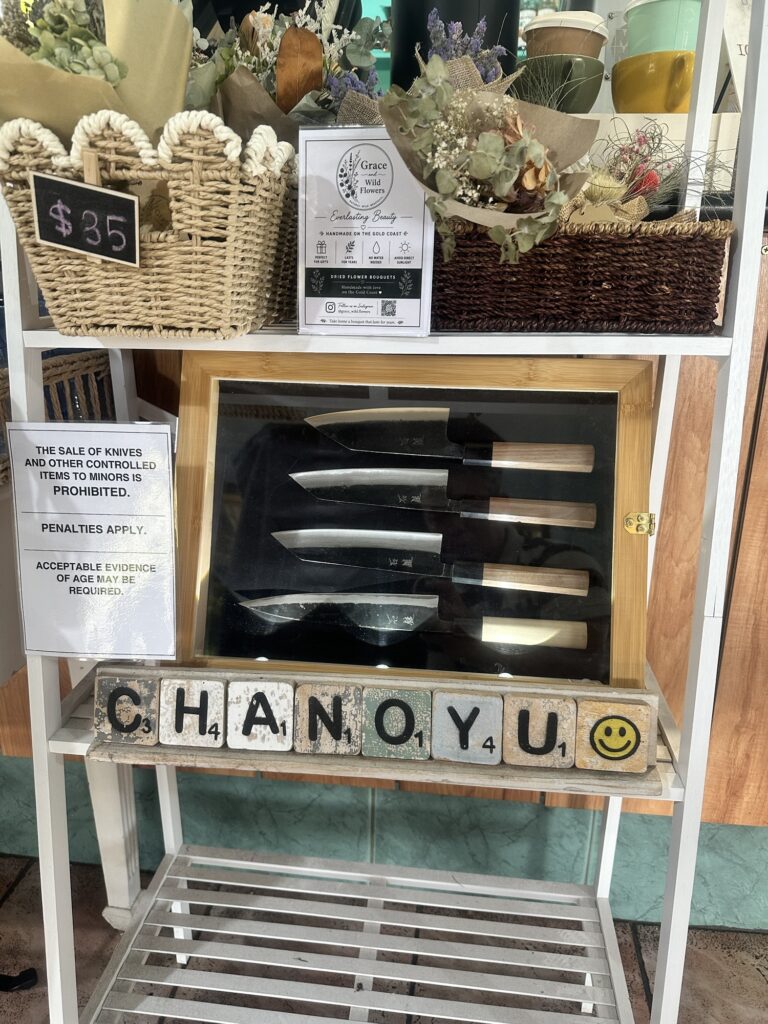
Chanoyu — Nerang, Gold Coast
Visit Chanoyu and See Our Japanese Knives
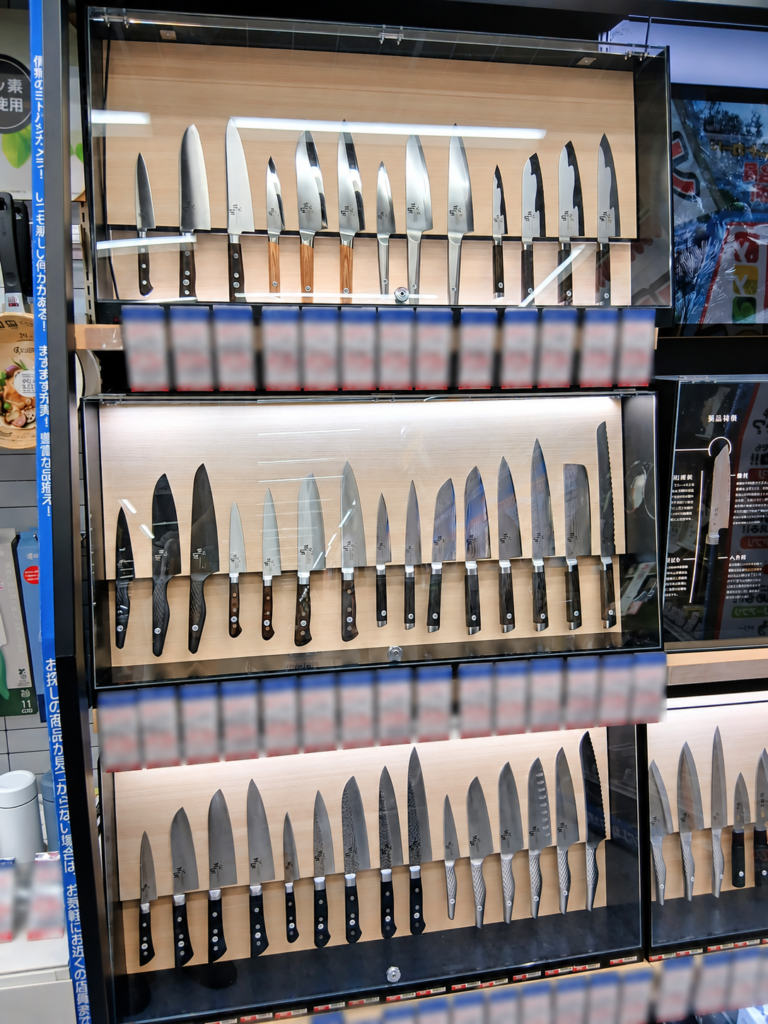
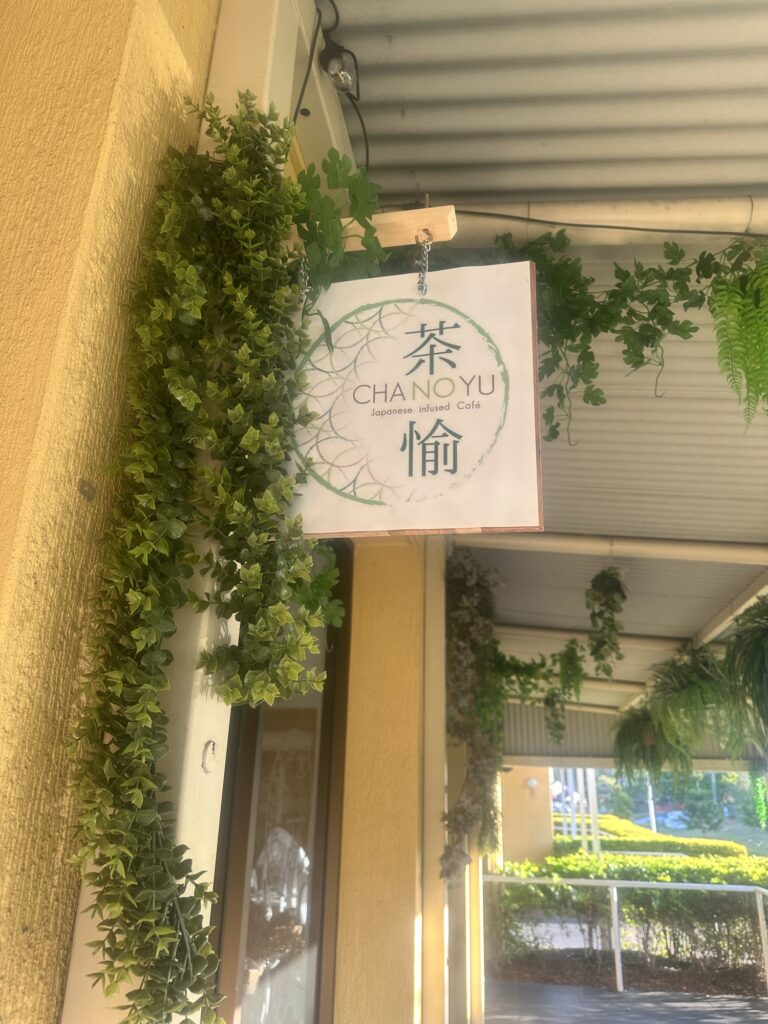
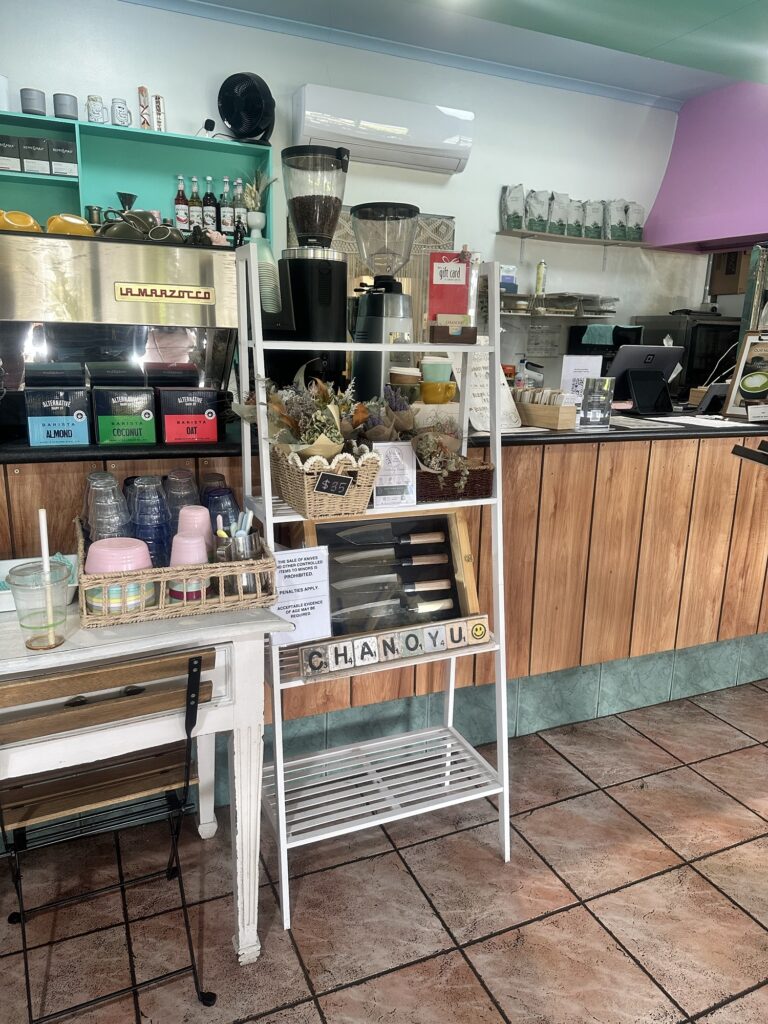
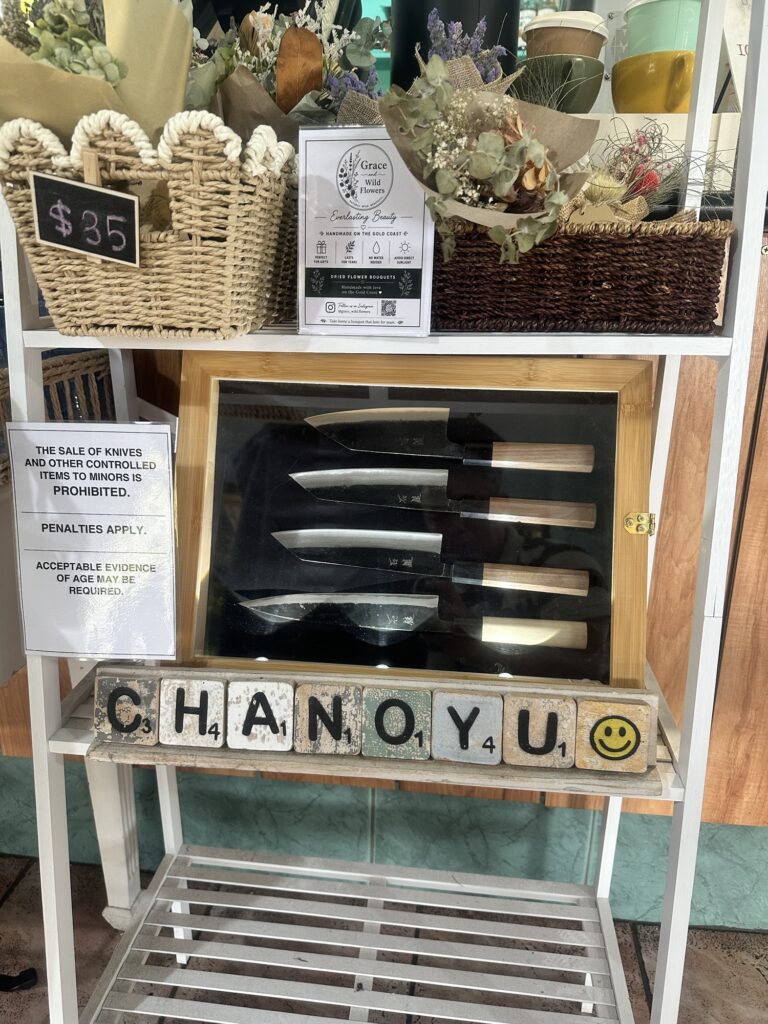
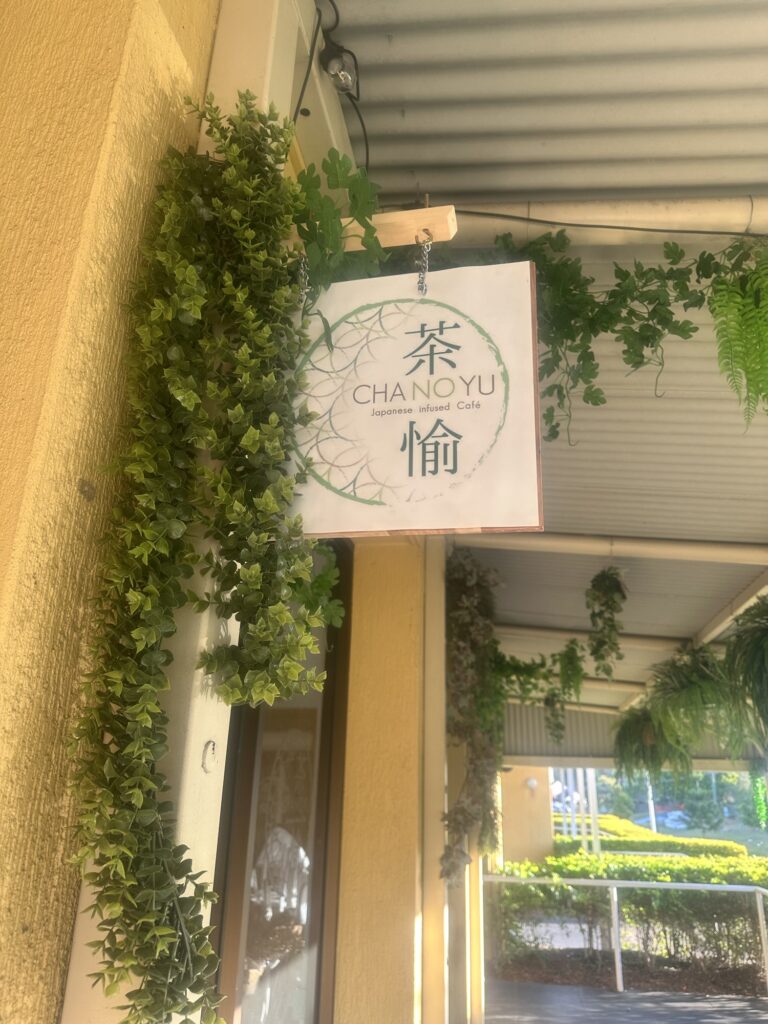
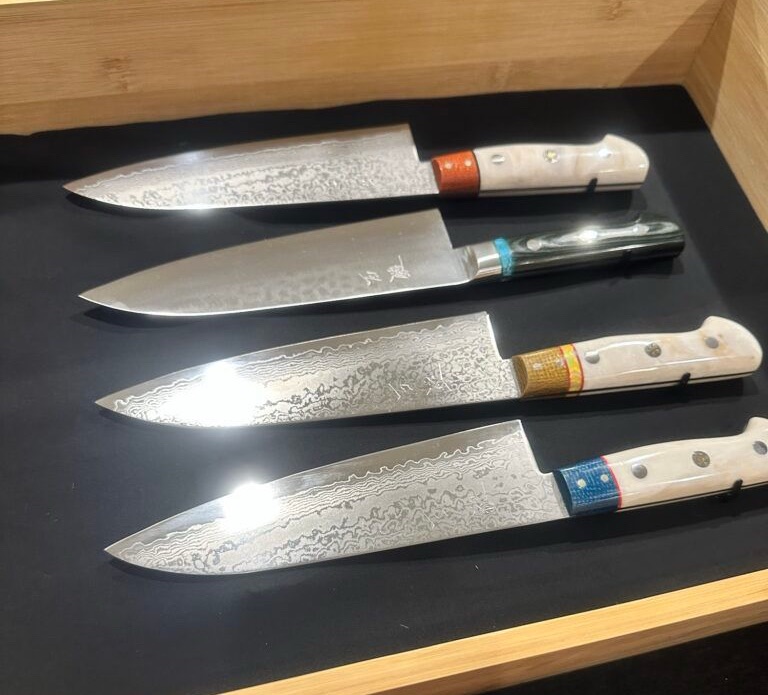
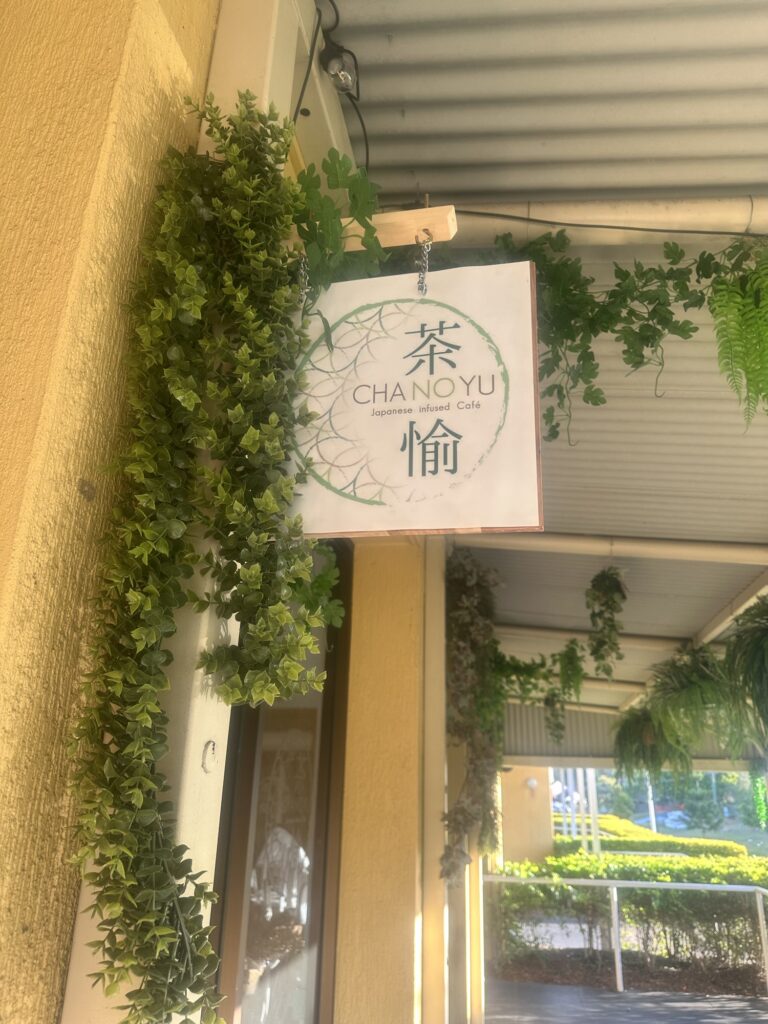
If you are on the Gold Coast, we would love you to visit Chanoyu, a Japanese café in Nerang where you can see and purchase a selection of Asaoya Yaichi knives in person.
Chanoyu is a lovely place to slow down and enjoy Japanese-inspired food, excellent matcha, coffee and handmade desserts. Its warm, peaceful atmosphere makes it a pleasure to visit, whether you are stopping in for breakfast, lunch or something sweet. We are delighted that our knives have a place there.
The selection of knives on display may change. If you are interested in a particular Asaoya Yaichi knife, please contact us through https://asaoyayaichi.com.au before visiting, and we will help you check whether it is available at Chanoyu.
I have worked as a professional chef for more than 25 years, including over 17 years in Australia.
Japanese knives have always been part of my everyday working life. I use them to prepare fish, slice sashimi and handle countless ingredients.
But recently, while running my Japanese knife business, Asaoya Yaichi, a question came to mind.
Why are Japanese knives so popular around the world?
I know how they perform. I know how they feel in my hands. But I realised I had never seriously investigated why they had become so highly regarded internationally.
So I decided to look into it.
If you are interested in experiencing Japanese craftsmanship yourself, now is a great time to explore our collection of Japanese knives in Australia.
Before exploring Japan, I wanted to understand the competition.
Germany has Solingen, one of the world’s most famous centres of blade manufacturing. Brands such as Wüsthof and Zwilling have established international reputations for producing dependable kitchen knives.
France has Thiers, a historic centre of cutlery production. Switzerland is home to Victorinox, whose practical kitchen knives are widely used in professional and domestic kitchens.
These countries have centuries of manufacturing experience. Their knives are respected for good reasons.
Traditional German-style chef’s knives generally prioritise durability, versatility and ease of maintenance. Many Japanese knives place greater emphasis on fine cutting performance and specialised blade geometry.
Neither approach is automatically superior.
This made my original question even more interesting.
If excellent knives already existed around the world, what made Japanese knives stand out?
2. Japanese Knife Craftsmanship Has a Remarkable History
Japan’s reputation for blade making did not begin with modern kitchen knives.
Regions such as Seki and Sakai developed sophisticated metalworking traditions over centuries.
Seki became famous for sword production, while Sakai developed a particularly strong reputation for traditional kitchen knives.
As Japanese society changed and demand for swords declined, blade-making skills continued through the production of practical cutting tools.
However, Japanese kitchen knives are not simply miniature Japanese swords. Their development also reflects regional industries, cooking traditions and specialised manufacturing techniques.
What impressed me most was how these skills survived generations of technological and cultural change.
Even today, traditional craftsmanship remains an important part of Japan’s knife-making identity.
Another important discovery was the relationship between Japanese food and Japanese knives.
As sushi and Japanese cuisine spread internationally, more people became familiar with Japanese cooking techniques.
Traditional Japanese knives were designed around particular tasks.
A Yanagiba creates long, clean slices of sashimi. A Deba is designed for preparing fish. An Usuba supports precise vegetable preparation.
These designs reflect the importance of presentation, texture and precision in Japanese cooking.
In 2013, UNESCO recognised washoku, traditional Japanese dietary cultures, as Intangible Cultural Heritage.
That recognition did not create the international popularity of Japanese cuisine, but it demonstrated how significant Japanese food culture had become.
I believe the global growth of Japanese restaurants helped introduce many overseas chefs to Japanese cutting techniques and the knives associated with them.
4. Japanese Knives Offer a Different Cutting Experience
After researching the history, I returned to something I understand personally: cutting performance.
Many Japanese knives use relatively hard steels and thin blade geometries, allowing them to take fine cutting edges.
This can produce an exceptionally smooth cutting experience, particularly when preparing delicate ingredients.
However, harder steel does not automatically mean a better knife.
Blade geometry, heat treatment, sharpening and maintenance all influence performance.
A poorly maintained expensive Japanese knife can perform worse than a properly sharpened, affordable Western knife.
I have experienced this throughout my career.
For sashimi, I personally enjoy the cutting feel of carbon steel. Yet I regularly use stainless steel knives professionally because they offer practical advantages during busy service.
The best knife is not necessarily the hardest or most expensive.
It is the knife that performs the job you need it to do.
After researching the subject, I no longer believe there is one simple explanation.
Japanese knives became internationally recognised through a combination of traditional craftsmanship, distinctive cutting performance, specialised cooking techniques and the worldwide growth of Japanese cuisine.
Their ability to adapt to modern kitchens has helped maintain that appeal.
But I also believe something else matters.
A well-made Japanese knife can make everyday preparation genuinely enjoyable.
After more than 25 years in professional kitchens, that feeling still matters to me.
I would never claim every Japanese knife is better than every German, French or Swiss knife.
However, I understand why so many cooks become fascinated with Japanese knives once they experience a well-made example.
That combination of performance, craftsmanship and character is what makes Japanese knives special to me.
For anyone exploring Japanese knives in Australia, there is an increasing range of options, from traditional carbon steel to modern stainless steel designs.
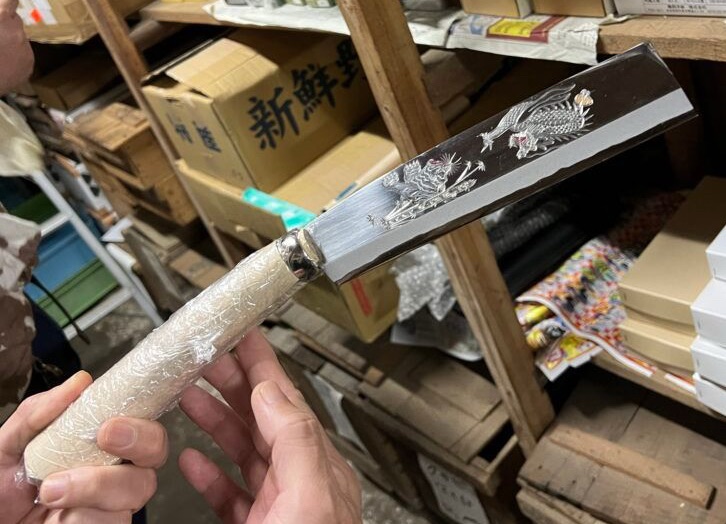
At Asaoya Yaichi, we introduce carefully selected Japanese knives, including blades produced in Tosa, Japan.
And perhaps that is the most interesting conclusion of all.
Japanese knives became popular worldwide not because other countries failed to make excellent knives, but because Japan developed its own distinctive approach to cutting.
Thank you for reading, and I hope to see you again in the next story.
—————————————————
Where to See and Buy Our Knives
Our Partner Stores
Chanoyu — Nerang, Gold Coast
Visit Chanoyu and See Our Japanese Knives
If you are on the Gold Coast, we would love you to visit Chanoyu, a Japanese café in Nerang where you can see and purchase a selection of Asaoya Yaichi knives in person.
Chanoyu is a lovely place to slow down and enjoy Japanese-inspired food, excellent matcha, coffee and handmade desserts. Its warm, peaceful atmosphere makes it a pleasure to visit, whether you are stopping in for breakfast, lunch or something sweet. We are delighted that our knives have a place there.
The selection of knives on display may change. If you are interested in a particular Asaoya Yaichi knife, please contact us through https://asaoyayaichi.com.au before visiting, and we will help you check whether it is available at Chanoyu.
Are Japanese knives in Australia really worth buying?
As a professional chef with over 25 years of experience in Japan and Australia, I believe they absolutely are. However, I also believe that exceptional Japanese craftsmanship should not always come with an exceptionally high price.
At Asaoya Yaichi, our mission is simple. We want more Australians to discover the quality of authentic Japanese knives without paying unnecessarily high prices.
If you are considering purchasing your first Japanese knife, I invite you to explore our collection at Asaoya Yaichi.
This Christmas, we are making that opportunity even more accessible.
1. Japanese Knives in Australia Offer More Than Sharpness
Thank you for reading, and I hope to see you again in the next story.
—————————————————
Where to See and Buy Our Knives
Our Partner Stores
Chanoyu — Nerang, Gold Coast
Visit Chanoyu and See Our Japanese Knives
If you are on the Gold Coast, we would love you to visit Chanoyu, a Japanese café in Nerang where you can see and purchase a selection of Asaoya Yaichi knives in person.
Chanoyu is a lovely place to slow down and enjoy Japanese-inspired food, excellent matcha, coffee and handmade desserts. Its warm, peaceful atmosphere makes it a pleasure to visit, whether you are stopping in for breakfast, lunch or something sweet. We are delighted that our knives have a place there.
The selection of knives on display may change. If you are interested in a particular Asaoya Yaichi knife, please contact us through https://asaoyayaichi.com.au before visiting, and we will help you check whether it is available at Chanoyu.
Christmas is approaching, and finding the perfect gift for someone special is not always easy.
A Japanese knife can make a wonderful Christmas present. It is not simply a kitchen tool, but something that can be used, appreciated, and treasured for many years.
After more than 25 years working as a professional chef, I have used many different Japanese knives. Some have impressed me with their cutting performance, others with their craftsmanship, and some simply because they are beautiful to look at.
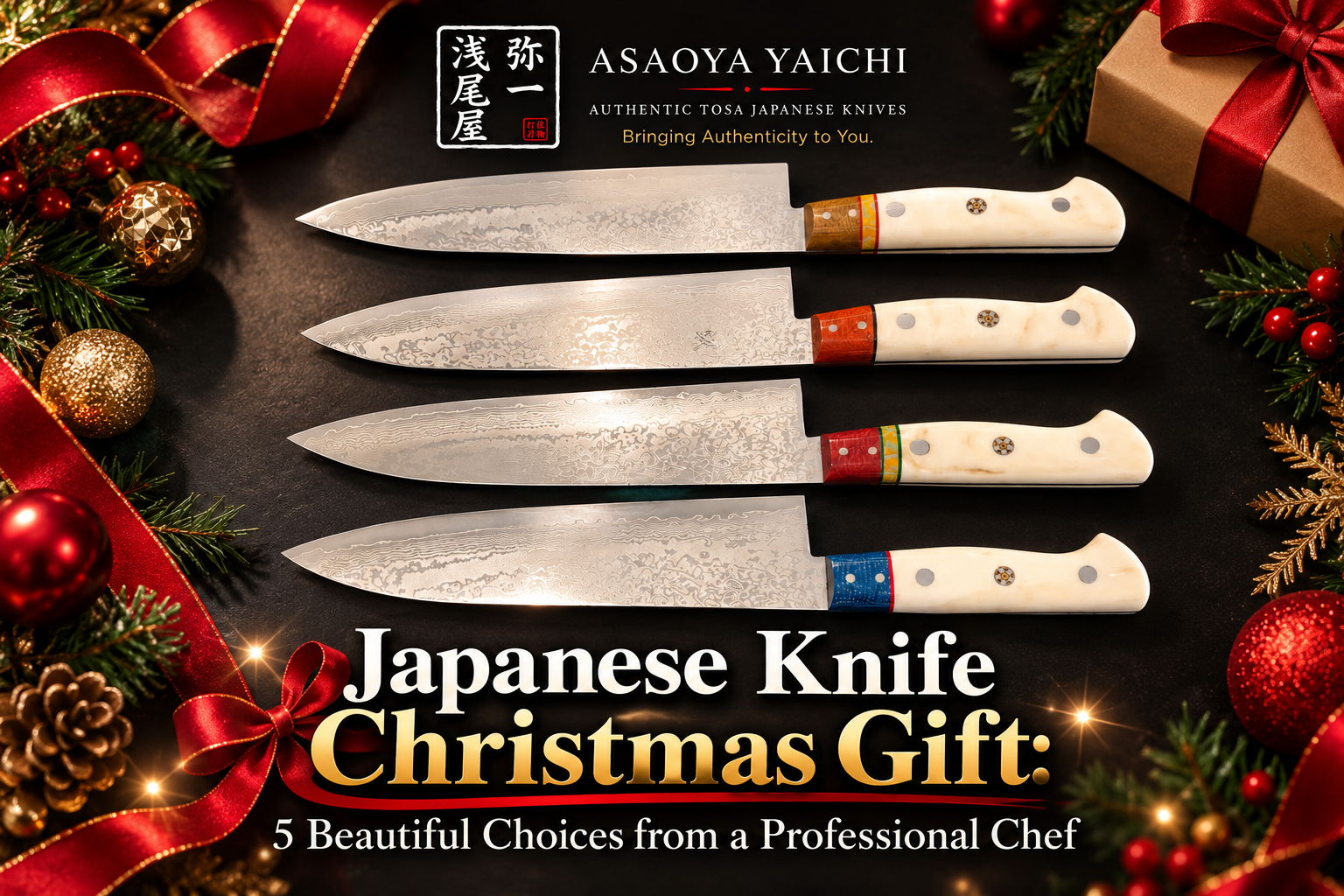
Today, I would like to introduce five Japanese knives from Asaoya Yaichi that I personally recommend as Christmas gifts.
These are not necessarily the five most expensive knives in our collection. They are five choices I genuinely believe would make wonderful presents.
Of course, choosing a knife for someone else is not always straightforward. Everyone has different cooking habits, preferences, and levels of experience.
That is why I have considered not only appearance but also practicality, maintenance, and the type of person who might enjoy each knife.
Our limited-time Christmas Sale begins on Wednesday, 14 October 2026, at 12:00 AM (Queensland time), so this is also a good opportunity to introduce some of the knives available at Asaoya Yaichi.
My first recommendation is one of the most beautiful knives in our collection.
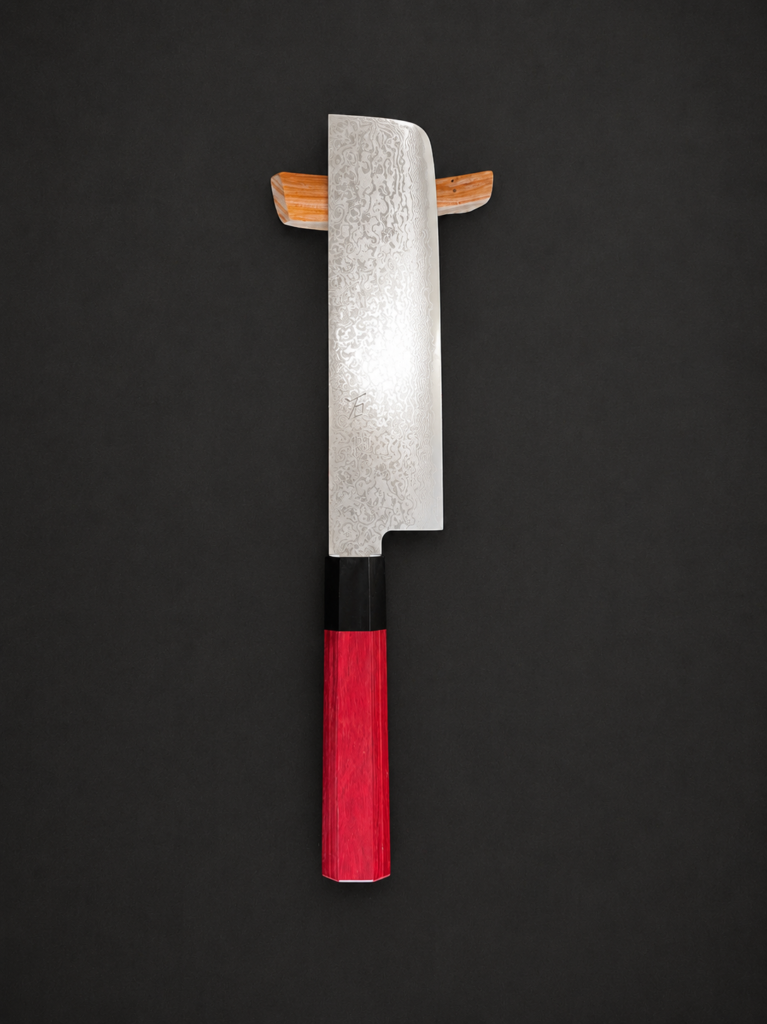
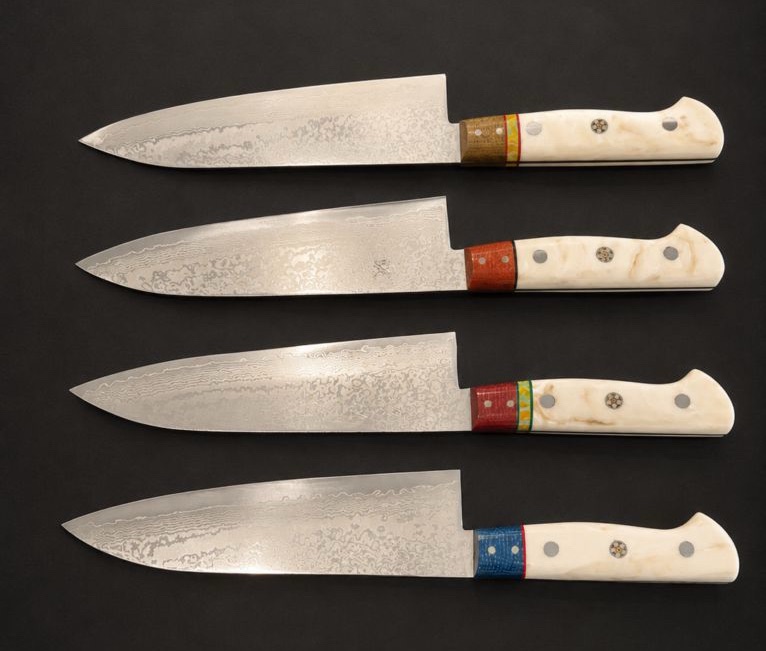
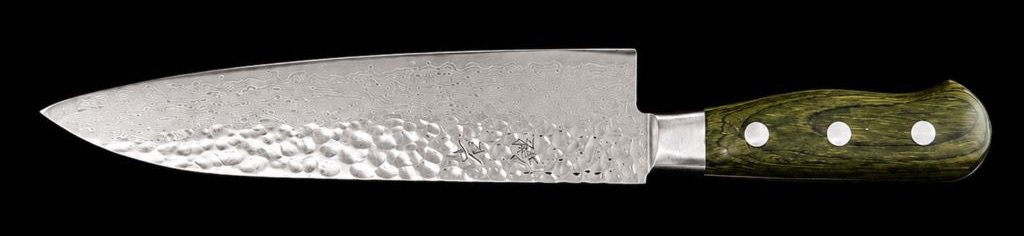
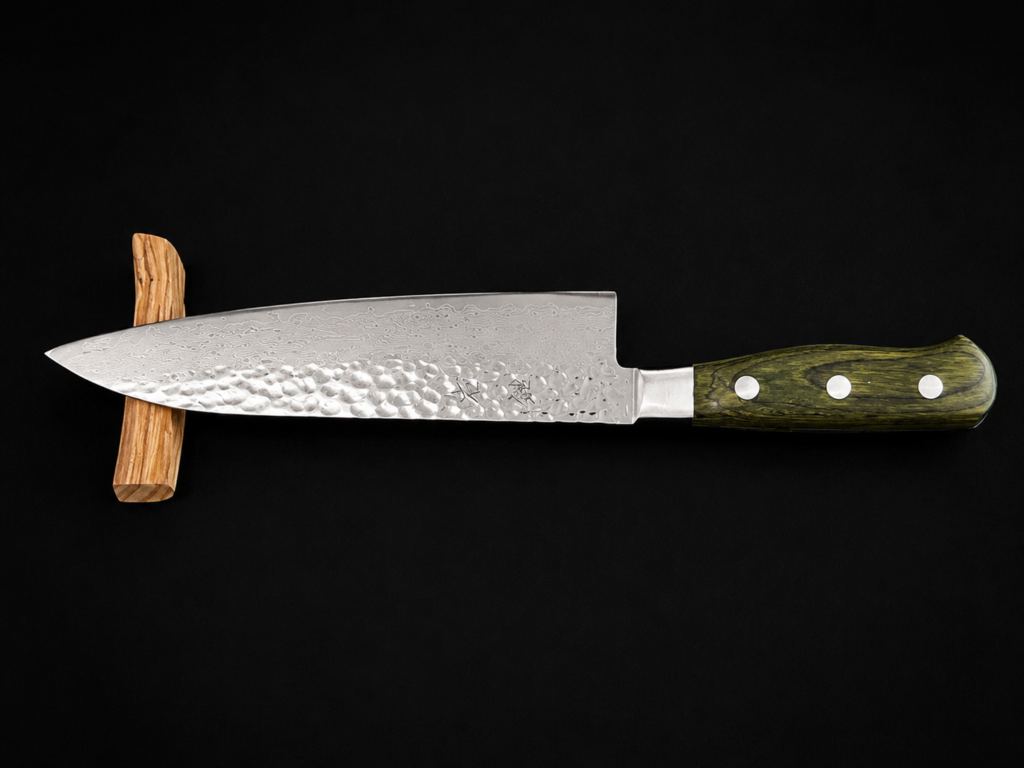
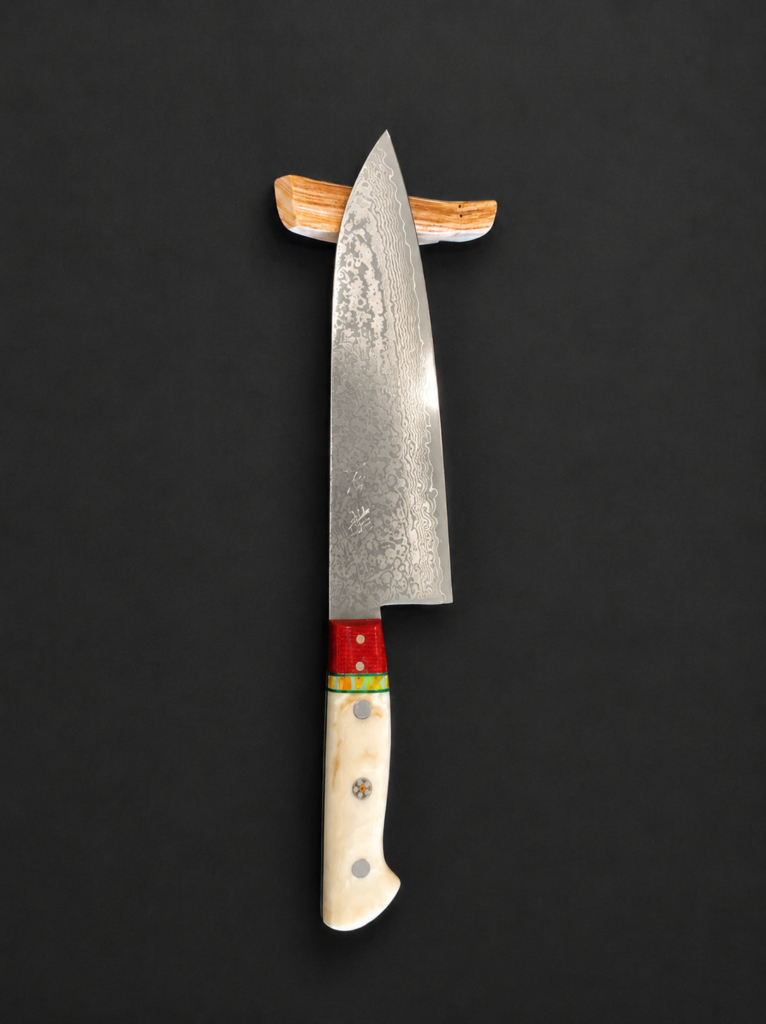
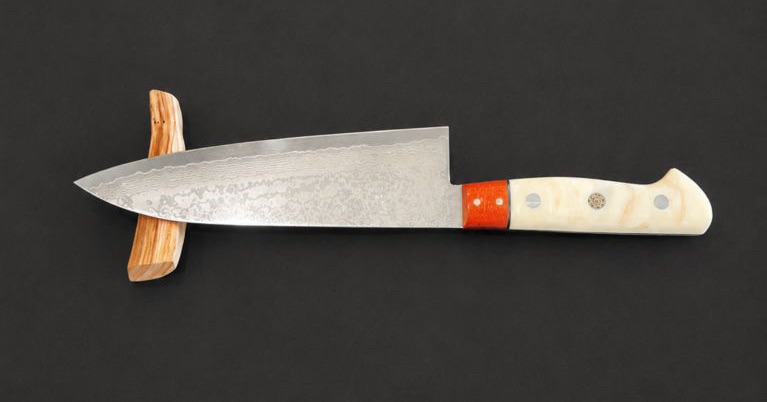
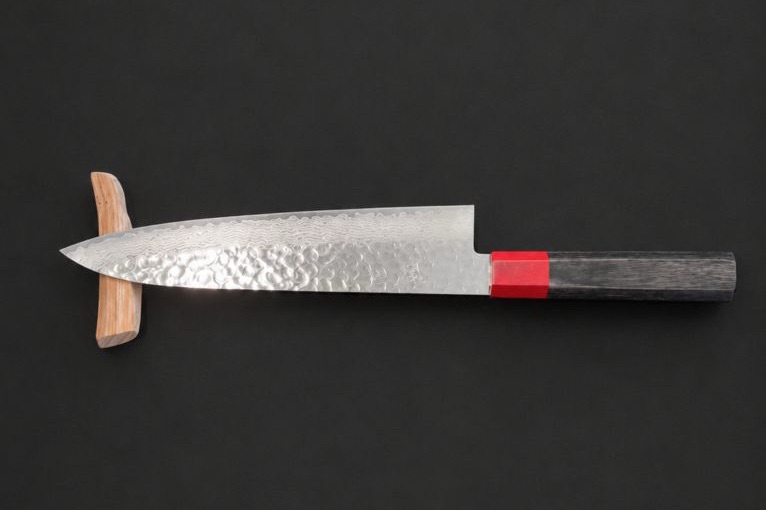
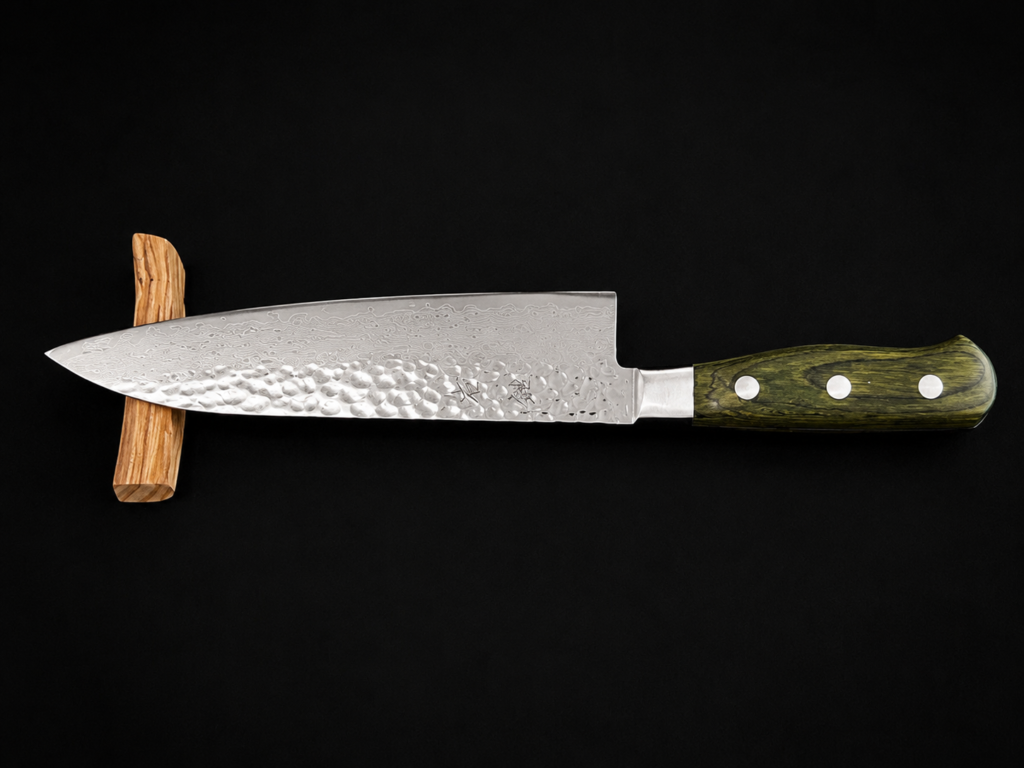
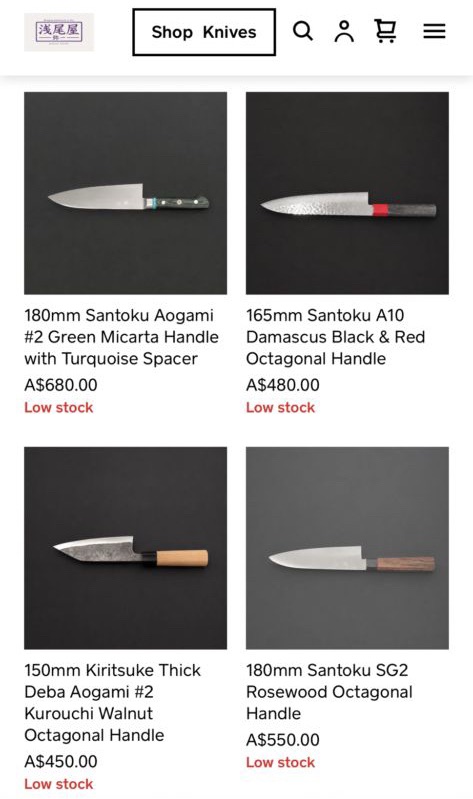
The 180mm Santoku VG10N 33 Layer Damascus features an elegant Damascus blade and a distinctive green marble-style handle decorated with a colourful spacer.
What makes this series particularly special is its limited availability.
Our supplier, Ishizuchi Kanamono Seisakusho, receives only small quantities from the blacksmith responsible for producing these knives.
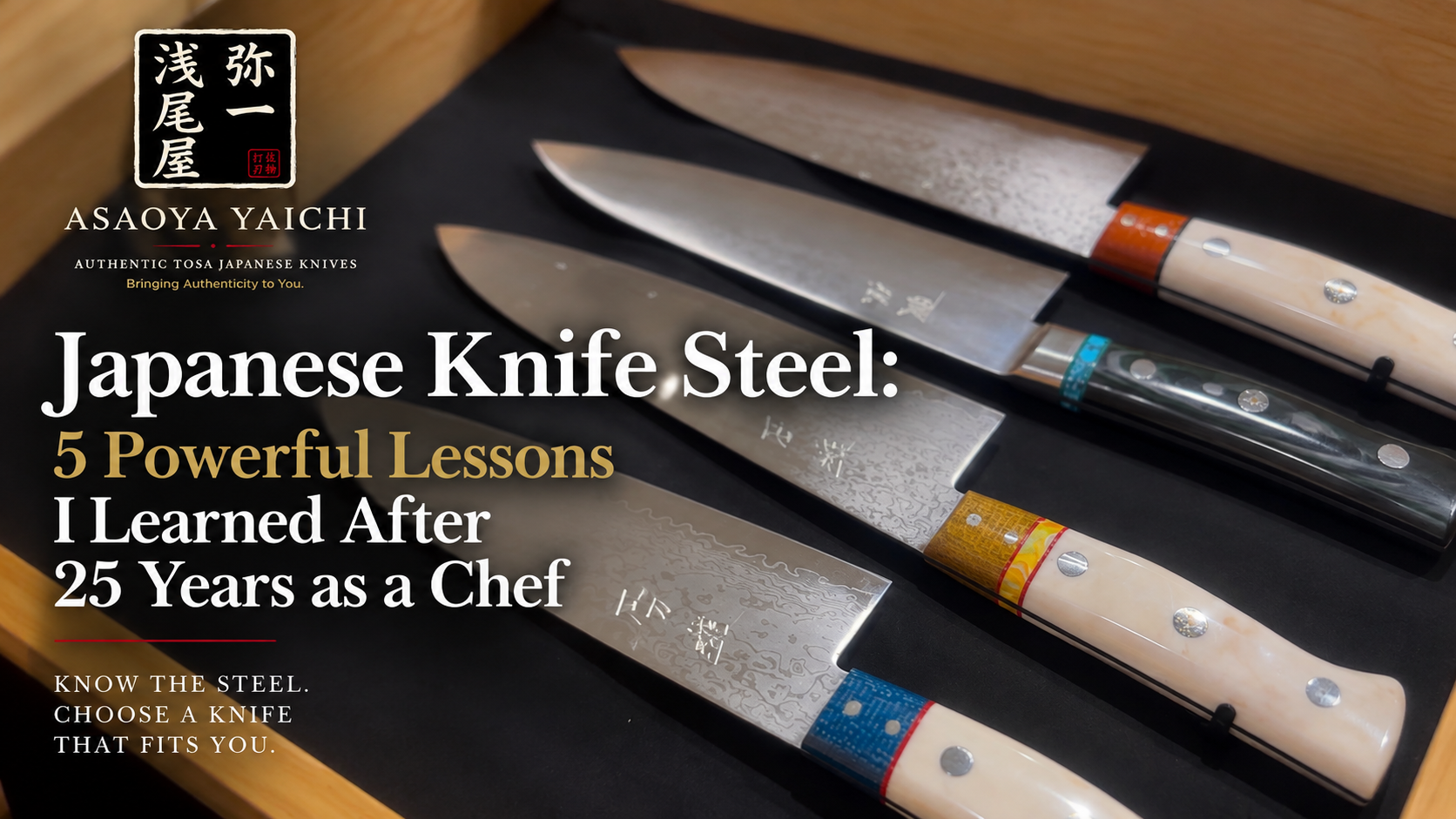
At Asaoya Yaichi, we currently have four different variations available, featuring red, orange, yellow, and blue spacers.
We have only one knife available in each colour.
The 180mm Santoku is also a practical choice for everyday cooking.
Personally, I believe 180mm is a very comfortable size for home kitchens. It is long enough for most everyday preparation while remaining manageable for people who may find a larger Gyuto slightly intimidating.
Vegetables, meat, and fish can all be prepared comfortably with this type of knife.
Another advantage is the VG10N stainless steel blade. Compared with traditional carbon steel, it is relatively easy to maintain because of its corrosion resistance.
Of course, even stainless steel knives should always be cleaned and dried properly.
For someone who enjoys cooking and appreciates beautiful kitchen tools, I believe this would make an exceptional Christmas present.
Personally, I find the combination of the Damascus blade and colourful handle particularly attractive.
It is certainly one of my favourites.
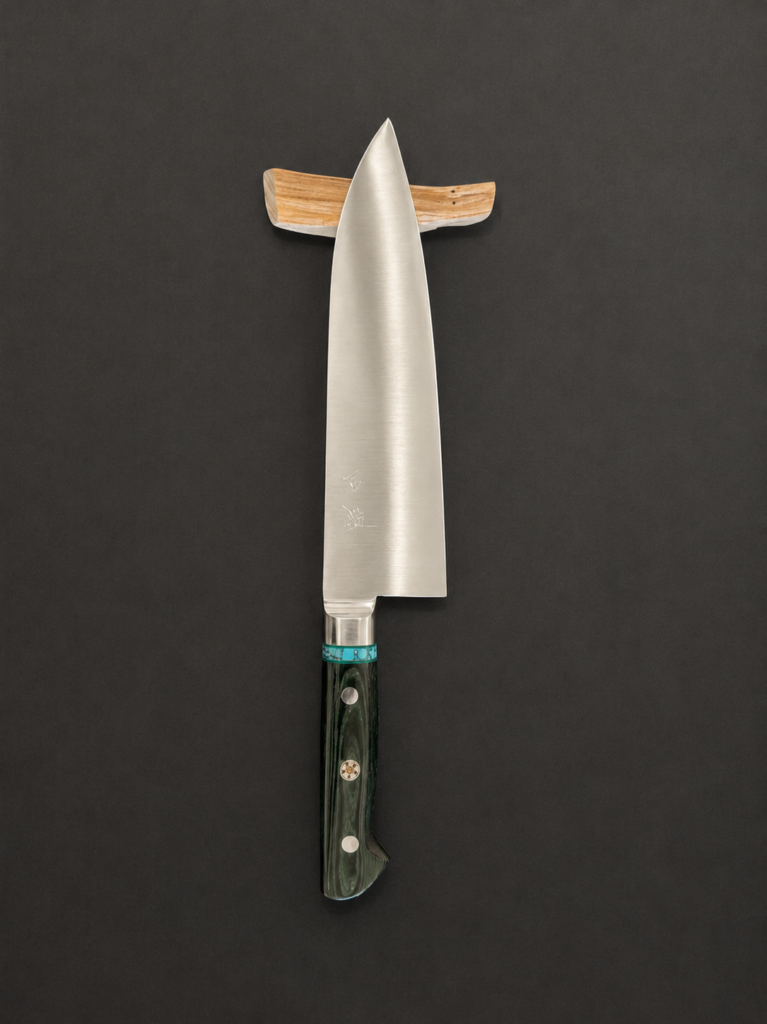
Japanese Knife Christmas Gift No. 2 — 180mm Santoku Aogami #2 Green Micarta Handle with Turquoise Spacer
My second recommendation has a completely different character.
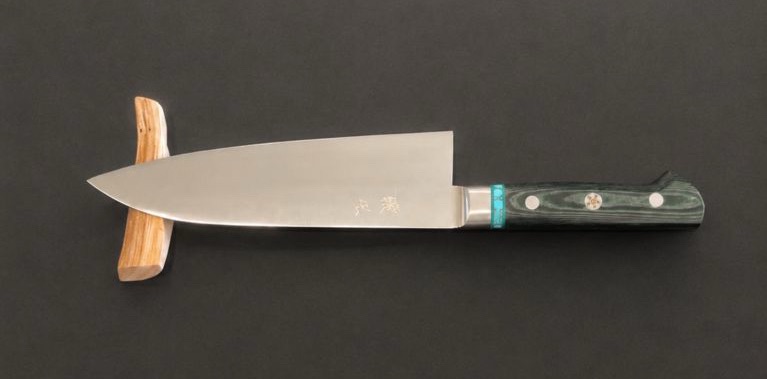
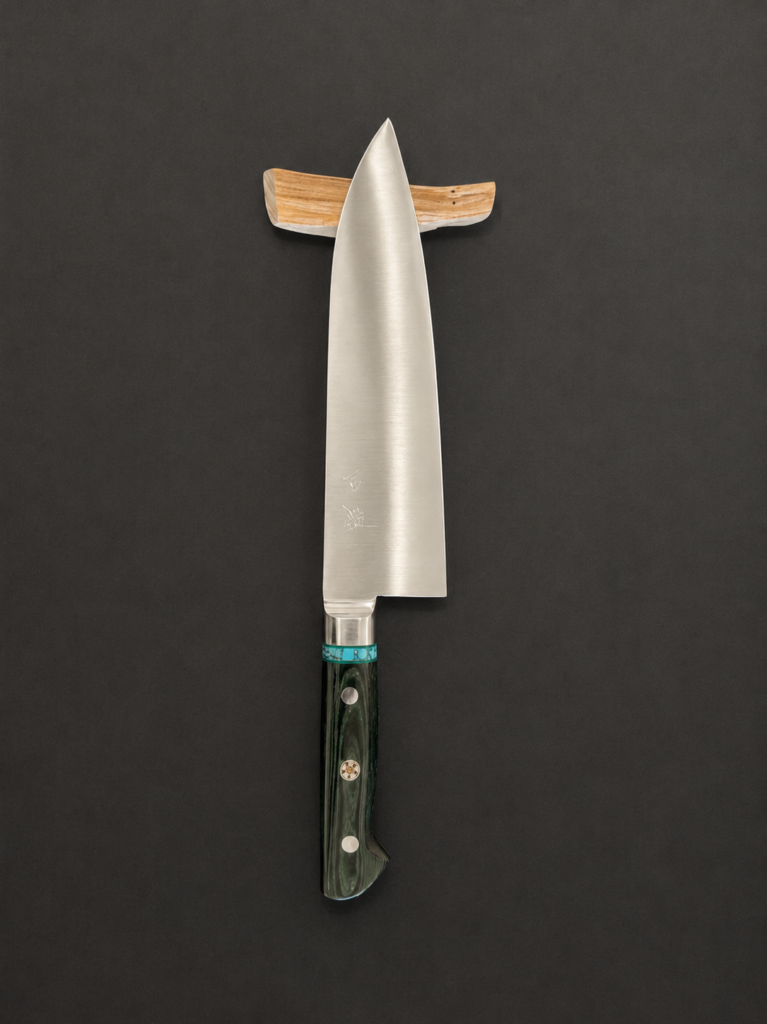
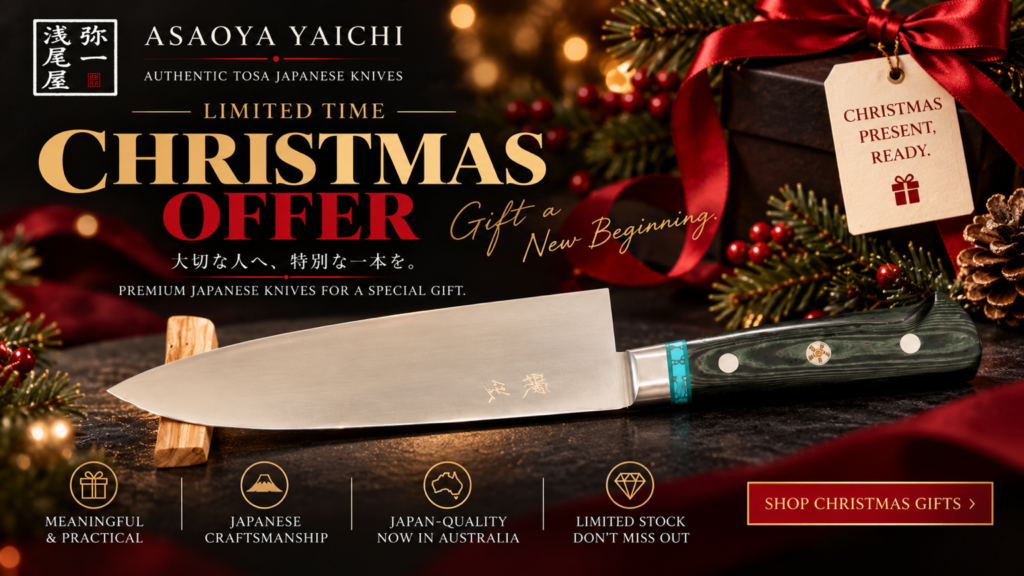
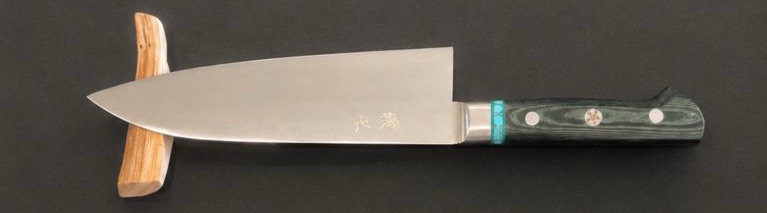
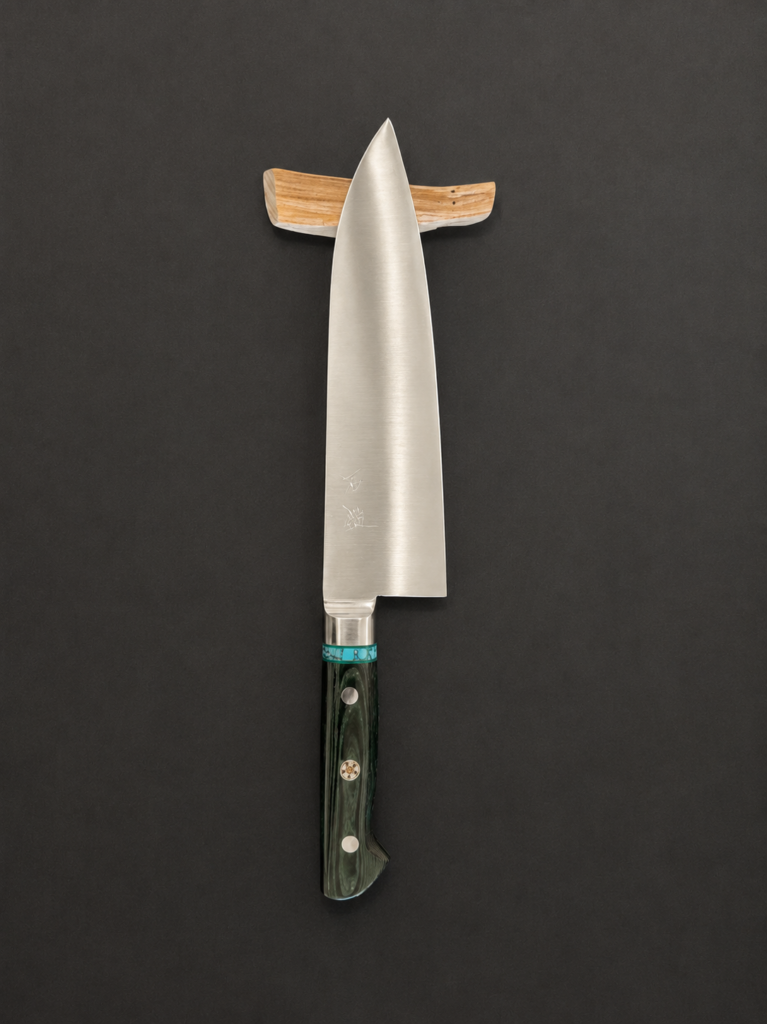
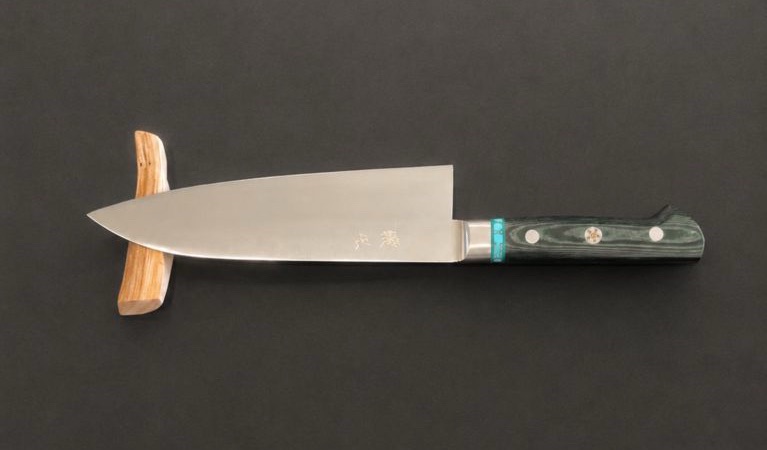
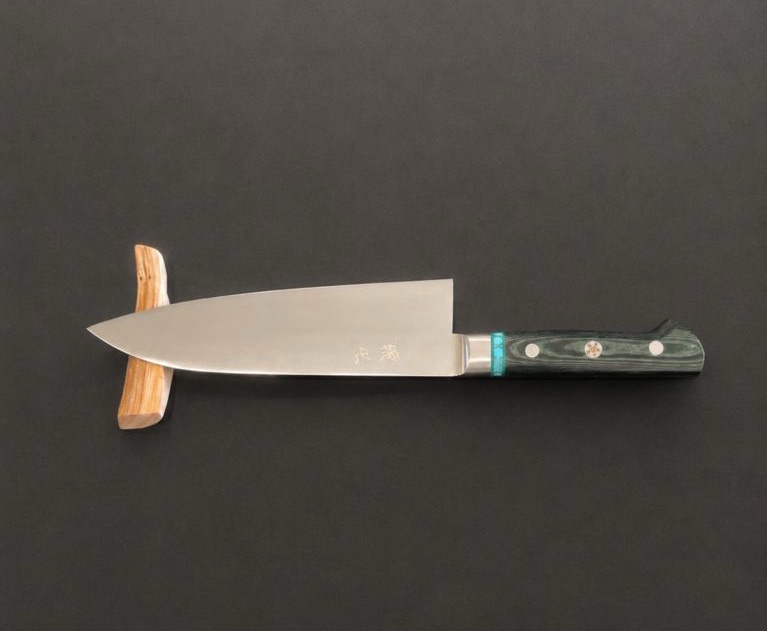
This 180mm Santoku features Aogami #2 carbon steel, a beautiful green Micarta handle, and a striking turquoise spacer.
Like my first recommendation, this knife comes from a blacksmith whose work is available only in limited quantities through our supplier.
Personally, I find the combination of the deep green handle and turquoise spacer particularly beautiful.
There is something about its appearance that reminds me of the Japanese aesthetic of wabi-sabi, an appreciation of simplicity, character, and understated beauty.
However, the real attraction of this knife is not just its appearance.
Aogami #2 is a traditional Japanese carbon steel appreciated for its cutting performance and sharpening characteristics.
Over the years, I have used several different carbon steel knives in professional kitchens, and I still enjoy the feeling of a well-maintained carbon steel edge.
There is something satisfying about using a knife that requires a little care but rewards that attention with excellent cutting performance.
However, carbon steel is not necessarily the best choice for everyone.
Unlike stainless steel, Aogami #2 can develop patina and rust if it is left wet or poorly maintained.
For that reason, I would recommend this knife to someone who already understands basic knife maintenance or genuinely enjoys looking after their kitchen tools.
If you are interested in learning more about the differences between Japanese knife steels, I have discussed this subject in my article about Japanese Knife Steel.
For the right person, this knife offers a wonderful combination of traditional Japanese steel and contemporary design.
Japanese Knife Christmas Gift No. 3 — VG10 Polished Hammered 67 Layer Damascus Green Handle Series
My third recommendation is particularly interesting because it offers the opportunity to create a matching knife set.
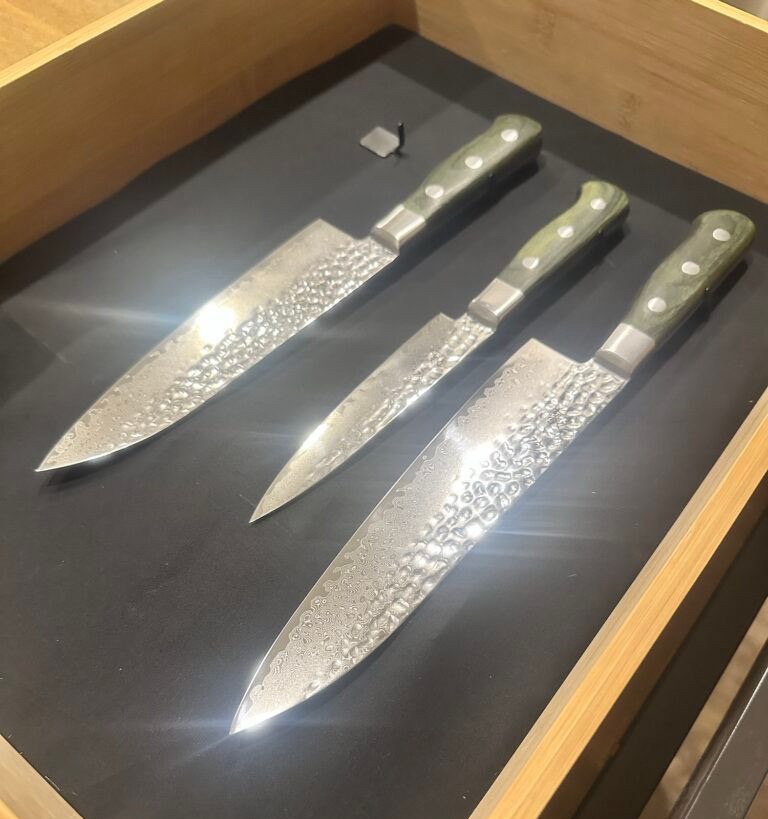
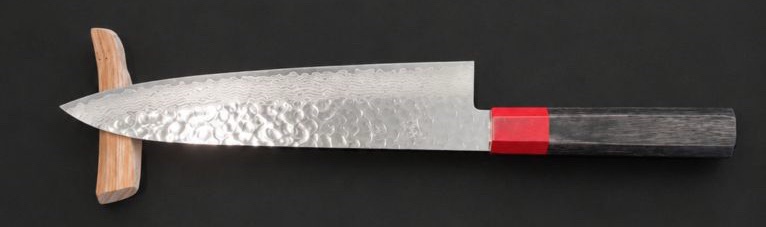
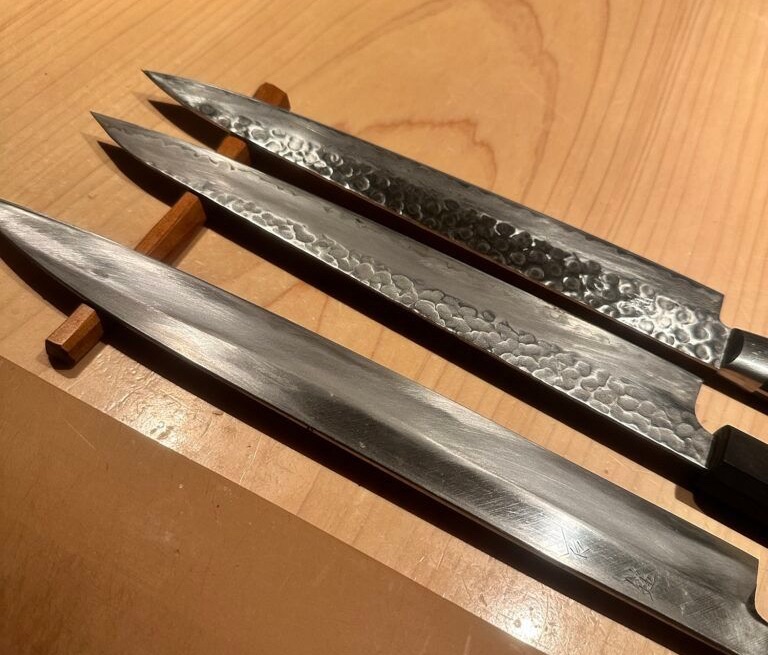
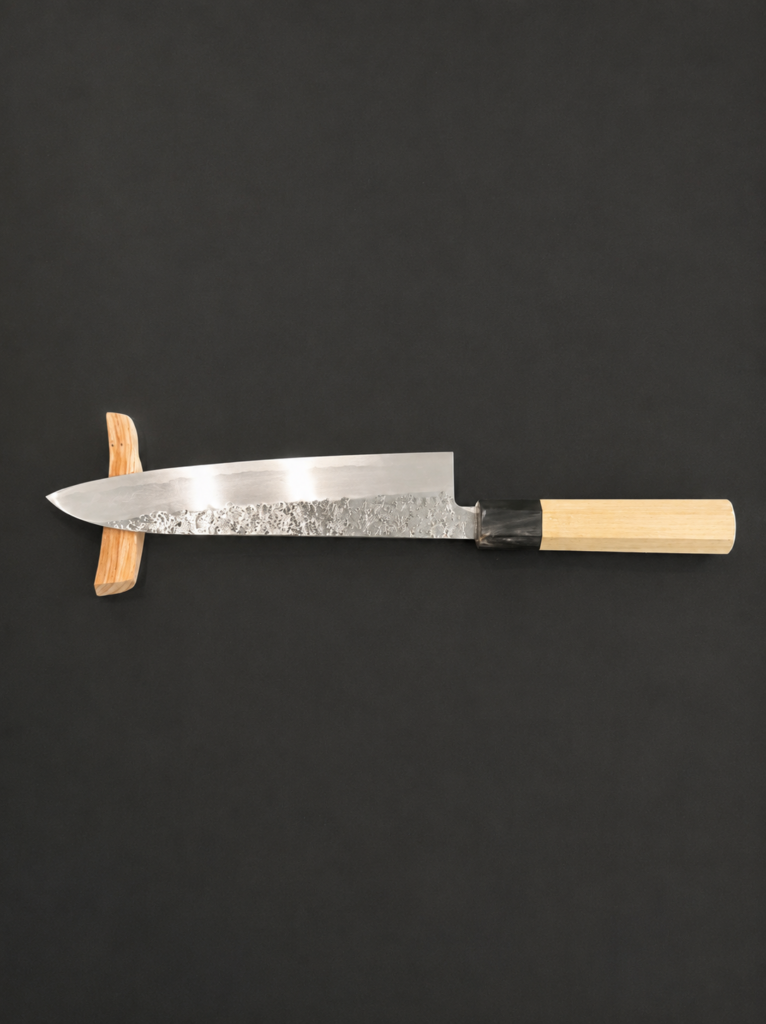
This beautiful VG10 series features a polished hammered finish, 67-layer Damascus construction, and elegant green handles.
At Asaoya Yaichi, we offer three different knives from this collection: a 180mm Santoku, a 210mm Gyuto, and a 135mm Petty.
All three are attractive knives individually, but I think they become even more interesting when considered as Christmas gifts.
For example, combining a Santoku with a Petty would make a beautiful and practical present for someone who enjoys cooking at home.
The Santoku can handle most everyday food preparation, while the smaller Petty is useful for more delicate work.
Alternatively, a 210mm Gyuto and 135mm Petty would be an excellent combination for someone who prefers a slightly longer main knife.
Personally, I do not think most home cooks need both a Santoku and a Gyuto from the same series.
Their uses overlap considerably, and I would rather recommend two knives that complement each other.
After working in professional kitchens for more than 25 years, I have come to appreciate the importance of choosing knives according to the work they actually need to perform.
A larger collection is not necessarily a better collection.
In fact, two carefully selected knives can be more useful than several knives that perform almost identical tasks.
My fourth recommendation is for someone who appreciates the traditional appearance of Japanese knives.
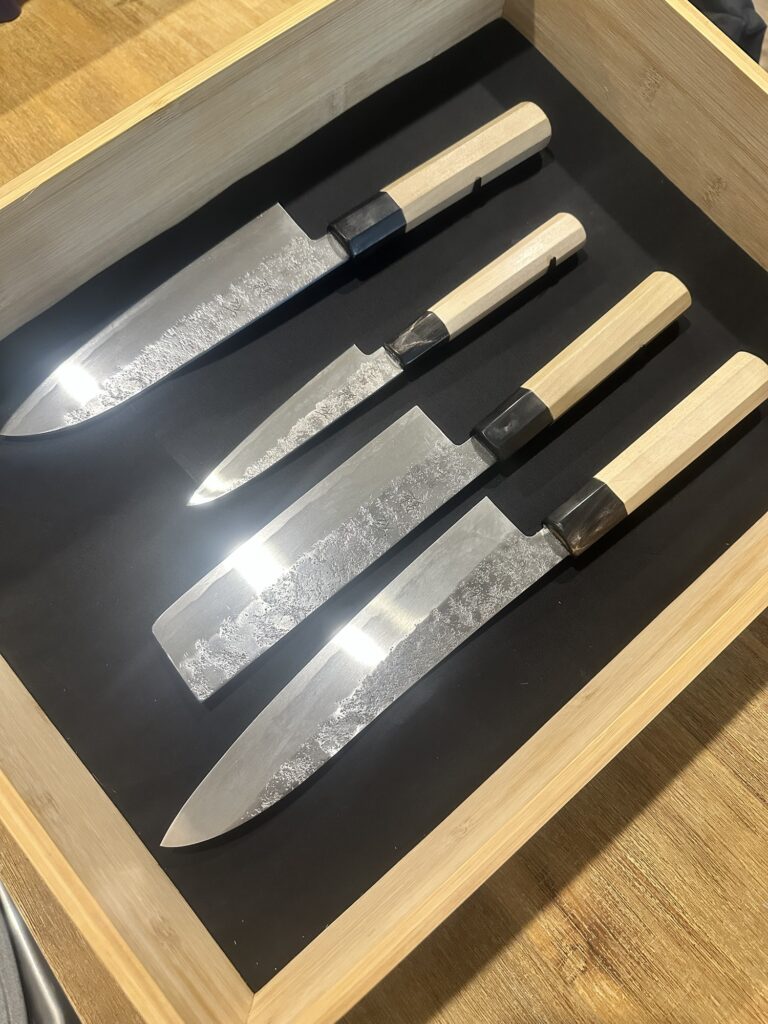
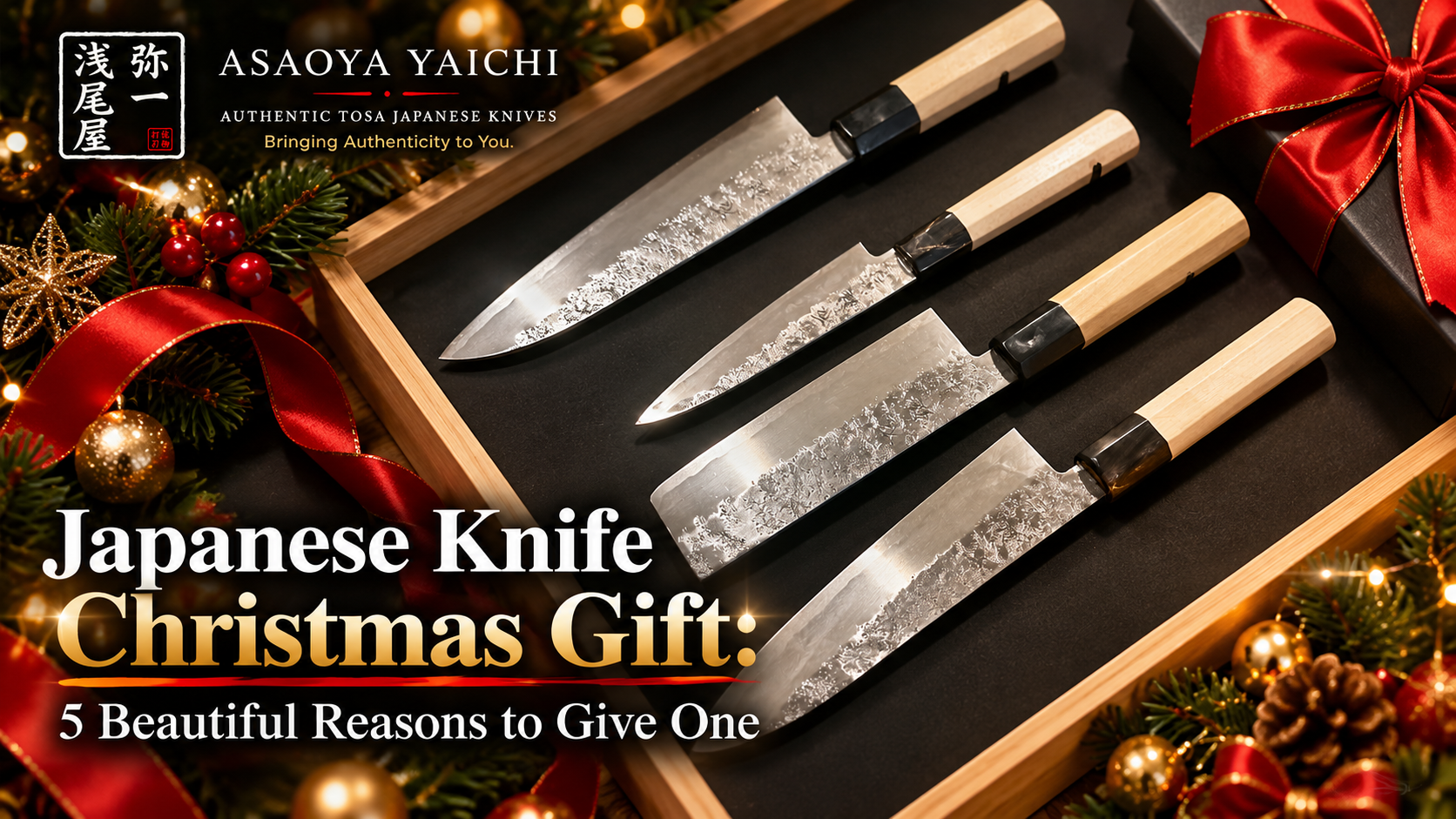
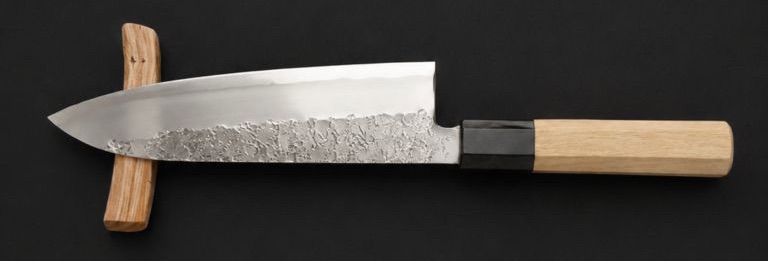
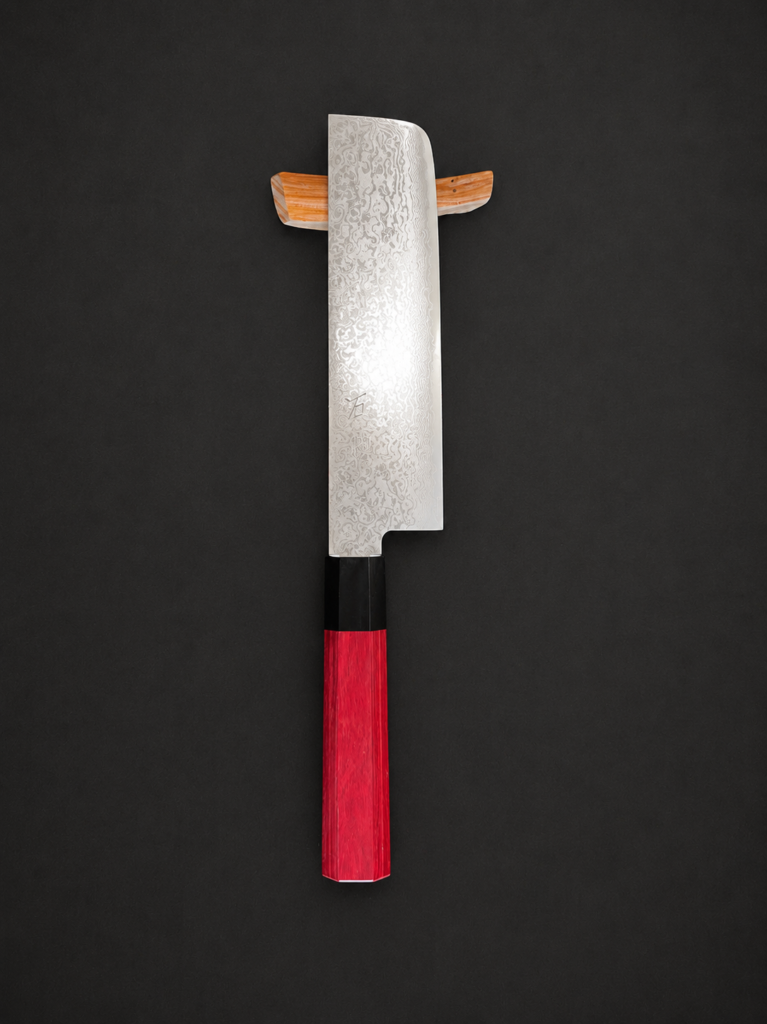
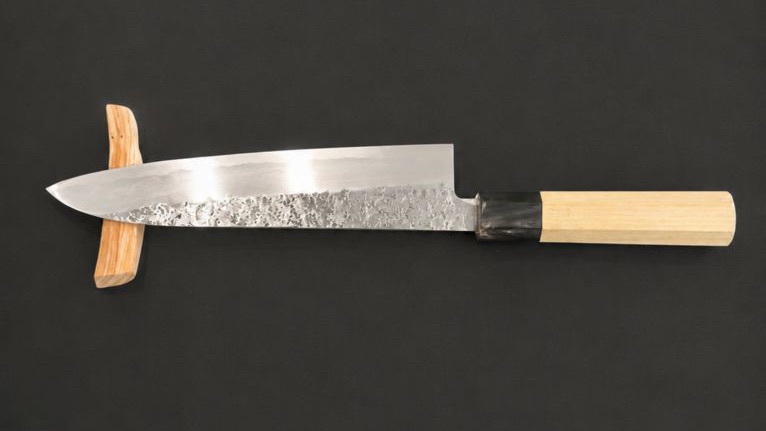
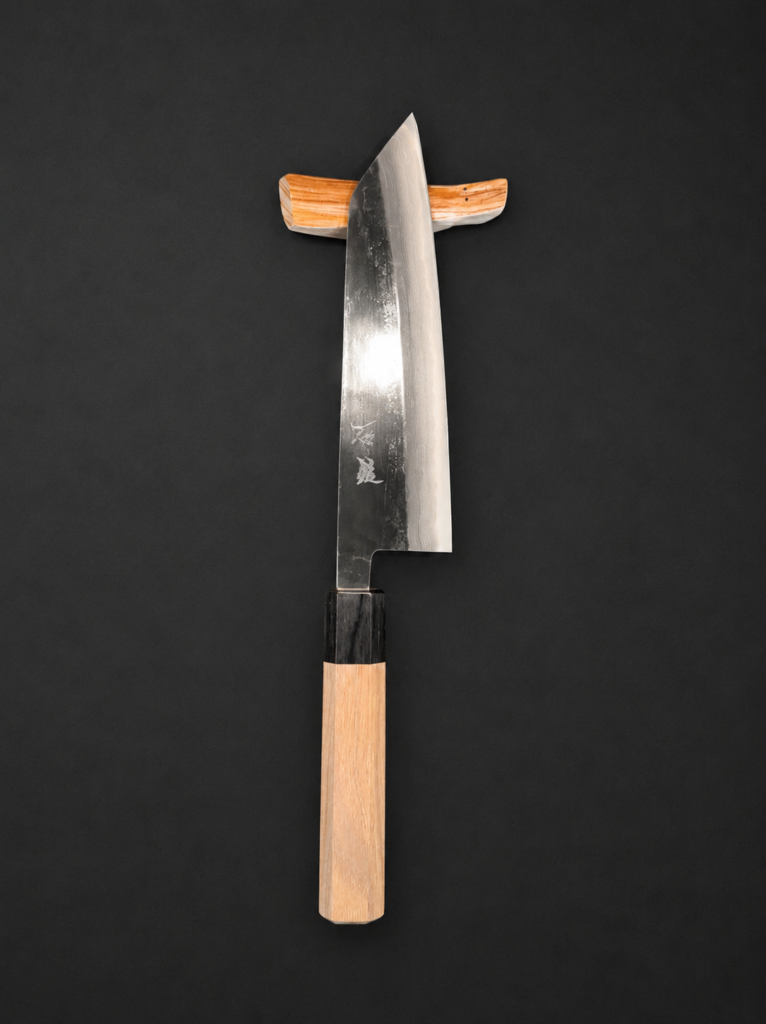
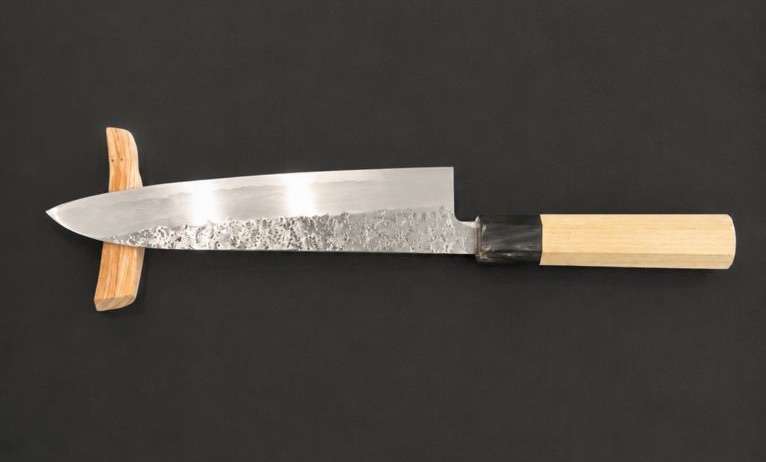
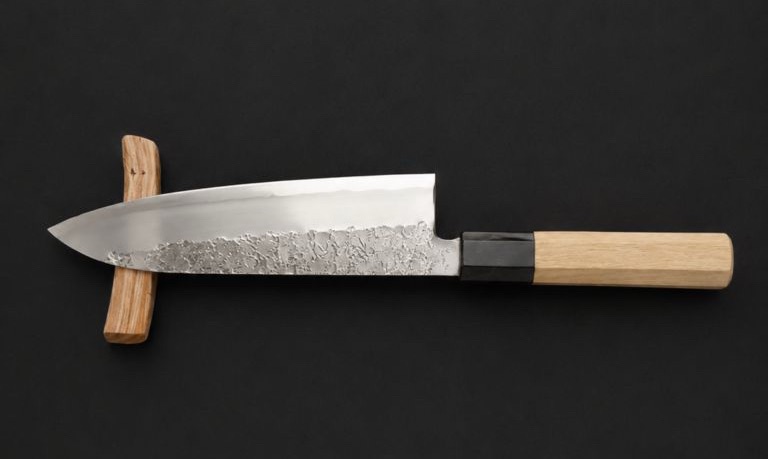
This series features Ginsan stainless steel, a Nashiji blade finish, and a traditional octagonal magnolia wood handle with a buffalo horn ferrule.
The appearance is unmistakably Japanese.
Personally, I find the simplicity of this design particularly appealing.
Unlike the colourful handles of my earlier recommendations, this series has a more traditional character.
There is no need for elaborate decoration. The forged blade, textured finish, and natural wooden handle already give the knife a beautiful presence.
At Asaoya Yaichi, we offer four different knives from this collection: a 210mm Gyuto, 180mm Santoku, 165mm Nakiri, and 120mm Petty.
Once again, combining two complementary knives could make a wonderful Christmas present.
For example, a Santoku and Petty would provide a versatile combination for everyday home cooking.
A Gyuto and Petty would also be an excellent choice for someone who prefers a longer main knife.
Alternatively, someone who enjoys preparing vegetables might appreciate the traditional appearance and specialised shape of the Nakiri.
Ginsan is an interesting steel because it combines good corrosion resistance with cutting and sharpening characteristics appreciated by many Japanese knife enthusiasts.
For someone who likes traditional Japanese knives but does not want the additional maintenance associated with carbon steel, I think Ginsan is well worth considering.
I have previously written about this steel in my article about Ginsan Steel.
The Nashiji finish is another distinctive feature of this series.
Nashiji literally refers to a pear-skin-like texture, and it gives the blade a traditional, understated appearance.
If you would like to learn more about this finish, you can also read What Does Nashiji Mean on a Japanese Knife?
If the person receiving your gift appreciates traditional Japanese craftsmanship, this series would certainly be worth considering.
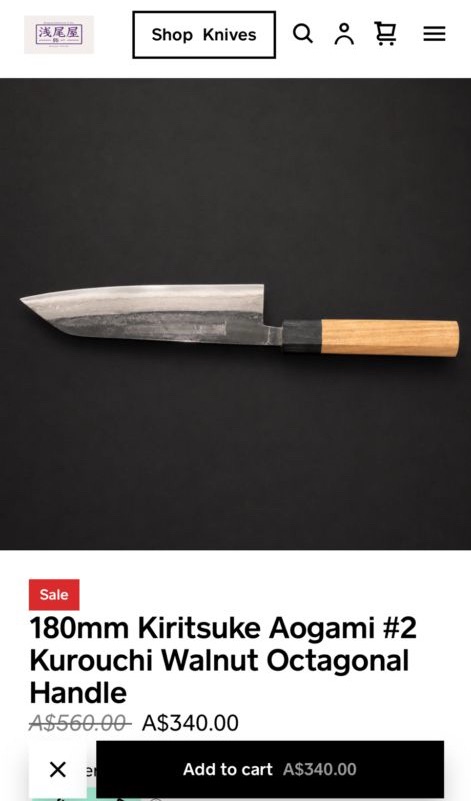
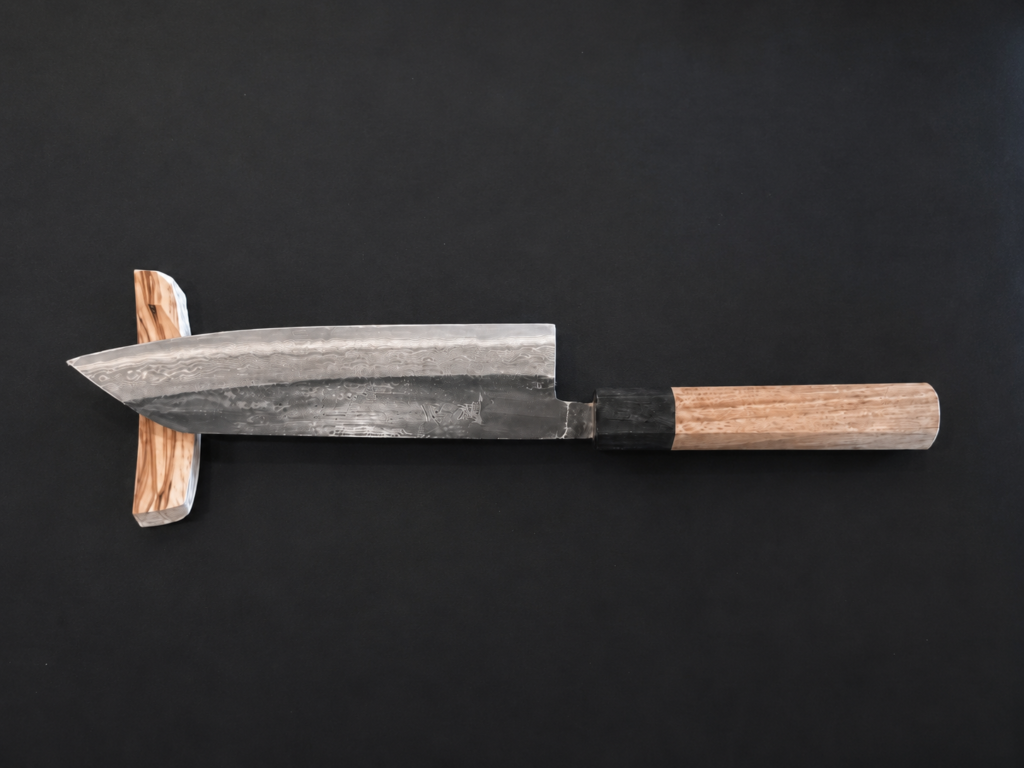
Japanese Knife Christmas Gift No. 5 — 180mm Kiritsuke Aogami #2 Kurouchi Walnut Octagonal Handle
For an experienced cook or professional chef, I believe this would be a particularly memorable Christmas gift.
Which Japanese Knife Christmas Gift Would I Personally Choose?
After introducing these five recommendations, you might be wondering which one I would personally choose.
The answer depends entirely on the person receiving the gift.
If I were choosing a knife for someone who had never owned a Japanese knife before, I would probably start with the VG10N Damascus Santoku or the VG10 hammered Damascus series.
Both offer beautiful designs, practical blade shapes, and relatively straightforward maintenance.
For someone who appreciates traditional Japanese craftsmanship, I would strongly consider the Ginsan Nashiji series.
Its appearance is beautifully Japanese, and its stainless steel blade makes it a practical choice for everyday use.
For an experienced cook who enjoys traditional carbon steel, the Aogami #2 Santoku or Kurouchi Kiritsuke would be particularly appealing.
Personally, I have always believed that choosing a knife should begin with understanding how it will be used.
A professional chef and someone who cooks occasionally at home may have completely different requirements.
Even two professional chefs can have very different preferences.
That is why I do not believe there is one perfect knife for everyone.
The best Japanese Knife Christmas Gift is not necessarily the most expensive knife or the one with the most elaborate design.
It is the knife that suits the person receiving it.
After more than 25 years working in professional kitchens, that is still one of the most important lessons I would share.
Christmas Sale Begins Wednesday, 14 October 2026!
Our limited-time Christmas Sale officially begins at 12:00 AM on Wednesday, 14 October 2026 (Queensland time).
This is a wonderful opportunity to discover our carefully selected range of authentic Japanese knives.
Some of the knives featured in today’s article are available in very limited quantities.
In particular, our VG10N 33 Layer Damascus Rainbow Spacer series currently has only one knife available in each colour.
Once these knives are sold, we cannot guarantee when the same models will become available again.
If you are considering a Japanese knife as a Christmas present this year, I encourage you to explore our collection before the sale begins.
At Asaoya Yaichi, we carefully select Japanese knives that we believe offer genuine quality, beautiful craftsmanship, and lasting value.
Whether you are purchasing your first Japanese knife, choosing a present for someone special, or adding another knife to your own collection, I hope you find something that brings enjoyment to your kitchen.
A carefully chosen Japanese knife can become much more than a Christmas present.
It can become a trusted kitchen companion for many years to come.
Thank you for reading, and I hope to see you again in the next story.
—————————————————
Where to See and Buy Our Knives
Our Partner Stores
Chanoyu — Nerang, Gold Coast
Visit Chanoyu and See Our Japanese Knives
If you are on the Gold Coast, we would love you to visit Chanoyu, a Japanese café in Nerang where you can see and purchase a selection of Asaoya Yaichi knives in person.
Chanoyu is a lovely place to slow down and enjoy Japanese-inspired food, excellent matcha, coffee and handmade desserts. Its warm, peaceful atmosphere makes it a pleasure to visit, whether you are stopping in for breakfast, lunch or something sweet. We are delighted that our knives have a place there.
The selection of knives on display may change. If you are interested in a particular Asaoya Yaichi knife, please contact us through https://asaoyayaichi.com.au before visiting, and we will help you check whether it is available at Chanoyu.
In Japan, giving a knife can have a meaning that surprises people unfamiliar with Japanese culture.
Although knives are sometimes associated with cutting relationships, they can also symbolise cutting away misfortune, overcoming difficulties, and opening a new path in life.
A knife can therefore represent a fresh beginning.
For someone moving into a new home, starting a new career, getting married, or beginning another chapter of life, this symbolism can make a thoughtful gift.
Of course, traditions and personal beliefs vary, but I find this positive interpretation particularly beautiful.
A Japanese Knife Christmas Gift can express your hope that someone will enjoy a wonderful future.
2. A Japanese Knife Christmas Gift Can Last for Many Years
Many Christmas presents are exciting when first opened but gradually lose their appeal.
A well-made Japanese knife is different.
With proper care and occasional sharpening, a quality knife can remain useful for many years.
I have personal experience with this.
My mother has owned a Japanese Yanagiba knife for approximately 40 years. I used that same knife for around 20 years before it became part of her kitchen again.
That experience taught me something important.
The value of a knife is not necessarily determined by how expensive it is when purchased, but by how long it continues to serve its owner.
A knife that accompanies someone through years of cooking can eventually become something surprisingly personal.
3. Japanese Craftsmanship Makes the Gift Special
Japanese knives are admired around the world for their craftsmanship, materials, and attention to detail.
However, I believe their greatest appeal lies in the people behind them.
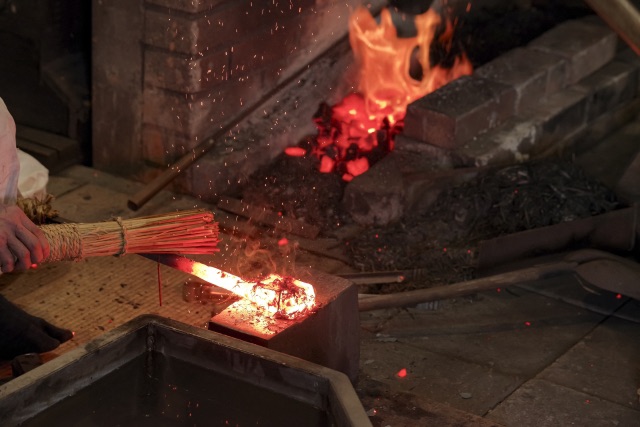
Many Japanese knife-making traditions have developed over generations, with craftspeople continuing to refine techniques that require considerable experience and dedication.
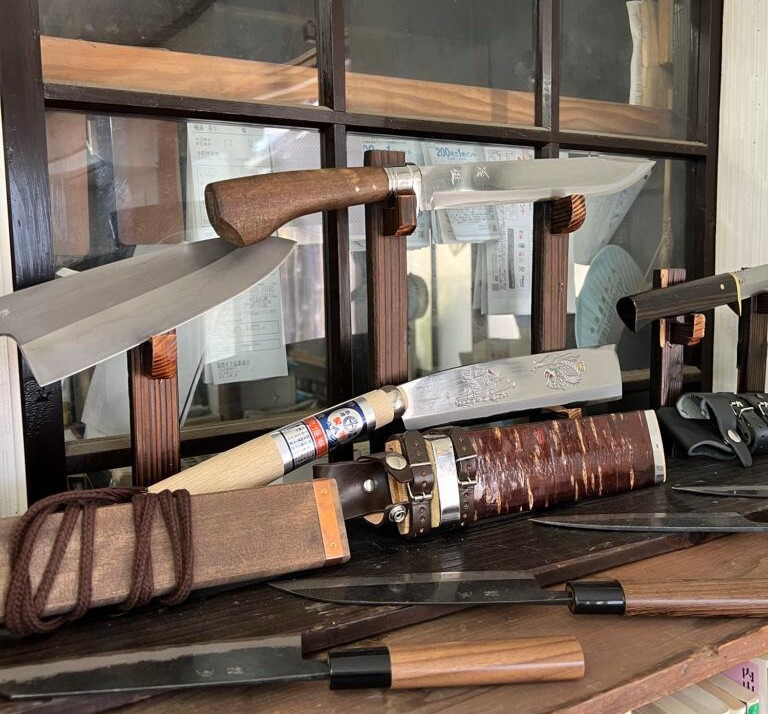
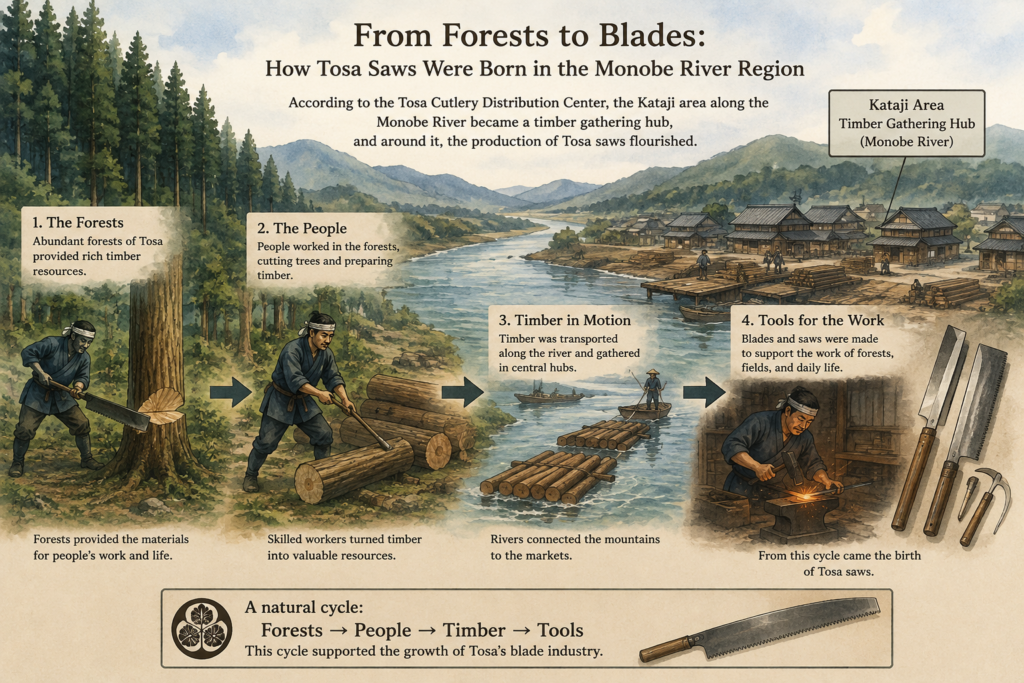
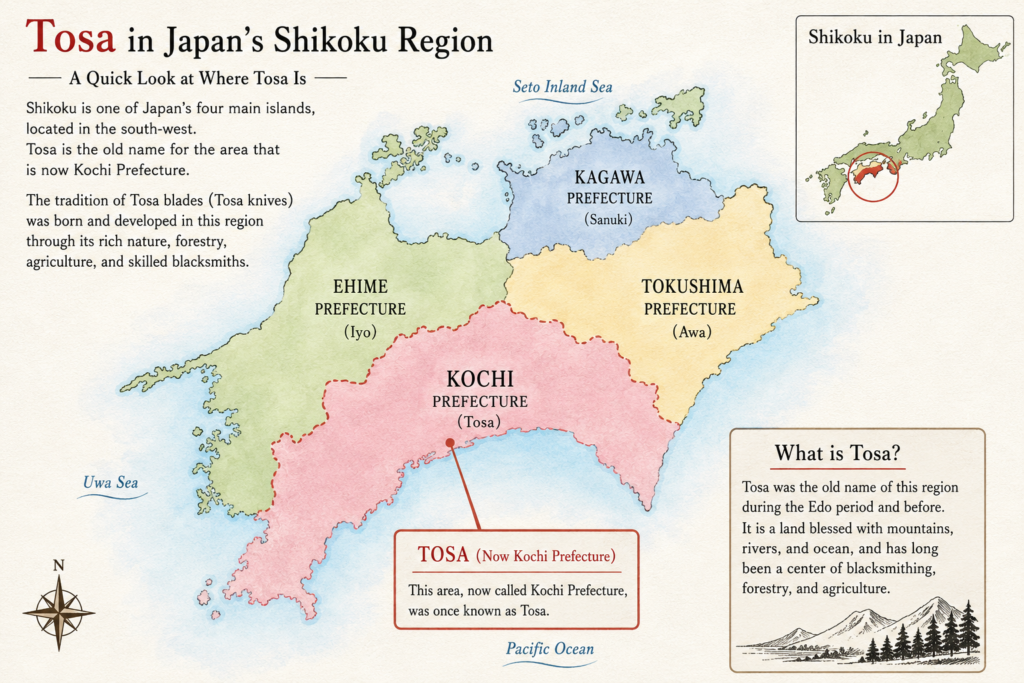
At Asaoya Yaichi, we particularly value knives produced in Tosa, Japan.
Tosa has a long history of blade-making, and its traditional blacksmithing culture remains an important part of Japanese craftsmanship.
If you are interested in understanding these traditions, please read:
The most important thing is not choosing the most expensive knife.
It is choosing something that suits the recipient’s cooking habits and experience.
That is what makes selecting a Japanese knife as a Christmas gift such a personal experience.
5. Discovering Japanese Knives in Australia Has Never Been Easier
Our Partner Store, Chanoyu
Finding authentic Japanese knives in Australia has become easier, but choosing the right knife can still feel overwhelming.
Different steels, blade shapes, handles, and price ranges can make the decision surprisingly complicated.
That is one reason I started Asaoya Yaichi.
After spending more than 25 years in professional kitchens, I wanted to share my experiences and introduce carefully selected Japanese knives to Australian customers.
If you are exploring Japanese knives for the first time, our dedicated page is a useful place to begin:
Today, I have shared why I believe a Japanese knife can make such a meaningful Christmas present.
But which knife would I actually choose?
Tomorrow, I will introduce five Japanese knife series from Asaoya Yaichi that I personally recommend as Christmas gifts, based on my experience of more than 25 years working as a professional chef.
From beautiful Damascus patterns and colourful handles to traditional Japanese carbon steel knives, each recommendation has its own character.
Some are ideal for home cooks, while others may appeal more to professional chefs or people who appreciate traditional Japanese craftsmanship.
I will also explain which knives I would recommend as matching pairs.
If you are considering a Japanese Knife Christmas Gift this year, I hope tomorrow’s article will help you find something truly special.
Thank you for reading, and I hope to see you again in the next story.
—————————————————
Where to See and Buy Our Knives
Our Partner Stores
Chanoyu — Nerang, Gold Coast
Visit Chanoyu and See Our Japanese Knives
If you are on the Gold Coast, we would love you to visit Chanoyu, a Japanese café in Nerang where you can see and purchase a selection of Asaoya Yaichi knives in person.
Chanoyu is a lovely place to slow down and enjoy Japanese-inspired food, excellent matcha, coffee and handmade desserts. Its warm, peaceful atmosphere makes it a pleasure to visit, whether you are stopping in for breakfast, lunch or something sweet. We are delighted that our knives have a place there.
The selection of knives on display may change. If you are interested in a particular Asaoya Yaichi knife, please contact us through https://asaoyayaichi.com.au before visiting, and we will help you check whether it is available at Chanoyu.
Choosing your first Japanese knife can be confusing. There are so many steels, shapes, sizes, brands and price ranges that it is easy to spend hours researching and still not know what to buy.
So let me make my answer simple.
If you are buying your first Japanese knife for general home cooking, I would start by looking at a 180mm Santoku or a 210mm Gyuto, preferably in an easy-to-maintain stainless steel such as VG10 or Ginsan.
That does not mean these are the “best” Japanese knives. It means they are practical places to start.
Interestingly, more than 25 years ago, my own first Japanese knives were quite similar to what I would still recommend today.
If you are looking for Japanese knives in Australia, you can also explore our current range here:
The first Japanese knives I bought for myself were a 210mm Damascus Gyuto and a Petty knife from the same series. If I remember correctly, the steel was probably VG10.
At the time, I certainly did not understand knife steels the way I do now. I was not comparing every specification or thinking deeply about hardness, edge retention or steel composition.
I simply bought knives that I wanted to use.
Looking back after more than 25 years in professional kitchens, however, I think the basic combination actually made a lot of sense.
A 210mm Gyuto can handle meat, fish and vegetables. The Petty takes care of smaller and more detailed jobs. Between those two knives, you can handle a huge amount of everyday kitchen work.
For someone choosing their first Japanese knife, this is probably one of the most useful questions to answer.
If you have enough bench space and are comfortable with a slightly longer blade, I think a 210mm Gyuto is an excellent starting point. The extra blade length becomes especially useful when cutting larger pieces of meat, fish or vegetables, because you can use a longer cutting stroke.
Steel names can make buying a Japanese knife unnecessarily intimidating.
VG10, Ginsan, Blue #2, Blue Super, SG2 — the list goes on.
For a beginner, I would not start by asking which steel can become the sharpest.
I would ask: How much maintenance do you want?
For many first-time buyers, VG10 or Ginsan makes a lot of sense. Both offer excellent performance while being stainless and relatively easy to live with.
I personally enjoy carbon steels such as Blue #2, especially for certain cutting jobs. But carbon steel requires more attention to moisture and maintenance.
That does not make it unsuitable for beginners. It simply means you should understand what you are buying.
There is another reason I do not think beginners should become too obsessed with specifications or prestige.
Years ago, I took one of my knives back to a knife shop to have it sharpened.
The person there almost laughed at it.
I still remember that experience.
Maybe, from his perspective, it was not a particularly special knife. But I had bought it, used it professionally and relied on it to do my job.
That experience taught me something I still believe today.
A knife does not need to impress another knife enthusiast. It needs to work for the person holding it.
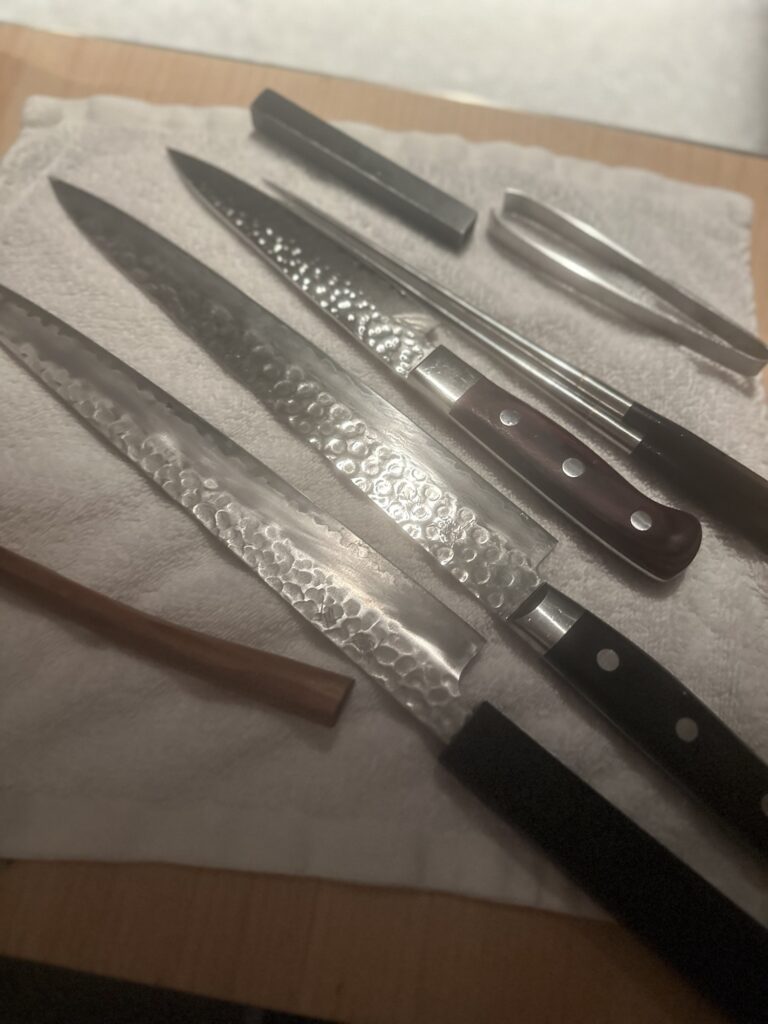
After more than 25 years as a chef, I have used carbon steel, stainless steel, Yanagiba, Gyuto, Sujihiki and many other knives. Today, one of the knives I use most at the sushi counter is a VG10 Sujihiki.
Once you have your main knife, my next choice would probably be a Petty.
A Petty around 120–135mm is useful for smaller ingredients and detailed preparation where a 180mm or 210mm knife feels unnecessarily large.
Interestingly, this is also what I did with my first Japanese knives: a Gyuto and a Petty.
I did not understand it this way at the time, but looking back, they complemented each other extremely well.
My Advice for Choosing Your First Japanese Knife
After more than 25 years in professional kitchens, my advice is actually simpler than it would have been when I was younger.
For general home cooking, start with a 180mm Santoku or 210mm Gyuto.
If you want easy maintenance, look seriously at VG10 or Ginsan.
Then, if you want a second knife, consider a 120–135mm Petty.
If you mainly prepare vegetables, a Nakiri may make more sense. If you regularly slice fish or meat in long clean strokes, you may eventually want to explore a Sujihiki.
But you do not need to start there.
When choosing your first Japanese knife, do not worry too much about owning the knife with the highest hardness, the most expensive steel or the most impressive specifications.
Start with a knife that fits your kitchen and the food you actually cook.
More than 25 years after buying my first 210mm Gyuto and Petty, that is still where I would begin.
Thank you for reading, and I hope to see you again in the next story.
—————————————————
Where to See and Buy Our Knives
Our Partner Stores
Chanoyu — Nerang, Gold Coast
Visit Chanoyu and See Our Japanese Knives
If you are on the Gold Coast, we would love you to visit Chanoyu, a Japanese café in Nerang where you can see and purchase a selection of Asaoya Yaichi knives in person.
Chanoyu is a lovely place to slow down and enjoy Japanese-inspired food, excellent matcha, coffee and handmade desserts. Its warm, peaceful atmosphere makes it a pleasure to visit, whether you are stopping in for breakfast, lunch or something sweet. We are delighted that our knives have a place there.
The selection of knives on display may change. If you are interested in a particular Asaoya Yaichi knife, please contact us through https://asaoyayaichi.com.au before visiting, and we will help you check whether it is available at Chanoyu.
Carbon Steel Japanese Knives are often described as difficult to maintain. They can rust, they react with certain foods, and compared with stainless steel, they certainly require a little more attention.
But after more than 25 years working as a professional chef, I don’t think carbon steel knives are as difficult to live with as many people imagine.
I currently use Aogami Super, Aogami #2 and VG10 knives in my daily work, and my experience with each one has been quite different. For me, the important thing is not trying to find a completely maintenance-free knife. It is understanding the steel you are using and learning how to look after it.
I also feel that once a carbon steel knife has developed rust, that particular knife can sometimes seem more likely to rust again.
However, that does not mean carbon steel is constantly difficult to maintain.
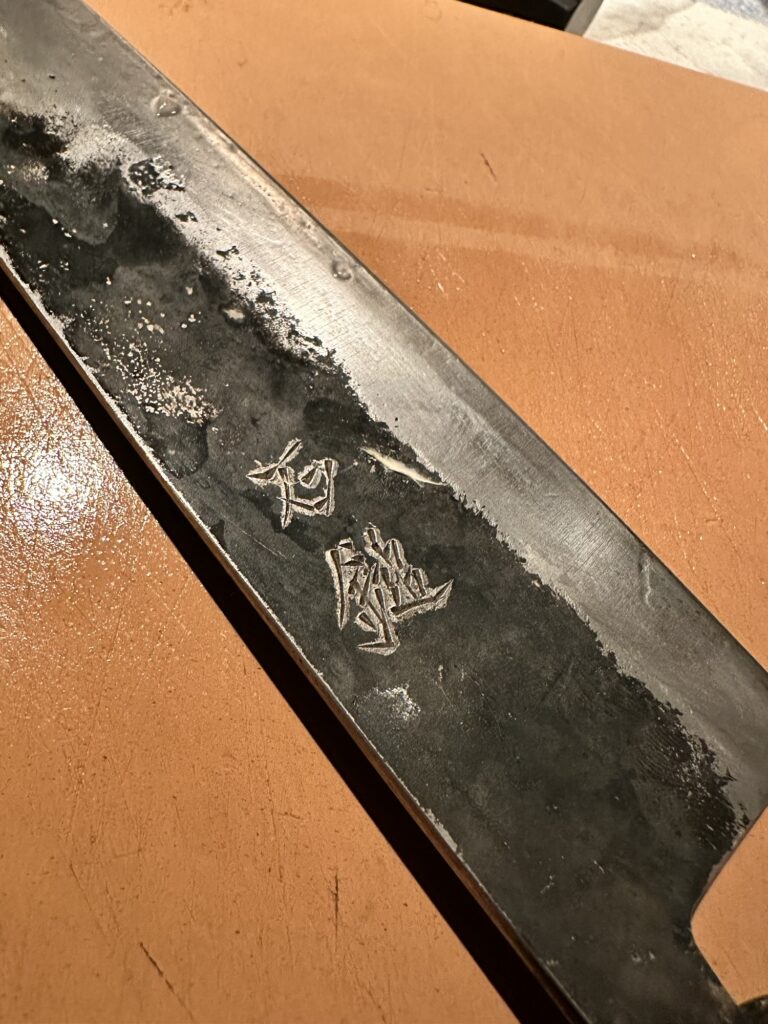
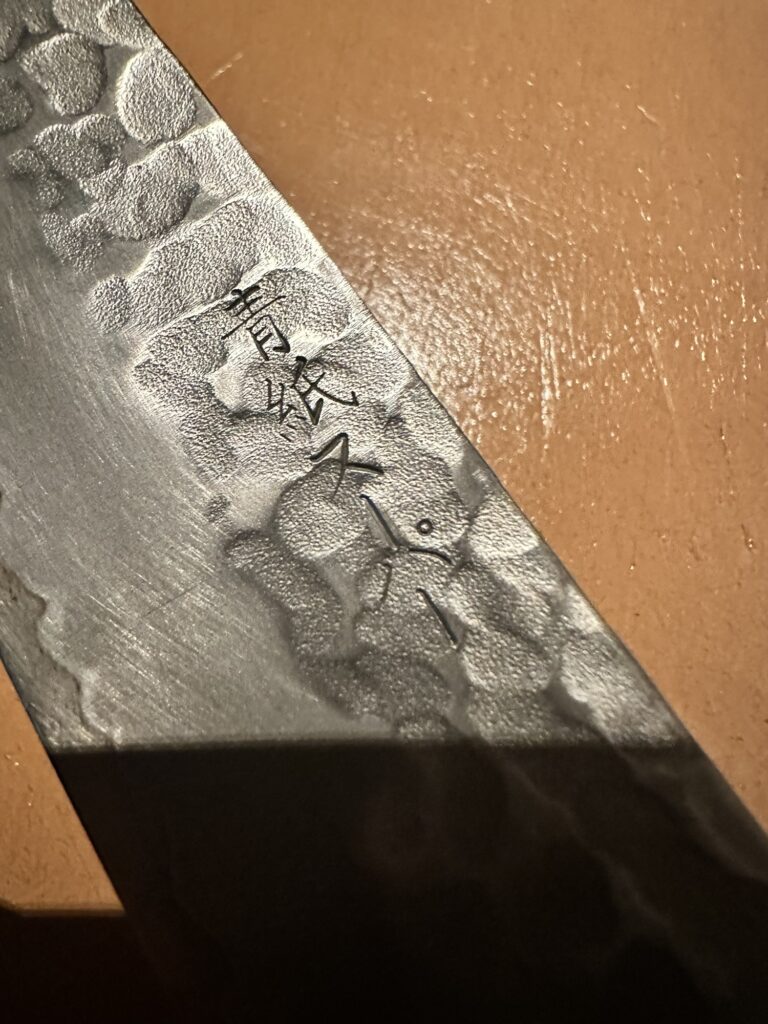
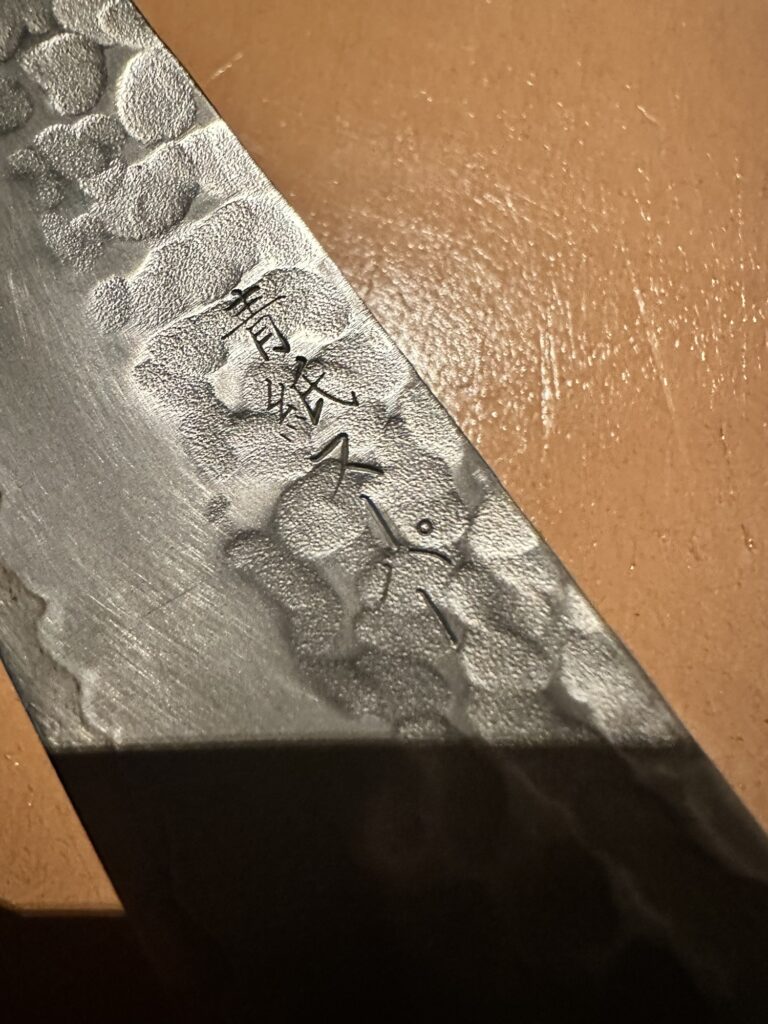
One knife I currently use regularly is an Aogami Super (青紙スーパー)sujihiki. I use it for fish, meat and vegetables, and sometimes even acidic ingredients such as lemons and limes.
My routine is extremely simple.
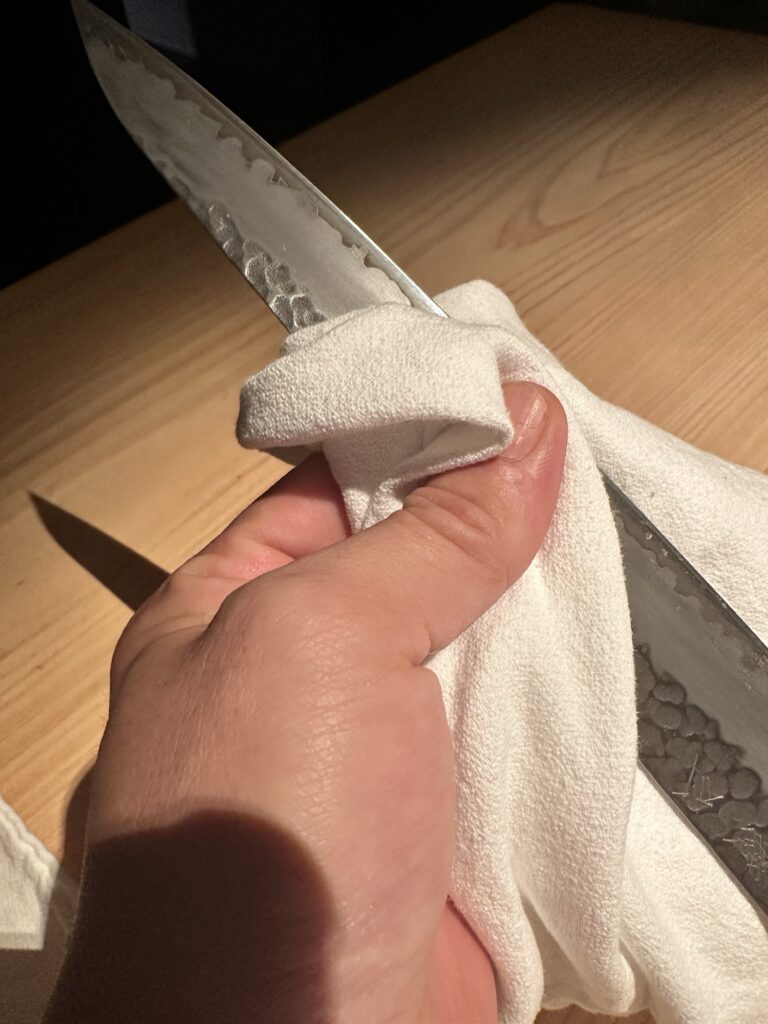
After using it, I wash it with water and immediately wipe it dry with a towel.
That’s basically it.
Despite using it constantly, rust has not been a major problem.
Perhaps the fact that I use this knife almost every day helps. It is regularly being used, washed, dried and checked rather than being left somewhere for weeks. I cannot say that daily use itself prevents rust, but in my experience, regular care makes carbon steel much easier to manage.
This knife has rusted before, and since then I have found that if I use it, wipe away the moisture and simply leave it for a long period, rust can return.
So I treat this knife differently.
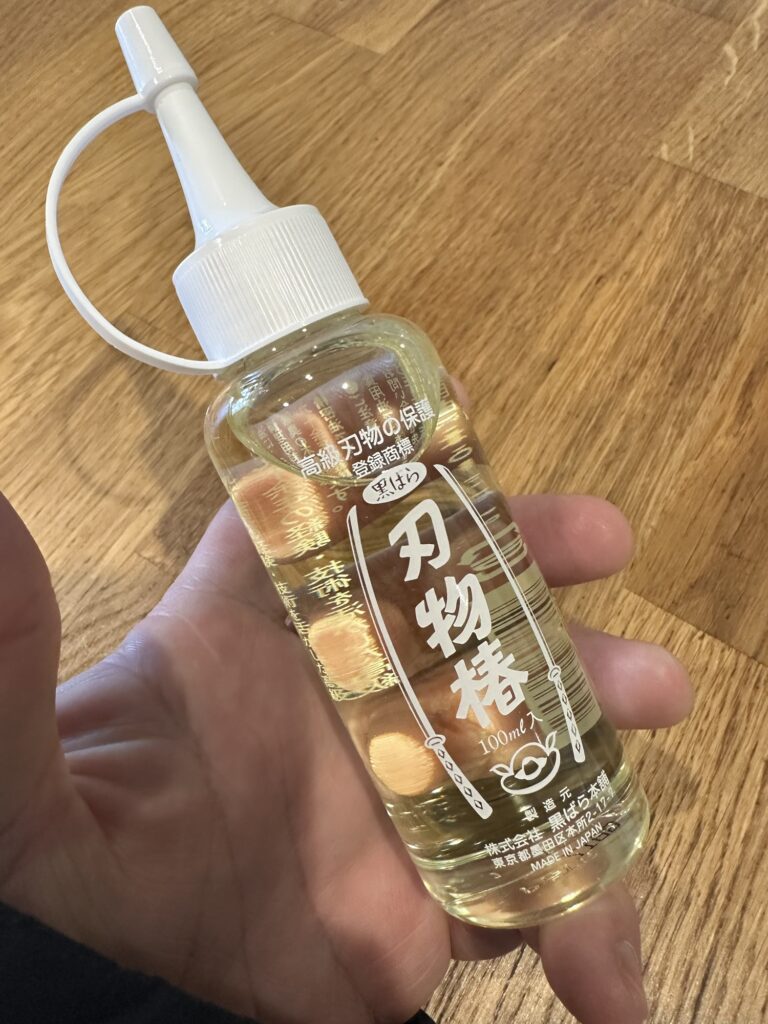
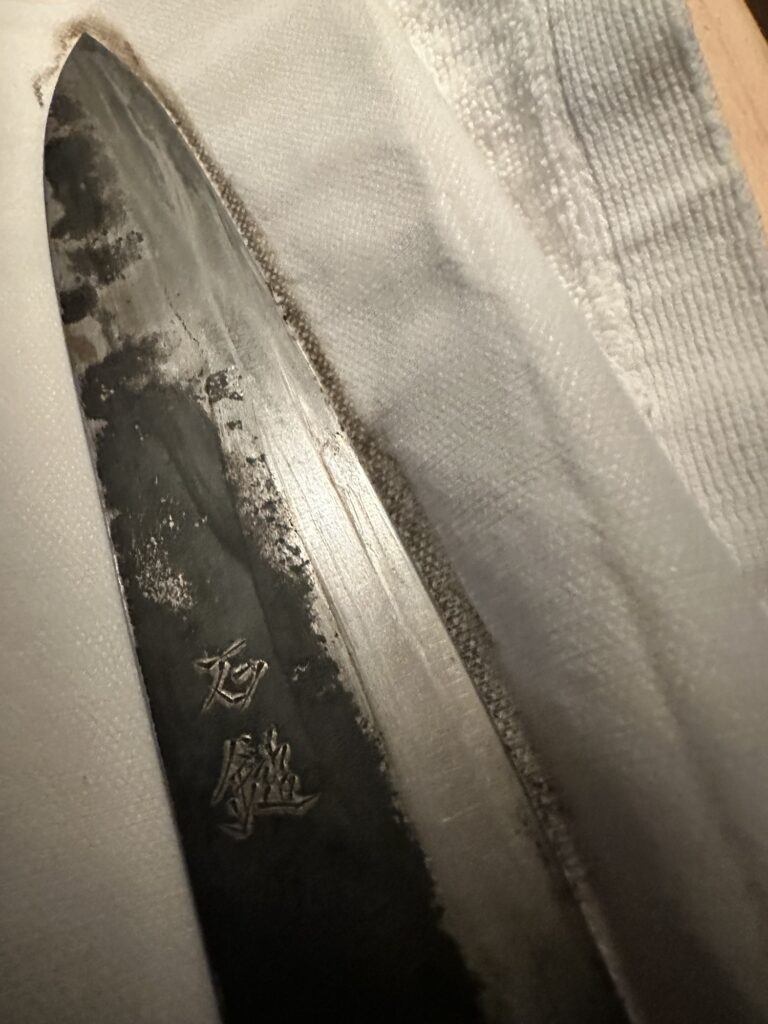
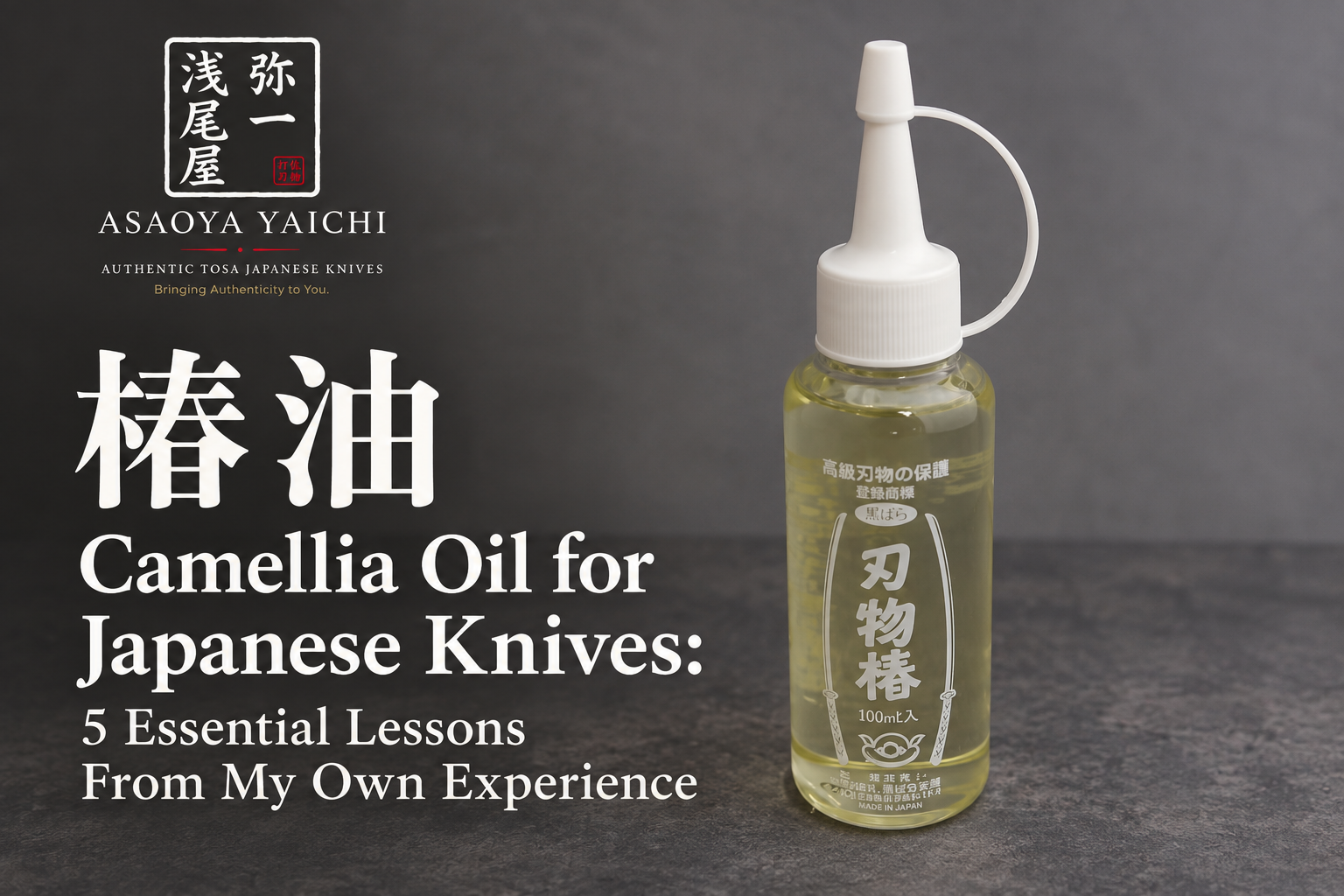
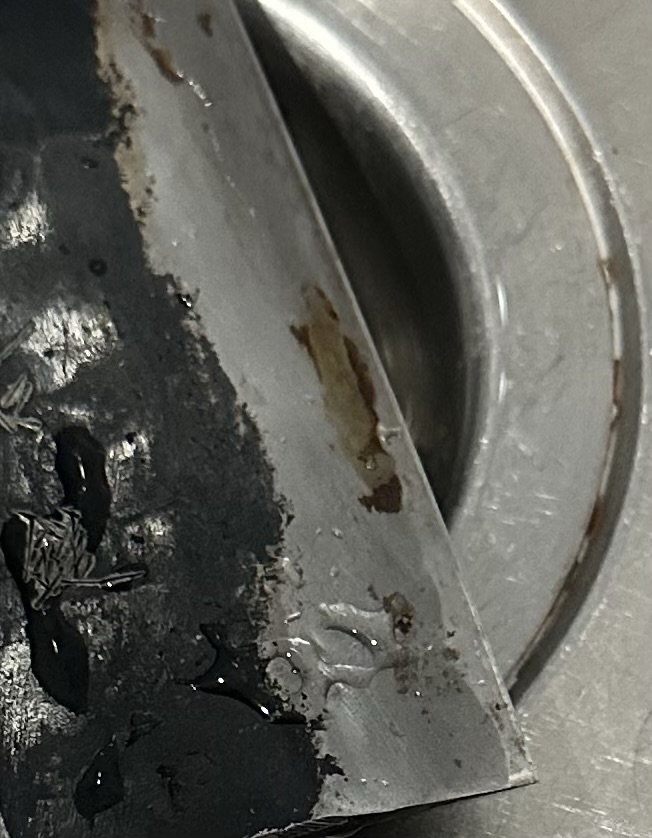
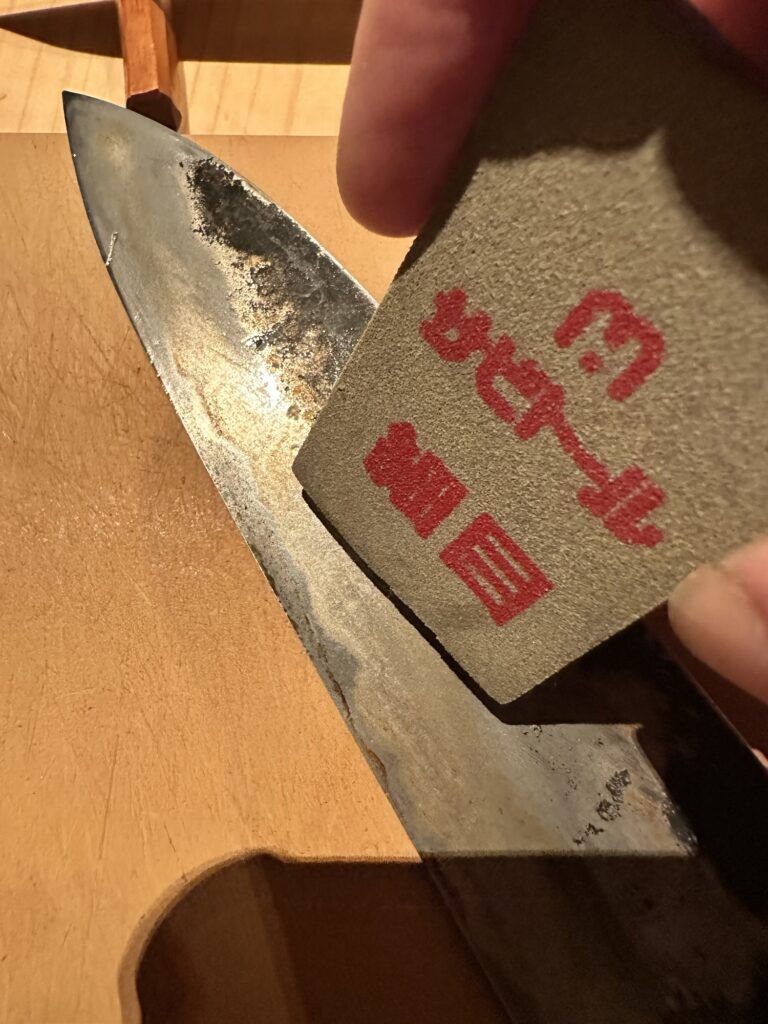
When necessary, I deal with the rust through sharpening and use Sabitoru to remove surface rust. If I know I will not use the knife for a while, I apply a thin layer of camellia oil before storing it.
Camellia oil is another simple option when storing carbon steel knives for longer periods.
This is why I don’t believe owning Carbon Steel Japanese Knives needs to be stressful. Once you have a basic maintenance kit and understand what your knife needs, caring for it becomes part of owning and using the knife.
The VG10 sujihiki I currently use is completely different when it comes to rust.
Honestly, rust is something I barely think about with this knife.
But I still treat it almost exactly the same way as my carbon steel knives.
Use it. Wash it. Dry it.
That’s all.
Stainless steel gives you considerably more freedom when it comes to corrosion resistance, but I still don’t believe that means you should leave a good knife wet or dirty.
There is also another side to stainless steel maintenance that I have noticed during my career.
Because stainless steel is so easy to live with, it can be tempting to keep using the knife without sharpening it until it becomes seriously dull.
That can create another problem.
A Rust-Resistant Knife Is Not a Maintenance-Free Knife
In my experience, when some stainless steels become extremely dull, bringing the edge back can feel harder than maintaining the knife regularly.
This is where people can make a mistake.
When a knife is not getting sharp quickly enough, there is a temptation to raise the sharpening angle and concentrate only on creating a sharp edge.
You may get an edge again, but over time the geometry behind that edge can become thicker. Eventually, the knife may feel sharp at the very edge but still struggle to move smoothly through food.
This connects directly with something I recently wrote about: knife thinning.
Thinning is not simply about making the edge sharp. It is about maintaining the geometry behind the cutting edge so the knife can continue cutting the way it should.
That is why regular maintenance matters whether your knife is carbon steel or stainless steel.
Are Carbon Steel Japanese Knives Really Difficult?
After using different steels professionally, my answer is no.
Carbon steel requires more awareness of moisture and rust. Stainless steel such as VG10 makes that part much easier.
But neither should be neglected.
For me, Carbon Steel Japanese Knives are not difficult knives. They are knives that you need to understand and learn how to live with.
Wash them after use. Dry them properly. Deal with rust early if it appears. Use camellia oil when storing carbon steel for longer periods. And don’t wait until any knife becomes completely dull before thinking about sharpening.
That small amount of care can make a very big difference.
For anyone exploring Japanese Knives Australia, I believe the question should not simply be, “Which steel is best?”
A better question is:
Which steel suits the way I cook, sharpen and care for my knives?
There is no single steel that is perfect for everyone. Understanding how you actually use your knife is far more important than simply choosing carbon steel or stainless steel.
Thank you for reading, and I hope to see you again in the next story.
—————————————————
Where to See and Buy Our Knives
Our Partner Stores
Chanoyu — Nerang, Gold Coast
Visit Chanoyu and See Our Japanese Knives
If you are on the Gold Coast, we would love you to visit Chanoyu, a Japanese café in Nerang where you can see and purchase a selection of Asaoya Yaichi knives in person.
Chanoyu is a lovely place to slow down and enjoy Japanese-inspired food, excellent matcha, coffee and handmade desserts. Its warm, peaceful atmosphere makes it a pleasure to visit, whether you are stopping in for breakfast, lunch or something sweet. We are delighted that our knives have a place there.
The selection of knives on display may change. If you are interested in a particular Asaoya Yaichi knife, please contact us through https://asaoyayaichi.com.au before visiting, and we will help you check whether it is available at Chanoyu.
Japanese Knife Thinning is something I never thought deeply about, even after more than 25 years working as a professional chef.
I have sharpened knives throughout my career, but there is something I have noticed many times, particularly with stainless steel knives I have used for years.
The edge can feel sharp after sharpening, yet somehow the knife does not pass through food as easily as it once did.
I once borrowed a colleague’s knife at work and was genuinely surprised by how easily it cut. My own knife was sharp too, so why did his knife move through food so much better?
I had some ideas, but I could not properly explain the reason. So I decided to research Japanese Knife Thinning.
What I had not fully understood was that making the cutting edge sharp and maintaining the overall cutting geometry of a knife are two different things.
As a knife is repeatedly sharpened, the cutting edge gradually moves higher into the blade, where the steel is generally thicker.
The edge can still be extremely sharp, but the steel immediately behind that edge can become relatively thick.
That thickness creates resistance once the edge has entered the food.
Why Japanese Knife Thinning Started Making Sense to Me
With some stainless knives I have owned for years, I have clearly experienced that feeling of the knife becoming harder to push through food.
My current Aogami Super sujihiki feels different.
It seems to form an edge quite easily on the stone. I do not need to raise the sharpening angle very much to get the edge I want, so I naturally sharpen it at a relatively low angle.
However, I do not think it would be correct to simply say this happens because Aogami Super is better than stainless steel.
Steel type, hardness, original blade geometry, thickness behind the edge, heat treatment and my own sharpening technique can all influence what I feel.
I have used VG10 extensively throughout my career, for example, and I still consider it an excellent practical knife steel.
The difference may partly be the knife itself—and partly the way I sharpen it.
Japanese Knife Thinning — So How Do You Fix the Problem?
This was the part I really wanted to understand.
If the edge is sharp but the knife has become too thick behind the edge, simply sharpening the cutting edge again does not remove that thickness.
The basic solution is thinning.
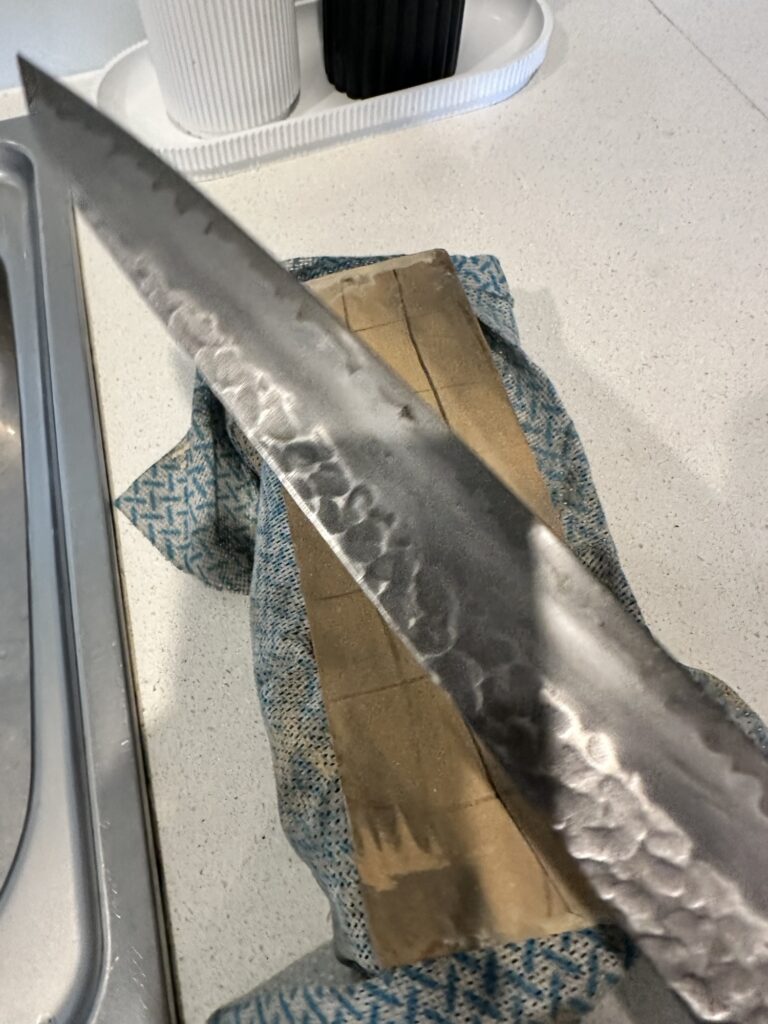
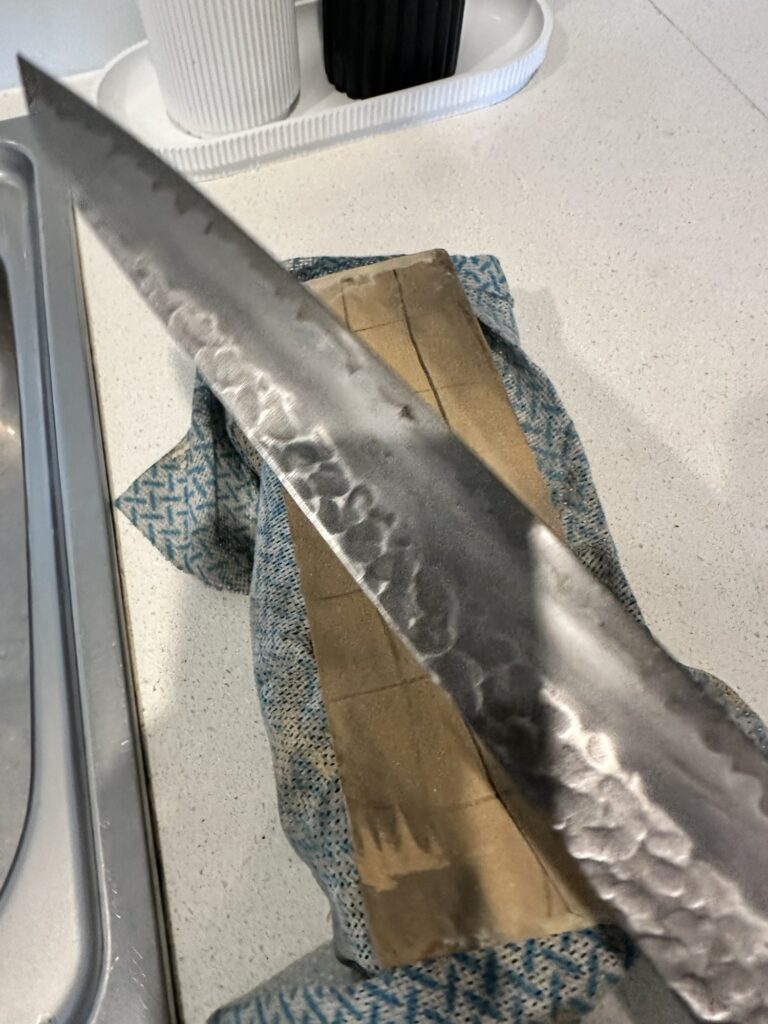
Instead of sharpening only at the normal edge angle, the blade is placed against the whetstone at a much lower angle. Steel is gradually removed from the area immediately behind the cutting edge.
The purpose is not simply to make another sharp edge. It is to reduce unnecessary thickness and restore a thinner cutting geometry.
After thinning, the actual cutting edge can then be sharpened normally again.
However, this is also something I would approach carefully.
Removing too much steel can change the geometry of the knife. Thinning can also scratch the blade face and alter its original finish. With an expensive Japanese knife, working slowly—or having an experienced professional sharpener do the work—may be safer than aggressively removing steel.
There was another slightly uncomfortable answer waiting for me.
The whetstone should be flat.
When trying to thin a knife at a very low and consistent angle, a dished stone makes controlling the contact between the blade and stone more difficult.
So perhaps my habit of occasionally avoiding stone flattening was part of the answer all along.
Prevention matters too.
Rather than repeatedly increasing the sharpening angle simply because I want to finish quickly, maintaining a lower, consistent angle where appropriate may help preserve the knife’s geometry for longer.
That does not mean every knife should be sharpened at the lowest possible angle. Different knives, steels and uses require different approaches. But continually making a steeper secondary edge without considering the thickness behind it can eventually change how the knife moves through food.
What Japanese Knife Thinning Taught Me About Sharpness
After researching this, I realised something surprisingly simple:
Sharpening restores the edge. Thinning restores the geometry behind the edge.
For years, I knew that some knives felt sharp but somehow did not cut like they used to. I also knew that I sometimes sharpened too quickly and occasionally neglected flattening my stones.
Perhaps I already knew part of the answer. I just did not always want to do it.
Even after more than 25 years in professional kitchens, there are still things about knives that I do not fully understand.
That is exactly why I enjoy researching them.
For anyone looking at Japanese knives in Australia, learning how to maintain the knife over many years can be just as important as choosing the steel, shape or handle when you first buy it.
Thank you for reading, and I hope to see you again in the next story.
—————————————————
Where to See and Buy Our Knives
Our Partner Stores
Chanoyu — Nerang, Gold Coast
Visit Chanoyu and See Our Japanese Knives
If you are on the Gold Coast, we would love you to visit Chanoyu, a Japanese café in Nerang where you can see and purchase a selection of Asaoya Yaichi knives in person.
Chanoyu is a lovely place to slow down and enjoy Japanese-inspired food, excellent matcha, coffee and handmade desserts. Its warm, peaceful atmosphere makes it a pleasure to visit, whether you are stopping in for breakfast, lunch or something sweet. We are delighted that our knives have a place there.
The selection of knives on display may change. If you are interested in a particular Asaoya Yaichi knife, please contact us through https://asaoyayaichi.com.au before visiting, and we will help you check whether it is available at Chanoyu.
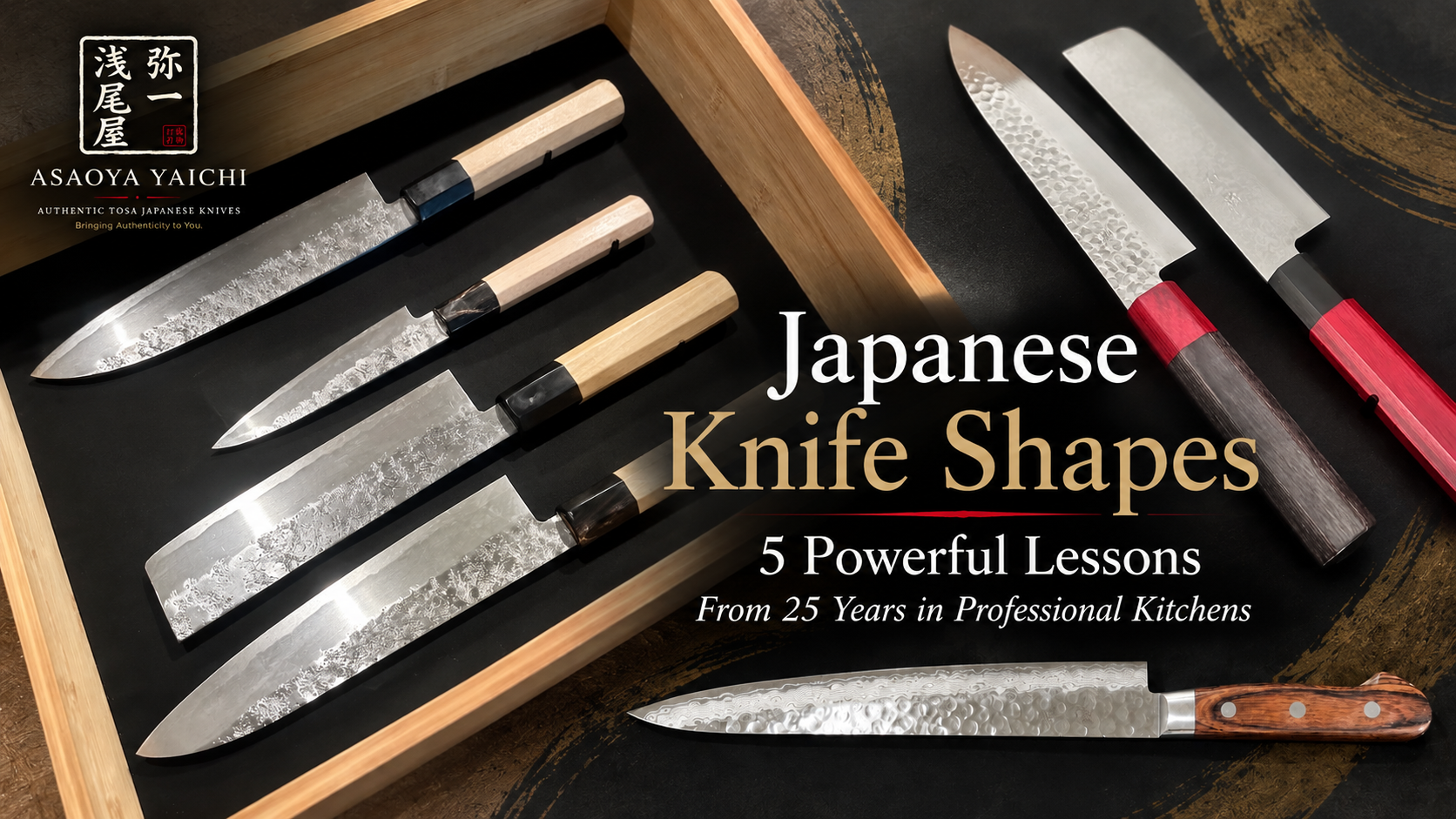
Japanese knife shapes can be confusing when you first start looking at Japanese knives. Gyuto, Santoku, Nakiri, Kiritsuke, Sujihiki — there are many different designs, and each one developed for a reason.
After more than 25 years working as a professional chef in Japan and Australia, however, I have learned that knowing every knife shape does not mean you need to own every one of them.
Some knives I have used constantly at work. Others, despite being extremely popular, I have rarely used professionally.
If you are looking for authentic Japanese knives in Australia, you can also see our current selection here:
One of the fascinating things about Japanese knives is how specialised they can be. Japanese cooking developed around very different jobs: preparing fish, slicing sashimi, cutting vegetables, breaking down meat and performing delicate preparation.
Naturally, different Japanese knife shapes developed around those different tasks.
But I think there is an important distinction between understanding why a knife exists and believing that you personally need one.
My own knife choices have always depended on the kitchen I was working in and the job I needed to do.
For more background on how Japanese knife-making developed, see:
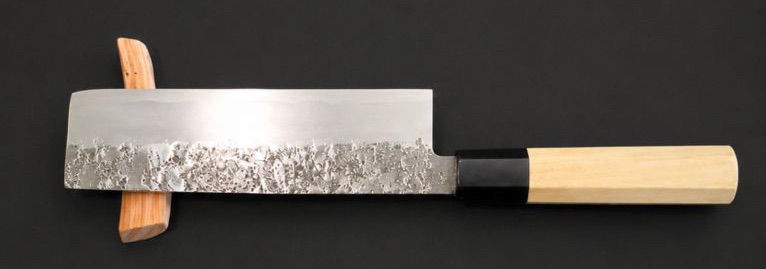
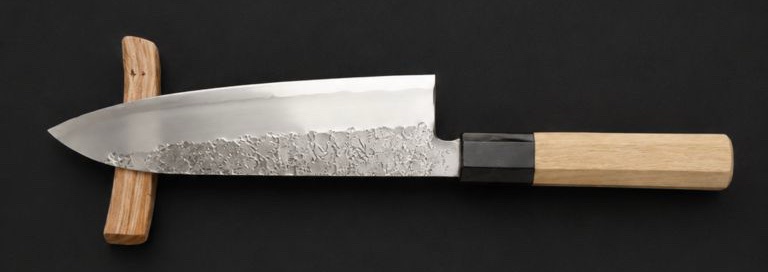
Santoku is probably one of the best-known Japanese knife shapes, particularly for home cooks. Nakiri is also popular because its straight edge and rectangular profile make it very comfortable for vegetable preparation.
But professionally, I honestly have not used either of them very much.
That does not mean they are bad knives. In fact, for many home kitchens, their relatively compact size can make them extremely practical.
I recently compared these two styles in more detail here:
Of the Japanese knife shapes I have used, I consider a Kiritsuke-style knife to be extremely versatile. The long cutting edge combined with its distinctive pointed tip allows me to perform many different jobs without constantly changing knives.
It can handle vegetables, meat preparation and detailed tip work, and I can even use it for certain fish preparation.
My answer changes completely when I think about working behind a sushi counter.
There, the Sujihiki may be the knife I use most.
Its long, narrow blade works beautifully for slicing fish and making clean cuts with fewer unnecessary movements. After years of preparing fish professionally, I appreciate how useful that length can be.
My preference for different steels when preparing sashimi is also something I have discussed before:
But would I recommend a Sujihiki as the first knife for every home cook?
Probably not.
Unless you regularly prepare larger pieces of meat or fish, that long specialised blade may spend much more time sitting in the knife rack than it would in a professional kitchen.
This is one reason choosing Japanese knives should be based on how you actually cook rather than simply buying the knife that looks most impressive.
Of All Japanese Knife Shapes, I Still Come Back to the Gyuto
After everything I have used over the years, somehow I keep coming back to the Gyuto.
For me, it is probably the easiest all-round knife to live and work with.
Meat, fish, vegetables and everyday preparation — a good Gyuto can comfortably handle an enormous range of jobs without feeling overly specialised.
This becomes especially important for people discovering Japanese Knives Australia for the first time. With so many steels, finishes, sizes and Japanese knife shapes available, it is easy to think that you need several knives immediately.
You probably do not.
Understanding the steel is just as important as understanding the shape:
After 25 years in professional kitchens, I do not choose a knife simply because a particular style is popular.
I think about what I am actually going to cut.
Santoku and Nakiri are popular, but I have rarely needed them professionally. A Kiritsuke feels extremely versatile to me. At a sushi counter, I may reach for a Sujihiki more than anything else. But when I want one dependable knife that can handle almost everything, I still find myself coming back to the Gyuto.
That is perhaps the most important lesson behind all these Japanese knife shapes.
The variety exists because different knives were designed to do different jobs.
You do not need to own them all.
You need the knife that makes sense for the way you cook.
Thank you for reading, and I hope to see you again in the next story.
—————————————————
Where to See and Buy Our Knives
Our Partner Stores
Chanoyu — Nerang, Gold Coast
Visit Chanoyu and See Our Japanese Knives
If you are on the Gold Coast, we would love you to visit Chanoyu, a Japanese café in Nerang where you can see and purchase a selection of Asaoya Yaichi knives in person.
Chanoyu is a lovely place to slow down and enjoy Japanese-inspired food, excellent matcha, coffee and handmade desserts. Its warm, peaceful atmosphere makes it a pleasure to visit, whether you are stopping in for breakfast, lunch or something sweet. We are delighted that our knives have a place there.
The selection of knives on display may change. If you are interested in a particular Asaoya Yaichi knife, please contact us through https://asaoyayaichi.com.au before visiting, and we will help you check whether it is available at Chanoyu.
Japanese Knife Care Australia can sound more complicated than it really is. After more than 25 years working in professional kitchens in Japan and Australia, I have learned that looking after a Japanese knife does not require a complicated routine.
For people searching for Japanese Knives Australia, understanding how to care for the blade is just as important as choosing the right knife. Different steels require different levels of maintenance, but the basic principles are simple: keep the blade clean and dry, sharpen it correctly, and use the right maintenance products only when necessary.
At Asaoya Yaichi, I want people in Australia to enjoy using Japanese knives rather than worry about maintaining them.
The first lesson in Japanese Knife Care Australia is that not every Japanese knife needs the same care.
Carbon steels such as Aogami #2 and Aogami Super can develop rust if moisture is left on the blade. Stainless steels such as VG10, Ginsan and SG2 are generally easier to maintain in everyday kitchens.
This does not mean one steel is automatically better than another.
I personally enjoy carbon steel, especially for certain fish work, but I also appreciate the convenience of stainless steel in a busy professional kitchen.
Understanding the steel should therefore be part of choosing among the many Japanese Knives Australia has available today.
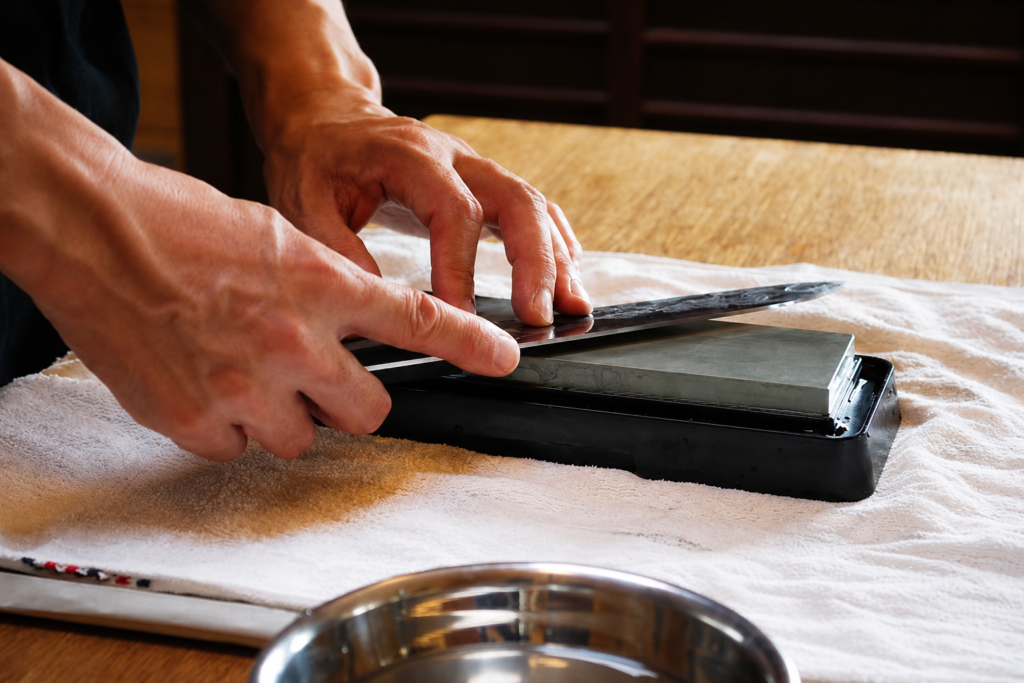
After using a knife, I do not like leaving it wet beside the sink. Wash it, wipe it properly and keep the blade dry. This is particularly important with carbon steel.
You do not need to become nervous every time water touches the blade. Japanese knives are tools made to be used.
Use the knife, clean it, dry it and put it away safely.
After decades in professional kitchens, I believe simple habits are more useful than complicated maintenance routines.
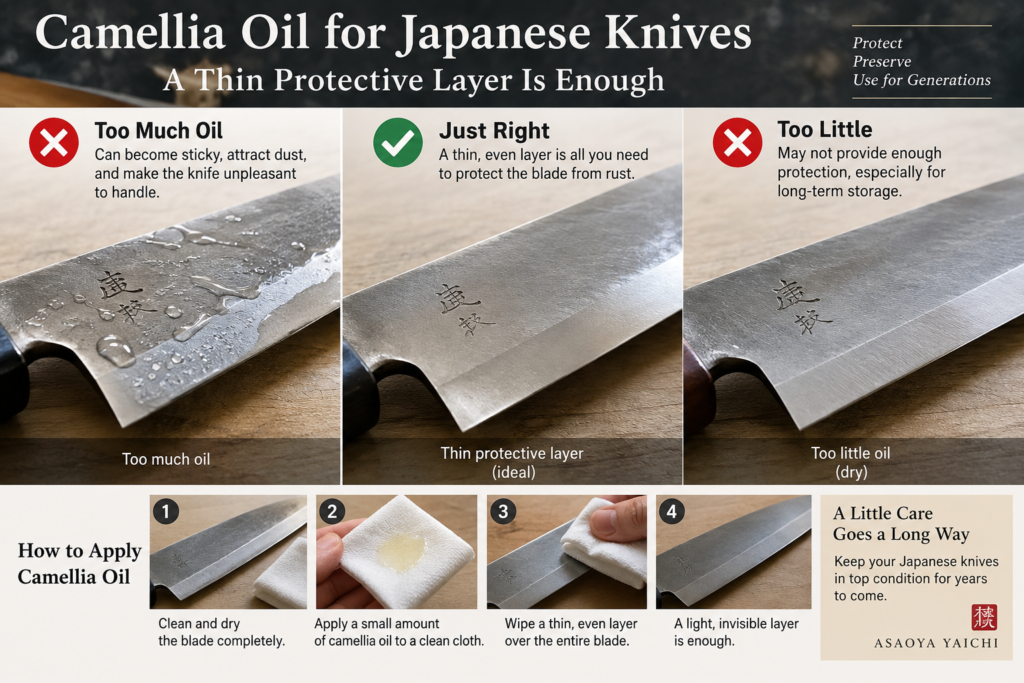
2. Camellia Oil Does Not Need to Be Thick
For carbon steel knives that will not be used for some time, I use camellia oil.
One thing I have learned from experience is that more oil is not necessarily better. A very thin protective film is enough. In the past, I have experienced oil becoming sticky after being left too heavily on a blade.
For me, Japanese Knife Care Australia should remain practical and simple.
4. Sharpening Is Part of Japanese Knife Care Australia
I sharpen my own knives regularly. At home I use a 1000-grit stone, and at work I also use a 6000-grit finish.
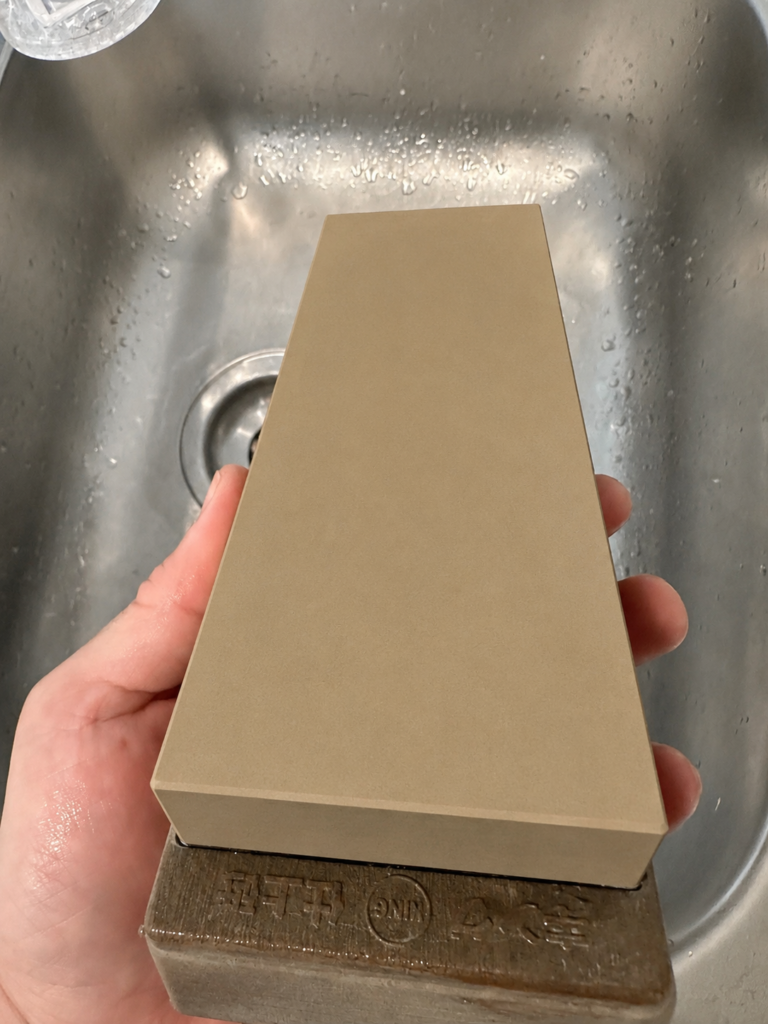
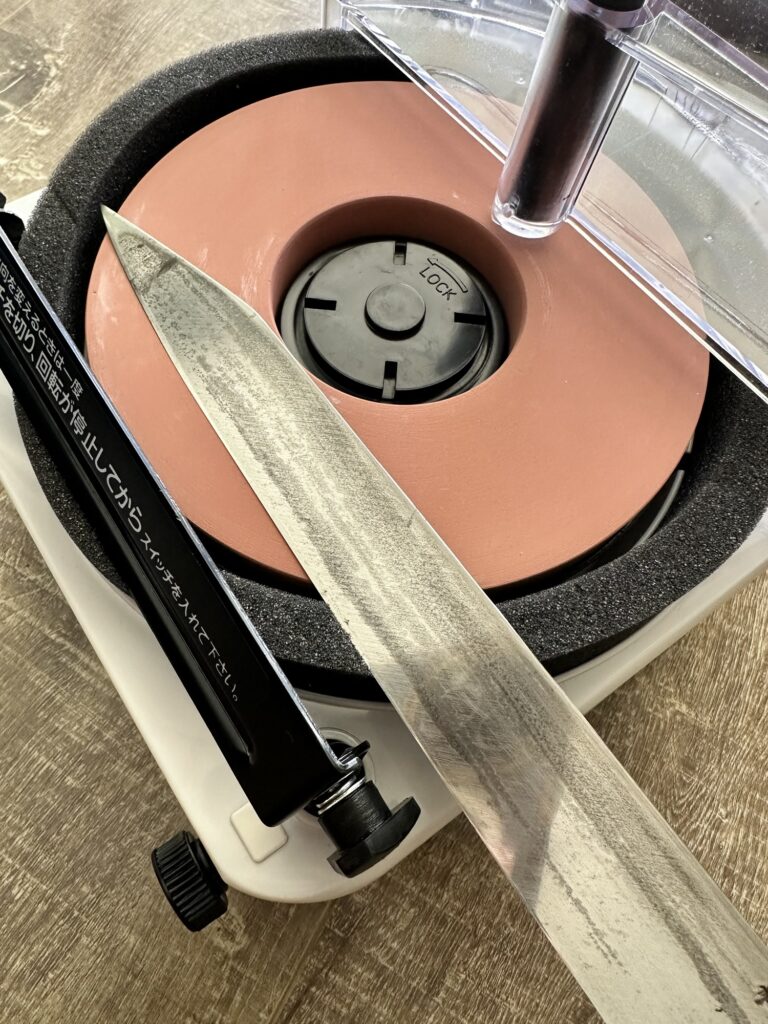
I flatten my stones every time because a stone that is no longer flat makes consistent sharpening much harder.
A Japanese knife should not be treated as something that stays sharp forever.
Sharpening is part of owning the knife. Over time, you begin to understand the angle, steel and edge that suit the way you work.
This is also something I believe people should consider when looking at Japanese Knives Australia. Choosing the knife is only the beginning. Learning how that knife behaves over years of use is part of the experience.
5. Expensive Does Not Mean Maintenance-Free
I have seen extremely expensive Japanese knives in professional kitchens, including knives costing thousands of dollars.
Price does not remove the need for care.
Even an expensive blade can lose its edge, rust or become damaged through poor use. At the same time, a reasonably priced knife that is sharpened and maintained properly can perform beautifully for many years.
6. Hand-Forged Japanese Knives Develop Their Own Character
One reason I enjoy hand-forged Japanese knives is that they change with use.
The blade is sharpened. Carbon steel develops character. The handle becomes familiar in your hand. Small signs of years spent cooking gradually become part of the knife.
That is very different from thinking of a knife as a disposable kitchen tool.
For me, this long relationship between the cook and the knife is one of the reasons traditional Japanese knives still have real value today.
7. Japanese Knife Care Should Help You Choose the Right Knife
Sometimes people see Japanese knives, particularly carbon steel knives, and immediately think they will be difficult to own.
I do not think that should stop anyone.
Choose a steel that suits your lifestyle. If you want lower maintenance, VG10, Ginsan or SG2 can be excellent choices. If you enjoy sharpening and caring for your tools, carbon steel such as Aogami #2 can be extremely rewarding.
When choosing a Japanese knife in Australia, do not look only at appearance, price or sharpness. Think about how you cook, how often you use the knife, whether you enjoy sharpening, and how much maintenance you realistically want to do.
There is no single Japanese knife that is right for everyone.
After more than 25 years in professional kitchens, my approach remains simple: use your knife, respect it, sharpen it, keep it clean and enjoy cooking with it.
A good Japanese knife is made to work.
For anyone discovering Japanese Knives Australia, I hope understanding basic knife care makes choosing and owning a Japanese knife easier, rather than more intimidating.
Take care of a good knife, and it can stay beside you for many years.
Thank you for reading, and I hope to see you again in the next story.
—————————————————
Where to See and Buy Our Knives
Our Partner Stores
Chanoyu — Nerang, Gold Coast
Visit Chanoyu and See Our Japanese Knives
If you are on the Gold Coast, we would love you to visit Chanoyu, a Japanese café in Nerang where you can see and purchase a selection of Asaoya Yaichi knives in person.
Chanoyu is a lovely place to slow down and enjoy Japanese-inspired food, excellent matcha, coffee and handmade desserts. Its warm, peaceful atmosphere makes it a pleasure to visit, whether you are stopping in for breakfast, lunch or something sweet. We are delighted that our knives have a place there.
The selection of knives on display may change. If you are interested in a particular Asaoya Yaichi knife, please contact us through https://asaoyayaichi.com.au before visiting, and we will help you check whether it is available at Chanoyu.
Choosing a Japanese Knife is about much more than comparing steel, price, blade length or appearance. For people exploring Japanese Knives Australia, there are now more makers, steels and styles to choose from than ever before. After more than 25 years working as a professional chef, I have learned that the person behind the knife matters too.
Japanese blacksmiths spend years developing skills that cannot simply be replaced by a machine or a famous brand label. Their experience, techniques and knowledge are part of the value of every knife they produce.
At Asaoya Yaichi, I want more people in Australia to know the names of the Japanese craftsmen behind their knives. Their names should have value because their skills, experience and years of work have value.
But at the same time, I do not want a blacksmith’s name to become just another luxury label.
When Choosing a Japanese Knife, I believe we should understand not only who made it, but why their work matters.
Choosing a Japanese Knife Means Knowing Who Made It
For many years, Japanese kitchen knives were often sold overseas simply as “Japanese knives.”
The steel might be listed. The blade length might be listed. The words “hand-forged” might appear in the description.
But who actually made the knife?
I believe that question deserves more attention.
A blacksmith is not simply part of the manufacturing process. The decisions they make about forging, heat treatment, construction and finishing all contribute to the character of the finished blade.
This is one reason I have become increasingly interested in telling the stories behind Japanese knives rather than simply selling them as products.
I have written before about something that concerns me: the future of Japanese blacksmiths and the value placed on their work.
If retailers compete only on price, eventually somebody in the chain has to absorb that pressure. I do not believe constantly making Japanese knives cheaper is necessarily good for the future of the industry.
Traditional skills take years to develop.
That should have value.
When a blacksmith produces excellent knives for decades, I want their name to become better known. If that reputation eventually allows their work to command a higher price, I do not see that as a bad thing.
In fact, I believe knife retailers can play a role in helping that happen.
Knowing the maker is important, but when Choosing a Japanese Knife, the knife still needs to make sense for the person using it.
I have spent more than 25 years working with knives in professional kitchens. From that experience, I know that a famous name cannot change whether a particular blade shape, steel or size suits the job in front of me.
A beautiful carbon-steel knife may be wonderful for one cook, while someone else may be much happier with the easier maintenance of VG10, Ginsan or SG2.
A Kurouchi finish, for example, is not simply a fashionable black surface. It is connected to a traditional way of producing practical forged blades.
Understanding that changes how we see the knife.
Japanese Knives Australia Should Be About More Than Price
As Japanese knives become increasingly available in Australia, I hope the market continues to grow.
But I also hope that growth does not become only a competition over who can sell Japanese knives for the lowest price.
There should be room for different steels, different regions, different craftsmen and different philosophies of knife making.
That is why I believe Japanese Knives Australia should become a market where customers can learn about the people behind the blades as well as the products themselves.
At Asaoya Yaichi, I want to continue introducing Japanese knives through my own experience as a professional chef, while also giving greater recognition to the craftsmen who make them.
I want customers in Australia to remember their names.
Not because a name automatically makes a knife better.
But because when excellent craftsmanship exists behind that name, the person responsible for it deserves recognition.
If Japanese knife retailers can help increase the value of those names while explaining the craftsmanship behind them, I believe we can do more than simply sell knives.
We can help carry Japanese knife-making traditions into the future.
And that, for me, is an important part of Choosing a Japanese Knife.
Thank you for reading, and I hope to see you again in the next story.
—————————————————
Where to See and Buy Our Knives
Our Partner Stores
Chanoyu — Nerang, Gold Coast
Visit Chanoyu and See Our Japanese Knives
If you are on the Gold Coast, we would love you to visit Chanoyu, a Japanese café in Nerang where you can see and purchase a selection of Asaoya Yaichi knives in person.
Chanoyu is a lovely place to slow down and enjoy Japanese-inspired food, excellent matcha, coffee and handmade desserts. Its warm, peaceful atmosphere makes it a pleasure to visit, whether you are stopping in for breakfast, lunch or something sweet. We are delighted that our knives have a place there.
The selection of knives on display may change. If you are interested in a particular Asaoya Yaichi knife, please contact us through https://asaoyayaichi.com.au before visiting, and we will help you check whether it is available at Chanoyu.
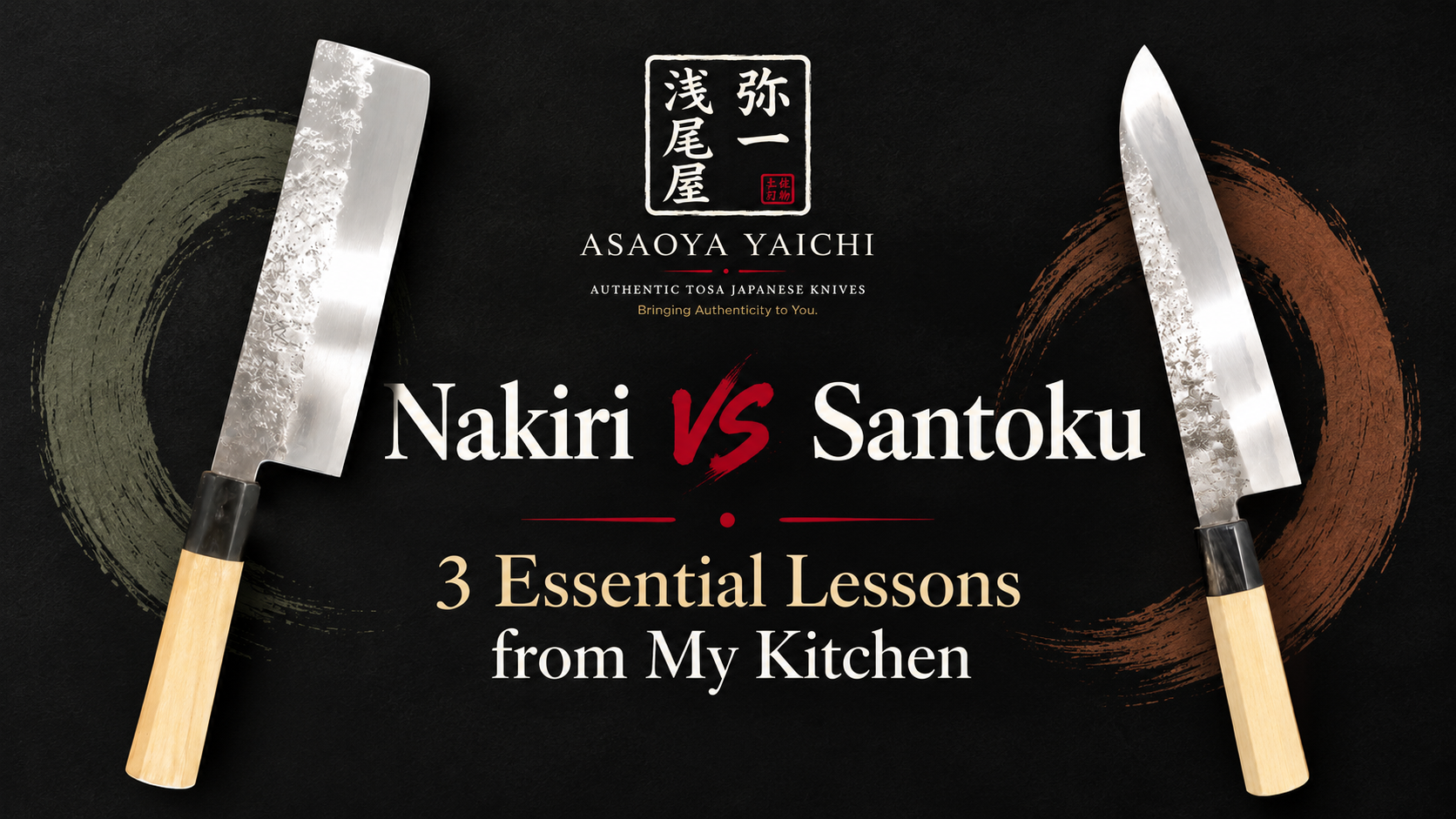
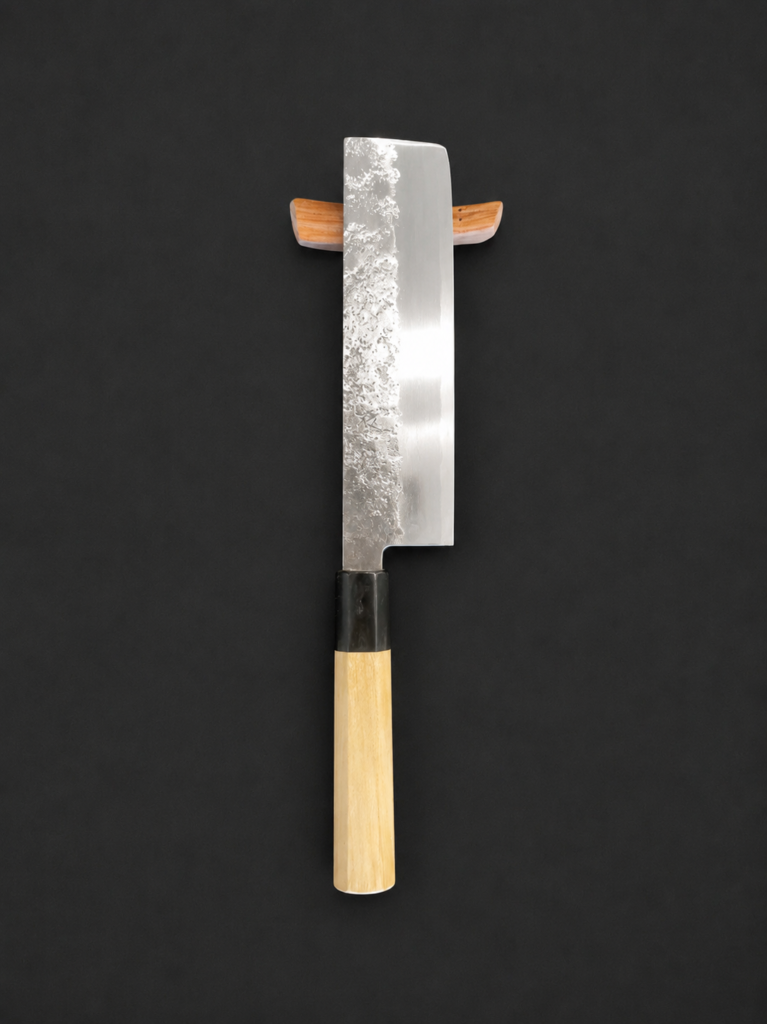
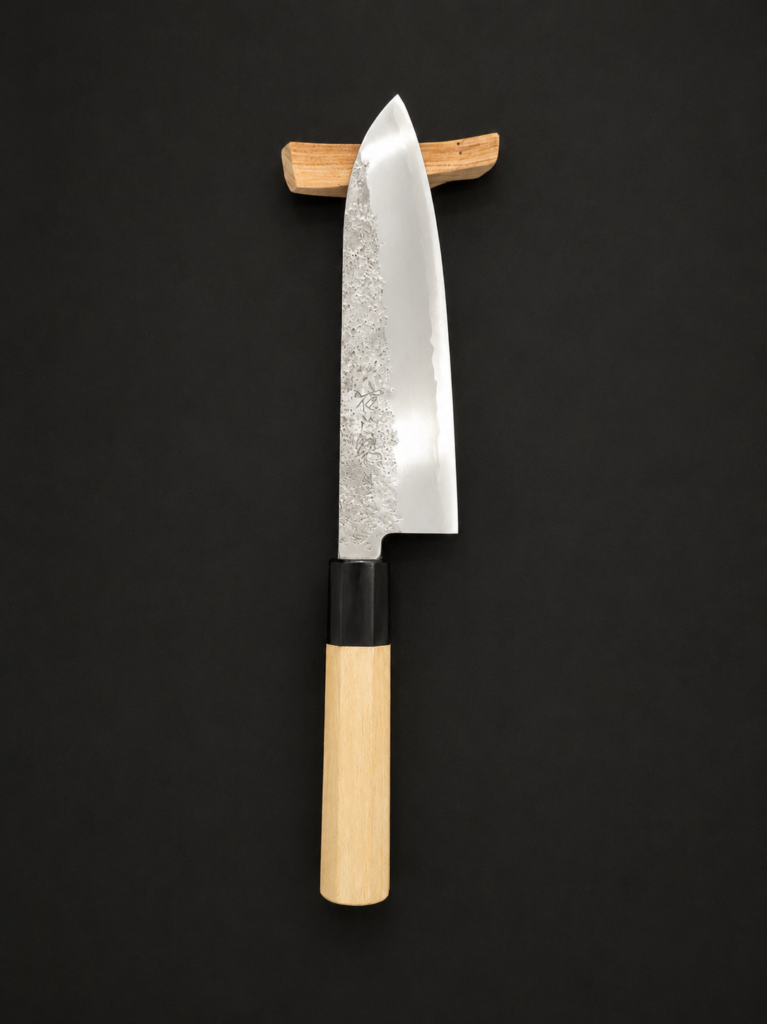
Nakiri vs Santoku is a comparison I think about differently after more than 25 years as a professional chef. Both cut vegetables. I notice the difference when I want a straight line or turn a daikon for katsuramuki. Then the edge shape becomes something I can feel. The same vegetable can make two knives feel surprisingly different in my hands when the goal is a precise shape rather than speed.
If you are looking at Japanese knives in Australia, you can explore the knives I have selected for Asaoya Yaichi here: https://asaoyayaichi.com.au. Before choosing a shape, I would think about the work you actually do on your cutting board.
When I cut a vegetable into neat rectangular strips, a nakiri’s relatively straight edge gives me a clear line to follow. I can use a controlled push cut and watch where the edge meets the board. With short, rectangular pieces, even a slight change in the direction of a cut is easy to see. I find myself paying attention to the line all the way through the vegetable.
A santoku can certainly make the same cuts. I have used santoku knives for vegetable preparation throughout my career. But some curve more toward the tip, and I may adjust my motion to keep a series of cuts consistent.
The knife does not make the strips straight by itself. My preparation, grip, sharpening and cutting technique matter too. Still, that straight edge is why I might choose a nakiri when a tidy result matters.
Blade thickness also changes how a knife moves through a vegetable. A straight outline alone cannot tell me whether a particular knife will feel good in use.
Katsuramuki means turning a vegetable, often a daikon, while peeling off a long, thin sheet. I watch the edge, turn the vegetable and try to keep an even thickness. It demands control.
In my experience, the straighter edge of a nakiri is easier to follow during this work. When I use a more curved section of a santoku, the peel can start to wander or curve away from the line I want. That is the practical difference I feel. Once a long peel starts moving away from my intended line, correcting it without breaking the sheet becomes difficult. A santoku can still do katsuramuki.
In fact, the straighter section near the heel of some santoku knives can also be used for peeling. The result depends on the individual knife and the way it is handled. For traditional, highly refined vegetable work, a single-bevel usuba is another specialised choice. A nakiri is generally double bevel, so I would not present it as a substitute for every technique an usuba is designed to perform.
The straight edge has a real purpose, but a kitchen does not consist of daikon and rectangular vegetable cuts alone. I might prepare onions and greens, then portion boneless meat or fish for the same meal. A santoku makes sense for that changing workload. Its pointed tip helps with some detail work, while the blade moves between ingredients.
If someone in Australia asked me to recommend just one Japanese knife for everyday home cooking, I would usually start by discussing a santoku or a gyuto. The choice depends on board space, ingredients and cutting style. A nakiri becomes more interesting when vegetable preparation is a regular part of their cooking and they value the way its straight edge behaves.
I notice the nakiri’s advantage when making straight strips or holding a line during katsuramuki. Someone preparing a wide range of meals may value the santoku’s flexibility more. The name of the knife alone cannot tell me which one belongs in a particular kitchen. I also consider the actual blade, its weight and the person holding it.
That is how I would choose between them: by the cut in front of me, not by a label on the knife. If you are still weighing up different shapes, I have written more about the knives I would choose for Australian kitchens.
If you are on the Gold Coast, we would love you to visit Chanoyu, a Japanese café in Nerang where you can see and purchase a selection of Asaoya Yaichi knives in person.
Chanoyu is a lovely place to slow down and enjoy Japanese-inspired food, excellent matcha, coffee and handmade desserts. Its warm, peaceful atmosphere makes it a pleasure to visit, whether you are stopping in for breakfast, lunch or something sweet. We are delighted that our knives have a place there.
The selection of knives on display may change. If you are interested in a particular Asaoya Yaichi knife, please contact us through https://asaoyayaichi.com.au before visiting, and we will help you check whether it is available at Chanoyu.
I have worked as a professional chef for more than 25 years, and Japanese knives have been part of my working life for a long time. But since starting Asaoya Yaichi and learning more about how Japanese knives are actually made, I have realised something interesting: there are many Japanese knife terms that I simply did not know.
Using a knife every day and understanding how a blacksmith constructs one are two very different things.
So I decided to research some of these words myself. This is not a glossary written from the perspective of a blacksmith. It is a chef learning more about the tools he has used for decades — and sharing what he discovers along the way.
If you are looking for Japanese knives in Australia while reading this story, you can also visit our collection here.
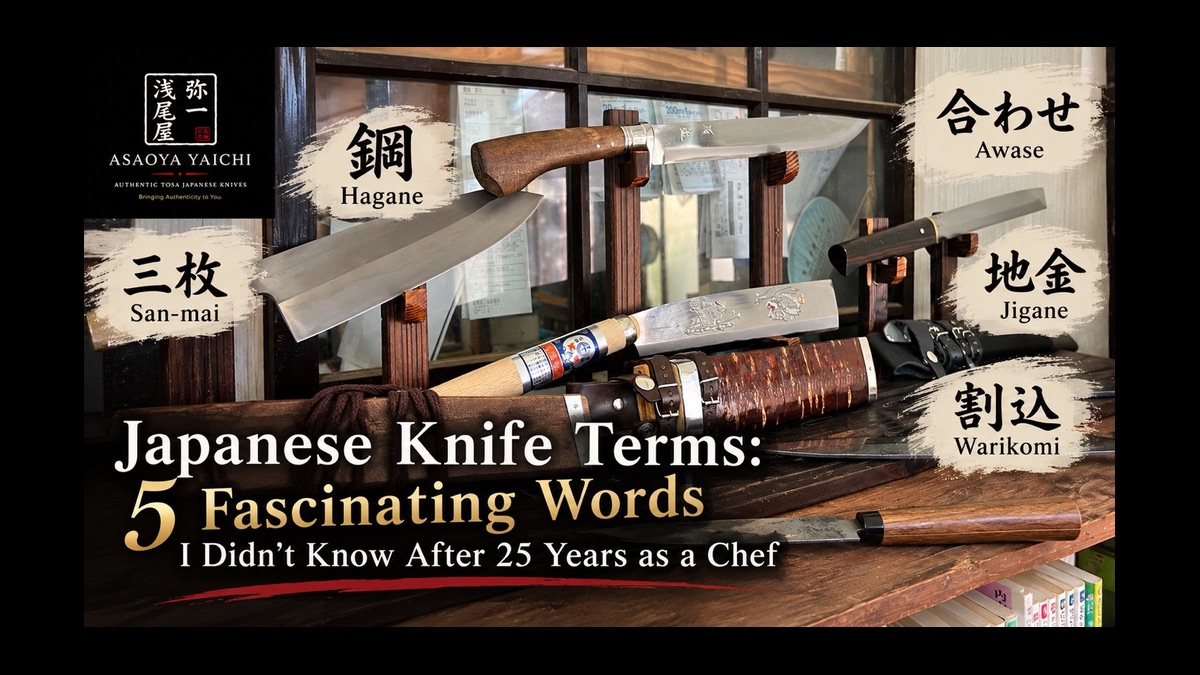
Hagane (鋼) means steel, but in discussions about laminated Japanese knives it commonly refers to the harder steel that forms the cutting edge.
This was interesting to me because, as a chef, I have normally thought about steel by names such as Aogami #2, Ginsan, VG10 or SG2. I thought about how the knife sharpened, how long the edge lasted and how it behaved during service.
Hagane approaches the subject from a different direction. It describes the role that hard steel plays within the construction of a laminated blade.
Jigane (地金 / 地鉄) was another term I had seen without really stopping to understand it.
In traditional laminated knife construction, jigane refers to the softer material supporting the harder hagane. Depending on the construction, this can be soft iron, mild steel or another softer cladding material.
The concept is surprisingly practical: the hard steel performs at the cutting edge, while the softer material supports it.
Once I understood this, some of the visual characteristics of traditional Japanese knives also started to make more sense.
Awase (合わせ) broadly describes a laminated or joined construction in which different materials are combined rather than making the blade from one homogeneous piece of steel.
This was one of those Japanese knife terms that helped several other words suddenly connect.
Hagane and jigane are not simply two unrelated materials. In an awase knife, they work together as part of the blade’s construction.
That also helped me better understand why hand-forging should not simply be reduced to the image of someone hitting hot steel with a hammer. The construction itself matters.
This is where the terminology became particularly interesting to me.
San-mai (三枚) literally refers to three layers. In a typical double-bevel construction, harder hagane forms the core, with softer cladding on either side.
Warikomi (割込) uses a different construction method. The softer body is split or opened and the harder steel is inserted into it.
I had previously seen these words in knife descriptions without giving much thought to why both existed. Researching them showed me that words that may look like technical marketing language can actually describe meaningful differences in how a blade is constructed.
Do you need to memorise Hagane, Jigane, Awase, San-mai and Warikomi before buying a good kitchen knife?
No.
I spent more than 25 years working in professional kitchens without knowing every one of these terms.
But now that I sell Japanese knives in Australia, I want to understand more than just how a knife feels on the cutting board. I want to understand why it was made that way, what the maker was trying to achieve and what the terminology in a product description actually means.
For me, learning these Japanese knife terms has become another part of understanding Japanese knives themselves.
And if you are currently comparing Japanese Knives Australia, terminology should not replace practical considerations such as what you cook, blade length, steel, maintenance and how the knife feels in use. It simply gives you another layer of knowledge when making that decision.
For most of my 25 years working as a professional chef, I honestly did not care much about Japanese knife steel.
I knew my knives felt different, but I rarely thought about the reason. Some held their edge longer. Some could lose their initial sharpness but still somehow get me through a busy service. Others became frustrating once the edge started to fade. Some were easy to sharpen, while others required more patience. And, of course, some rusted much more easily than others.
I noticed all of these differences long before I understood the steels behind them.
It was only after starting Asaoya Yaichi and learning more seriously about Japanese knives that those years of experience began to connect with what I was learning about steel.
If you are looking for Japanese knives in Australia, understanding these differences can make choosing your next knife much easier.
Learning more about knife making also taught me that steel is only part of the story. Heat treatment, blade geometry, sharpening and construction all influence how a knife performs.
Learning Japanese Knife Steel Finally Explained My Preferences
Once I started selling Japanese knives, I needed to understand what I was actually selling.
That changed the way I looked at my own knives.
Suddenly, experiences from many years in professional kitchens started making sense. Today I know that I personally enjoy using Aogami #2 and Aogami Super. They suit the way I work and, importantly, the way I sharpen.
That does not mean I believe they are the best steels for everyone.
Specifications and price can tell us something about a knife, but they cannot completely describe what it will feel like after months or years of real kitchen use.
Choosing Japanese Knife Steel for Japanese Knives in Australia
This becomes particularly important when choosing Japanese knives in Australia.
As a professional chef, I use my knives constantly. With carbon steel, I wash the blade, dry it and continue using it regularly. Patina develops, but personally I have not found rust particularly difficult to manage during everyday professional use.
Home use can be very different.
You might use a carbon-steel knife tonight and then not touch it again for several days. If moisture remains on the blade during that time, rust can appear surprisingly quickly.
That is one reason stainless steels such as VG10 or Ginsan can make a lot of sense for people who want a Japanese knife without constantly thinking about maintenance.
There is another difference I have noticed over the years: sharpening.
This is my personal experience rather than a rule for every knife, but when some stainless knives become very dull, I find they can become frustrating.
I can usually bring them back to a reasonably sharp edge without too much trouble. But getting that edge back to the extremely sharp condition I personally want can sometimes require patience.
With Aogami carbon steels, I often feel that I can bring the edge back more naturally.
Of course, this depends on much more than simply whether a knife is carbon or stainless. Hardness, heat treatment, blade geometry and sharpening stones all matter.
That is why I prefer talking about what I have actually experienced rather than saying one steel is universally better.
If you are searching for Japanese knives in Australia, I would not start by asking, “What is the best steel?”
I would start with different questions.
How often do you cook? Do you sharpen your own knives? Are you comfortable drying a carbon-steel blade immediately after use? Do you want something easy to maintain? What shape and length actually suit the food you prepare?
Understanding Japanese knife steel helps answer those questions, but steel should not become the only reason you choose a knife.
I recently wrote about the Japanese knives I would personally choose after more than 25 years in professional kitchens. That article looks beyond steel and considers the complete knife from the perspective of actual use.
For me, that is the real value of finally learning about steel.
Twenty-five years ago, I could tell you whether I liked a knife. I just could not always explain why.
Today, I understand much better why Aogami #2 and Aogami Super suit me, why stainless steel can be a better choice for many people, and why the most impressive steel name does not automatically make the best knife for the person holding it.
If you are choosing Japanese knives in Australia, learn about the steel—but choose the knife according to the way you actually cook.
Authentic Japanese Knives are often discussed in terms of sharpness, steel, performance and craftsmanship. But behind every genuine handmade knife is something that is much harder to see: the years of knowledge, experience and dedication required to make it.
Price matters. I understand that completely. A more affordable knife can make Japanese knives accessible to more people, especially those buying their first serious kitchen knife. There is nothing wrong with offering good value, and there is nothing wrong with occasional sales or promotions.
But I believe there is an important difference between making a good knife more accessible and allowing genuine craftsmanship to become a permanent race toward the lowest possible price.
When we pick up a handmade Japanese knife, we see the finished blade. We do not immediately see the years it took the craftsman to develop the skills required to make it.
Forging, heat treatment, grinding, sharpening and finishing all require experience. The final knife represents not only materials and labour, but knowledge passed down and refined over generations.
That is why I believe Authentic Japanese Knives should be valued for more than their specifications.
This does not mean that an expensive knife is automatically a better knife. I have worked in professional kitchens for more than 25 years, and I know very well that price alone does not determine how useful a knife will be.
A seasonal promotion, special offer or occasional discount can help someone experience a good Japanese knife for the first time. A retailer may choose to reduce its own margin for many different reasons.
That does not change the underlying value of the craftsmanship.
What concerns me is not discounting itself. It is the idea that authentic handmade products should always compete by becoming cheaper than the next seller.
If price becomes the main battlefield, eventually someone in the chain has to absorb that pressure.
And I do not want that pressure to continually move towards the people actually making the knives.
Authentic Japanese Knives Exist Because Craftsmen Still Make Them
Today, Japanese-style knives are produced around the world. Many are affordable, and some are perfectly good kitchen tools.
There is room for them.
But genuine Japanese craftsmanship exists because there are still people willing to spend years learning how to forge, heat treat, grind and finish blades.
Traditional craftsmanship cannot survive on admiration alone.
People can tell craftsmen that their work is beautiful, important and culturally valuable. But if the profession cannot provide a sustainable future, eventually fewer people may be willing to dedicate their lives to learning it.
The Future of Authentic Japanese Knives Depends on the Next Generation
I want young people to be able to look at a respected blacksmith and think:
“I want to become like that person.”
For that to happen, craftsmanship must offer more than respect. It must also offer the possibility of building a meaningful and sustainable career.
If a young apprentice can see that an exceptional craftsman is recognised around the world, that their knives are valued, and that their name itself carries meaning, becoming a blacksmith can become something to aspire to.
That matters because without a next generation, even centuries of tradition can eventually stop.
I also believe that achieving this future is not the responsibility of blacksmiths alone. Those of us who sell Japanese knives have a role to play as well.
Rather than seeing each other only as competitors, perhaps knife retailers can collectively help raise the appreciation and value of genuine Japanese craftsmanship. We may run different businesses, carry different knives and approach the market in different ways, but ultimately, a stronger appreciation for authentic Japanese knives can help support the craftsmen and the tradition we all depend on.
One of my hopes for Japanese knives is that the finest examples will increasingly be viewed in the same way we appreciate fine watches, jewellery and other forms of exceptional craftsmanship.
Not because a kitchen knife should become something too precious to use.
Quite the opposite. A great knife should be used.
But we can use something every day while still respecting the person who created it.
In the world of fine craftsmanship, the maker’s name can become part of the object’s value. I would like to see more Japanese blacksmiths receive that same recognition.
Perhaps one day a young person will see a blacksmith whose knives are respected and valued around the world and think, “If I dedicate myself to this craft, maybe my name could mean something too.”
That is how a tradition gains a future.
Authentic Japanese Knives Should Carry Their True Value Forward
At Asaoya Yaichi, I want customers to receive good value. There may be promotions, special offers and opportunities to purchase knives at reduced prices.
But I do not want the long-term value of Authentic Japanese Knives to be determined simply by who can sell them for the lowest price.
There is a difference between offering customers a good deal and undervaluing the craft itself.
For me, respecting Japanese knife making means respecting the customer, the knife and the people who make it.
I hope Japanese Knives in Australia continue to gain recognition not only for their sharpness and performance, but also for the craftsmen and traditions behind them.
Because when craftsmen are properly valued, the profession itself has value.
And when a profession has a future, a young person may dream of becoming part of it.
Choosing a Japanese knife is highly personal. Steel, balance, blade shape, handle design and even appearance can completely change how a knife feels in your hand. After more than 25 years working in professional kitchens, I have learned that the knife I personally want is not always the most expensive one.
That is why I wanted to create my own Japanese Knives Australia Ranking. Rather than ranking knives purely by price or specifications, these are five knives from the Asaoya Yaichi collection that stand out to me through a combination of usability, craftsmanship, steel, rarity and character.
If you are currently looking for Japanese knives in Australia, you can also see our collection here:
There are many excellent Japanese knives available today, so this ranking is deliberately personal. I am looking at these knives from the perspective of someone who has spent decades actually using knives in professional kitchens.
Some knives impress me because of their practicality. Others because of traditional Japanese craftsmanship. And sometimes there is simply a knife that makes you think, “I want that one.”
At number five in my Japanese Knives Australia Ranking is a 210mm Gyuto made from VG10 stainless steel with a polished hammered 67-layer Damascus finish.
This is what I would call a dependable all-rounder. A 210mm Gyuto is extremely versatile in both professional and home kitchens, while VG10 offers a practical combination of edge retention, corrosion resistance and ease of maintenance.
The Damascus pattern and green handle also make this knife visually impressive without sacrificing everyday usability.
Personally, I would be very tempted to purchase this Gyuto together with the matching Petty. As a set, they cover an enormous amount of everyday kitchen work while looking fantastic together.
This 180mm Santoku combines VG10N steel with 33-layer Damascus, a Green Marble handle and a Rainbow Spacer.
The marble-style handle immediately catches the eye, but what makes this knife particularly interesting to me is its rarity. Japanese knives with this combination of blade and handle design are not something you see everywhere.
The 180mm Santoku size is also highly practical. It gives you enough blade for serious preparation while remaining comfortable and controllable for everyday cooking.
For someone wanting a Japanese knife that feels genuinely different from the usual choices, this is a special piece.
If I ranked these knives purely on usability, this could easily be number one.
I have written about this knife before because I genuinely think its shape is exceptionally easy to use. The Aogami #2 carbon steel is also a steel I personally enjoy working with.
But what gives this knife its character is the Kurouchi finish.
The dark, rustic surface carries the character I associate with traditional Tosa knives. It does not try to look overly polished or perfect. For people who understand Japanese knives, that simplicity is part of the attraction.
This knife is also currently available to see at Chanoyu cafe on the Gold Coast.
Number two in my Japanese Knives Australia Ranking is our Ginsan Nashiji Gyuto.
This knife represents something very different from the modern Damascus designs above. Quality Ginsan stainless steel, a Nashiji finish, forged construction, Magnolia octagonal handle and Buffalo Horn ferrule come together in a knife that feels unmistakably Japanese.
Interestingly, when I take our knives to businesses and show them in person, this Ginsan series consistently attracts attention. Many of the people I speak with immediately want to know more about it.
We also carry this style in Gyuto, Santoku, Petty and Nakiri, making it particularly attractive for someone who wants to build a matching Japanese knife set rather than purchase just one knife.
My number one choice is the 180mm Santoku Aogami #2 with Green Micarta Handle and Turquoise Spacer.
I have featured this knife before, and my opinion has not changed.
For me, it is simply the coolest knife in the collection.
The turquoise band running through the handle immediately catches the eye, while Aogami #2 is one of my favourite steels. What I particularly like is the contrast between these elements.
Aogami #2 represents a very traditional Japanese carbon steel, yet the Green Micarta and turquoise give the knife a modern personality. At the same time, the polished blade still retains a subtle, restrained character that reminds me of Japanese wabi-sabi rather than excessive decoration.
It is traditional and contemporary at the same time.
After more than 25 years working with kitchen knives, I have handled plenty of expensive and impressive blades. But if I were choosing one knife from the Asaoya Yaichi collection for myself, this is the one I would want.
That is why it takes first place in my Japanese Knives Australia Ranking.
Final Thoughts on My Japanese Knives Australia Ranking
This is not a ranking based simply on price. It reflects what I personally value after more than 25 years in professional kitchens: usability, steel, craftsmanship, individuality and the feeling a knife gives you when you pick it up.
Your number one may be completely different from mine — and that is part of what makes Japanese knives so interesting.
A knife is a tool, but a good knife can also become something personal. Among these five, there are knives I admire, knives I would recommend for their practicality and knives I simply want to own.
When people search for Japanese Knives Australia, they are often faced with an enormous choice of steels, shapes, finishes and prices. After more than 25 years working in professional kitchens in Japan and Australia, I look at knives a little differently. I am less interested in what sounds impressive on paper and more interested in what I would actually want beside me during a long day in the kitchen.
If you are looking for Japanese knives in Australia, you can also explore the current Asaoya Yaichi collection here:
For me, a good knife collection should not simply look beautiful. Each knife should have a purpose, feel comfortable in the hand and be something I genuinely want to use.
Japanese Knives Australia: My First Choice Would Be Ginsan Nashiji
If I were building a professional set from the current Asaoya Yaichi range, I would seriously consider starting with Ginsan steel with a Nashiji finish.
Ideally, I would like a Gyuto, Petty, Nakiri and Santoku in this combination.
Ginsan, also known as Silver #3, offers an excellent balance for professional work. I like the idea of having the performance and sharpening characteristics associated with a quality Japanese knife while gaining the practical advantage of stainless steel.
The Nashiji finish is another reason I like this combination. Its subtle, textured appearance has character without being overly decorative. For me, these are knives that can look beautiful while still feeling like serious working tools.
Another set I would be very comfortable using is our VG10 series with green handles.
A Gyuto, Petty and Santoku would already cover a huge amount of everyday kitchen work. VG10 is familiar to many people looking for Japanese knives in Australia, and from my experience, a properly sharpened VG10 knife can perform extremely well.
I currently use a VG10 Sujihiki myself, and that experience is part of why I do not judge a knife only by the reputation or price of its steel. Sharpening, geometry and how the knife is actually used matter enormously.
Then there is the choice that is harder for me to ignore personally: Aogami #2 with a turquoise handle.
I have used carbon steel extensively during my career, and I still have a particular appreciation for Aogami #2. It requires more care than stainless steel, but for someone comfortable maintaining carbon steel, it can be extremely rewarding.
The turquoise detail also gives the knife a personality of its own. If I were choosing purely according to my own taste rather than trying to create the most practical matching set, this would be very difficult for me to leave behind.
Carbon steel is not automatically the right choice for everyone, which is why understanding maintenance is important.
Purely from the perspective of usability, I also keep coming back to the 180mm Kurouchi Kiritsuke.
I have written about this knife before because the size and shape make sense to me as a chef. At 180mm, it is large enough to handle serious preparation while remaining compact and controllable.
For someone exploring Japanese Knives Australia and wanting one versatile knife rather than immediately building a complete set, this style deserves consideration.
Looking at the Asaoya Yaichi range as a professional chef, I think we already have a very strong foundation. Gyuto, Santoku, Petty and Nakiri give both professional chefs and home cooks plenty of practical choices across Ginsan, VG10 and carbon steels.
But I do not consider the collection finished.
One area I particularly want to expand is traditional Japanese slicing knives. Yanagiba and Takohiki are important knives for sashimi and specialised fish work, and these are areas where I would like Asaoya Yaichi to offer more choice in the future.
My goal is not to build the biggest collection of Japanese knives in Australia simply for the sake of having more products. I would rather develop a carefully selected range of knives that I can look at after more than 25 years in professional kitchens and genuinely say: I would use these myself.
That principle will continue to guide how Asaoya Yaichi grows.
Camellia oil for Japanese knives is often recommended as a traditional way to help protect blades from rust, especially carbon steel knives. I have worked with Japanese knives throughout more than 25 years in professional kitchens, but surprisingly, camellia oil has never been something I used regularly.
I had used it before, however, and one particular experience has stayed with me for years.
Now that Asaoya Yaichi will soon be carrying Kurobara Hamono Tsubaki, a Japanese blade-care oil, it seemed like the right time to look again at what knife oil actually does, when it is useful, and what I learned from my own experience.
If you are looking for authentic Japanese kitchen knives and traditional knife-care products, you can also visit our online store:
Japanese carbon steel knives can develop rust when moisture remains on the blade. This is simply part of owning reactive carbon steel. With normal daily use, washing and thoroughly drying the knife immediately after use is often the most important habit.
However, a protective oil becomes particularly useful when a carbon steel knife will not be used for some time.
A very thin film of oil creates an additional barrier between the steel and moisture in the surrounding environment. This is why knife oils have traditionally been associated not only with kitchen knives but also with Japanese swords, woodworking tools and other high-quality steel tools.
Kurouchi knives are a good example. Their dark forge scale may provide some protection to parts of the blade, but the exposed cutting edge is still reactive carbon steel and needs proper care.
My Own Mistake With Camellia Oil for Japanese Knives
Years ago, one of the restaurants where I worked kept camellia oil for knife maintenance. Because it was available, I occasionally used it, although it never became part of my normal knife-care routine.
At one point, I applied the oil to a knife that I planned to store for a longer period.
Then I forgot about it.
When I eventually took the knife out again, the oil had become unpleasantly sticky. Instead of finding a beautifully protected blade covered with a light film of oil, I found a knife with a thick, tacky residue.
That experience stayed in my mind.
Importantly, I do not know the brand or exact composition of the oil I used at that time, so I cannot say that the problem was caused by camellia oil itself. It may have been the particular product, the amount I applied, the storage conditions, the length of storage, or a combination of these factors.
What I can say is that it taught me a simple lesson: more oil does not necessarily mean better protection.
Knife oil does not need to make the blade look wet.
For storage, the goal is simply to leave a very thin and even protective film on a completely clean and dry blade. Applying excessive oil can create unnecessary mess and may attract dust or make the knife unpleasant to handle when it comes out of storage.
This is particularly relevant for carbon steels such as Aogami #2 and other traditional Japanese steels.
For a knife that is being used every day in a professional kitchen, careful washing and immediate drying may be more practical than constantly applying oil. For a knife that may sit unused for weeks or months, however, a protective oil makes much more sense.
This time, I wanted a product specifically intended for blade maintenance rather than simply assuming that any bottle labelled camellia oil would be suitable.
Kurobara Hamono Tsubaki is made in Japan specifically for the maintenance and storage of blades. Kurobara describes it as suitable for Japanese swords, high-quality blades, tools and kitchen knives, and as a non-drying, odourless rust-prevention oil.
This is also an important distinction: Hamono Tsubaki is not simply a bottle of 100% pure camellia seed oil. It is a formulated blade-care product containing mineral oil, camellia seed oil and other ingredients.
That difference is one reason I am interested in trying it properly myself.
A good Japanese knife can last for many years, but price alone does not protect it. How the knife is used, sharpened, cleaned and stored matters just as much.
After more than 25 years in kitchens, I still do not believe there is one maintenance routine that suits every Japanese knife or every cook.
A stainless VG10 knife used every day has very different maintenance needs from an Aogami carbon steel knife that might remain in storage for several months.
Understanding the steel, how frequently you use the knife and how you store it is more useful than blindly following a traditional routine.
That is also why my old sticky-oil experience does not make me dismiss camellia oil. Instead, it makes me want to understand and use the right product correctly.
Kurobara Hamono Tsubaki will soon be available from Asaoya Yaichi in Australia.
Once it arrives, I will use it myself and see how it performs with the carbon steel knives I actually work with. Rather than recommending something simply because it is traditional, I prefer to understand how it works in real use.
Japanese knives are tools designed to be used, but looking after them properly is part of keeping them working for years. Sometimes that means sharpening. Sometimes it means removing rust. And sometimes, especially before longer storage, it may be as simple as applying the right protective oil — and remembering that a little can go a long way.
If you use carbon steel Japanese knives, rust is something you will eventually need to think about. Good Japanese knife rust removal is not only about removing large patches of corrosion. Sometimes the real challenge is dealing with a tiny rust spot in a place where a whetstone simply cannot reach.
After more than 25 years working in professional kitchens, I have used different ways to maintain Japanese knives. Whetstones are essential for sharpening, and sandpaper can certainly be useful for restoration work. But for small, targeted rust removal, there is another simple Japanese tool that I find extremely practical: the Sabitoru Rust Eraser.
At Asaoya Yaichi, we are planning to introduce the Sabitoru Fine #320 to our knife-care range. It is small, simple and inexpensive, but there are several reasons why I think it deserves a place in a chef’s knife kit.
A whetstone is one of the most important tools for maintaining a Japanese knife, but it has a limitation: it is flat.
That becomes particularly obvious with traditional single-bevel Japanese knives such as yanagiba and deba.
The back of a traditional single-bevel knife normally has a slightly hollow-ground area known as urasuki. Because this area is recessed, a flat whetstone cannot simply contact every part of the surface.
This is where a small rust eraser becomes very useful.
Rather than trying to grind an entire surface, Sabitoru can be positioned directly over a small area that needs attention. Its compact, slightly flexible form makes Japanese knife rust removal much more targeted in areas that are difficult to reach with a stone.
Sabitoru works almost like an eraser. The Fine version is approximately 65 × 40 × 9–10 mm and uses a #320 abrasive. It is intended for smaller areas of rust and situations where you want to minimise scratching compared with a more aggressive grade.
That does not mean it cannot scratch a knife.
Any abrasive removes material, and even the Fine version can leave fine marks depending on the condition of the blade, its original finish and how aggressively it is used. This is especially important with polished, Damascus or decorative finishes.
The idea is not to attack the blade. Use only the amount of abrasion necessary to deal with the affected area.
Another reason I like this type of tool is that rust removal and sharpening are two different jobs.
If a knife is already sharp but develops one tiny rust spot, I do not necessarily want to put the whole knife on a whetstone just to address that one area.
With a Sabitoru, I can concentrate on the problem itself.
This is particularly useful in professional kitchens, where knives are constantly exposed to moisture, acidic ingredients and repeated washing throughout service.
I have nothing against it. Different grades of wet-and-dry paper can be extremely useful when restoring or refinishing a blade, and in some situations they give you greater control over the final surface.
But Sabitoru has one very practical advantage: convenience.
It is compact, easy to hold and easy to keep inside a knife kit. If I notice a small rust spot, I do not need to prepare a complete refinishing setup. I have a small abrasive tool ready to use exactly where it is needed.
One Thing I Would Like to See: Sabitoru Extra Fine
The Fine Sabitoru is #320, but personally, I would love to see the manufacturer produce an even finer version someday.
Maybe a Sabitoru Extra Fine.
For extremely light surface rust or very delicate maintenance, an even finer abrasive could potentially give users another level of control. There are times when I want to remove as little material as possible and disturb the original finish as little as possible.
Until then, Fine is the grade I have chosen to bring into Asaoya Yaichi.
A Small Tool That Makes Japanese Knife Rust Removal Easier
Japanese knives do not need complicated maintenance, but carbon steel does require attention.
Keep the blade clean, dry it properly after use and do not allow active rust to remain on the steel. When a small rust spot does appear, having the right tool can make the job considerably easier.
Sabitoru does not replace a whetstone, and it does not replace proper knife care. Sandpaper still has its place as well.
What it does offer is something different: a compact, targeted and practical way to perform Japanese knife rust removal, especially in areas that are difficult to reach with a flat stone.
That is exactly why I like it.
The Sabitoru Fine Rust Eraser will be coming soon to Asaoya Yaichi in Australia. Once it arrives, I will also add my own photographs showing how I use it on Japanese kitchen knives.
There is a Japanese expression I have always liked: 一期一会 — Ichigo Ichie.
It means something like “one time, one meeting” — the idea that an encounter may happen only once, so we should value it while it is in front of us.
Recently, I have started to think that this expression fits handmade Japanese knives surprisingly well.
With mass-produced products, we often assume that if something sells out, another one will arrive soon. But handmade Japanese knives do not always work like that. The knife you see today may be gone tomorrow, and the same knife may not appear again for years.
Handmade Japanese Knives Are Not Always Continuously Produced
A salesperson from Ishizuchi Hardware Manufacturing once told me something interesting about the working habits of traditional Japanese blacksmiths.
A blacksmith may concentrate on making several particular types of knives for a period of time. Once enough stock has been produced, they move on to making something different.
They are not necessarily producing every model continuously throughout the year.
That means when the remaining stock of one particular knife is gone, another batch may not simply arrive next month. According to what I was told, sometimes it can take four or five years before the same type is produced again.
For me, this is one of the fascinating differences between handmade Japanese knives and ordinary factory-made products.
The price may change too. Materials, production costs and the circumstances surrounding craftspeople change over time. Even if the same knife eventually returns, there is no guarantee it will return at the same price.
In my previous article, I talked about an expensive Japanese knife owned by one of my colleagues.
There is another side to that story.
He ordered the knife while visiting Japan. From placing the order to the knife finally being completed took around a year and a half.
Because it was such an expensive knife, he did not want to risk sending it internationally. Instead, he waited until a friend was travelling from Japan to Australia and asked them to bring it over.
By the time he actually held his knife in Australia, almost two years had passed since he ordered it.
Two years for one knife may sound extraordinary, but handmade craftsmanship operates on a very different timeline from ordinary retail.
Strangely enough, I learned a similar lesson from something completely unrelated to knives.
My old E-scooter had broken, and I needed another one for commuting. While I was on holiday, I found one I really wanted. Better still, it was on sale.
But I hesitated.
“Maybe I’ll wait a little longer.”
Then it sold out.
Fuel prices were rising sharply at the time, and I wondered whether more people were considering electric transport to save money on petrol. Whatever the reason, the scooter I wanted was suddenly unavailable.
I was still on holiday, so I decided to wait for it to return.
Eventually, it did.
Except now it was about $200 more expensive.
Work was about to start again and I needed it for commuting, so I had little choice. I bought it.
Then, sometime later, I checked the price again.
It had dropped by around $100.
Somehow, I had managed to buy it at almost the worst possible time.
I am not saying you should panic and buy a knife simply because you are afraid it might disappear.
That is not the point.
But if you find one of those handmade Japanese knives that makes you stop and think, “This is the one,” and you genuinely feel comfortable with the price in front of you, personally, I would not wait too long hoping for something better.
Maybe it will still be there next month.
Maybe the price will drop.
But perhaps it will sell out, and the next production could be years away. When it finally returns, the price may be different too.
That uncertainty is part of what makes handmade Japanese knives interesting to me. Behind each knife are blacksmiths, sharpeners, wholesalers and generations of regional craftsmanship. They are not simply identical objects flowing endlessly from a production line.
At Asaoya Yaichi, prices and availability may change over time, and from time to time there may be seasonal offers too.
So if a knife catches your eye, keep an eye on our website.
But if you find one that makes you think, “This is the one,” and you are happy with the price in front of you, I personally wouldn’t wait too long hoping for a better deal.
Because there is no guarantee that the same knife will still be there when you come back.
一期一会 — Ichigo Ichie.
Sometimes the right knife, at the right price, at the right moment really can be a once-in-a-lifetime encounter.
Tosa Knives are often easy to recognise. Among polished Japanese knives, Damascus patterns and mirror finishes, many traditional Tosa knives have a much rougher appearance: a dark, almost black surface left above the cutting edge.
This finish is called Kurouchi (黒打ち).
Today, Kurouchi has become something many people associate with traditional Japanese knives. But while researching the history of Tosa Knives, I became curious about a more specific question: why does Kurouchi seem to fit Tosa knives so naturally?
To understand Kurouchi, we first need to understand where Tosa Knives came from.
Kochi Prefecture has one of Japan’s strongest historical connections with forestry. Surrounded by mountains and forests, the region developed a long tradition of producing tools for agriculture and forestry.
Tosa blacksmiths were not historically making only kitchen knives. They produced sickles, hatchets, saws and many other cutting tools required by farmers and forestry workers.
According to Kochi City, records from the Chosokabe land survey of 1590 indicate that there were 399 blacksmiths in the region. Demand for agricultural and forestry blades later increased during the Edo period as these industries developed.
These were working tools.
They needed to cut well, survive hard use and remain practical.
That practical background is important when looking at the appearance of traditional Tosa blades.
Tosa Knives and the Tradition of Free Forging
One of the defining characteristics of Tosa cutlery is a technique known as Jiyu Tanzo (自由鍛造), or free forging.
Rather than simply cutting a standard shape from sheet steel, Tosa blacksmiths traditionally forged blades according to their intended purpose. Different regions, working conditions and users could require different dimensions and shapes.
Kochi Prefecture still describes this free-forging tradition as one of the defining characteristics of Tosa cutlery.
In other words, the blade begins with its purpose.
Its shape follows what the user needs.
That philosophy helps explain why the sometimes rugged appearance of traditional Tosa Knives does not feel out of place. These blades developed from a culture where function mattered enormously.
Kurouchi literally refers to the dark finish left on part of a forged blade.
During forging and heat treatment, a dark oxide scale forms on the steel. Instead of polishing the entire surface until it becomes bright and uniform, part of that dark surface is left visible while the cutting area is ground and sharpened.
The result is the familiar contrast between the dark upper blade and the exposed steel closer to the edge.
It looks rustic because, in a sense, it is.
Kurouchi is not Damascus decoration painted onto a blade. The dark appearance comes from the blade-making process itself.
I could not find a reliable historical source that simply states: “Kurouchi became common in Tosa because of this one reason.”
So I do not want to invent a history just because it makes a good story.
What we can establish is that Tosa cutlery developed strongly alongside agriculture and forestry, that practical working blades were extremely important to the region, and that free forging became a defining part of its manufacturing culture.
From that background, leaving part of the forged surface unpolished makes practical sense. It avoids the need to polish every part of a working blade purely for appearance while retaining the unmistakable character of forging.
That does not prove that Kurouchi originated in Tosa.
It almost certainly should not be described that way.
But it does help explain why Kurouchi and Tosa Knives feel so naturally connected.
Something interesting happened to me today here in Australia.
I visited a café to show the owner some of our knives. When he saw one of the Kurouchi knives, he told me:
“I want to have this kind of Japanese-looking knife.”
That comment stayed with me.
A finish that historically makes perfect sense on a practical forged tool now communicates something completely different on the other side of the world.
It communicates Japan.
The uneven black surface, the visible contrast with the sharpened steel and the slightly rugged appearance tell a story before anyone even uses the knife.
For me, that is part of what makes Tosa Knives fascinating.
I cannot say that Kurouchi was invented in Tosa, nor can I point to a single historical event that explains exactly why it became so strongly associated with Tosa blades.
But perhaps that is not the most important point.
Tosa cutlery grew from forests, farms, blacksmiths and people who needed reliable tools. Its tradition of free forging placed purpose before perfect uniformity.
Kurouchi fits that philosophy remarkably well.
What was once simply a practical way to finish a forged blade has also become part of the visual character that people around the world now recognise as distinctly Japanese.
And today, standing in a café in Australia and hearing someone say, “This is the kind of Japanese knife I want,” I was reminded that the old character of Tosa still has the power to speak for itself.
When I started looking deeper into Tosa knife history, I became curious about something I had never really thought about before.
We often talk about how Tosa blades were forged, the blacksmiths who made them, and the traditions that survived for hundreds of years. But after researching the history of Tosa knives recently, another simple question came to mind:
How did these blades actually get from the blacksmiths of Tosa into the hands of people elsewhere in Japan?
I sell Tosa knives in Australia today, yet I honestly did not know much about how Tosa blades were distributed in the past. So, as with many of the subjects on this blog, I decided to look it up.
Tosa Knife History Started With More Than Kitchen Knives
One thing that becomes clear when researching Tosa knife history is that we should not imagine Tosa as simply a historical kitchen-knife production area.
Kochi Prefecture, historically known as Tosa Province, has long been closely connected with forestry. Its warm, rainy climate supported extensive forests, and timber became an important resource.
Working in those forests required cutting tools.
Axes, hatchets, sickles and saws were essential working tools, and the demand for agricultural and forestry blades helped Tosa’s blacksmithing industry develop. During the early Edo period, policies encouraging forestry and the development of new farmland increased this demand significantly.
In other words, these blades were not originally objects made to sit beautifully in a display case. They were tools made to work.
This was the part I found particularly interesting.
Tosa’s blade industry developed alongside its timber industry. One example is the Tosa saw. Historical information from the Tosa Cutlery Distribution Center explains that Tosa saw production developed around Kataji, an area along the Monobe River that served as a gathering point for timber.
So there was a natural relationship between the forests, the workers, the movement of timber and the tools required to work with it.
As Tosa’s forestry culture developed, its blades gained a reputation as practical working tools.
Some accounts also describe forestry workers carrying Tosa-made tools when travelling to work in other regions. Other workers saw and used these blades, helping their reputation spread beyond Kochi.
That is very different from modern marketing.
There was no Instagram, online advertising or SEO. A tool could build its reputation simply because someone used it every day and trusted it.
By the Meiji period, the distribution story becomes clearer.
Historical accounts of the Tosa blade industry indicate that around 1887, sales routes had expanded beyond the local area. They later spread throughout Shikoku and into the Chugoku region of western Honshu.
As this happened, wholesalers dealing in forged blades began to develop, creating a more organised distribution system.
I found this fascinating because it shows a transition.
A blade could begin in a small workshop, pass through merchants and wholesalers, and eventually reach users far beyond the place where it had been forged.
The blacksmith did not necessarily need to travel across Japan himself. A distribution network was beginning to connect regional craftsmanship with a much larger market.
Tosa Knife History Was Built Around Practical Tools
The more I read about Tosa knife history, the more I feel that practicality is one of the keys to understanding Tosa blades.
Their reputation was not created only by beautiful craftsmanship.
These were blades expected to cut wood, clear land, harvest crops and perform demanding everyday work. Kitchen knives later became an important part of the tradition, but they belong to a much broader culture of forged working tools.
Perhaps that is one reason I personally find Tosa knives so appealing.
They can be beautiful, but they were never supposed to be beautiful only.
And this is where researching the past made me think about what I am doing today.
Hundreds of years ago, Tosa blacksmiths made blades for people working in the forests, farms and kitchens of Japan. Over time, those blades travelled farther through workers, merchants and developing distribution networks.
Today, the distance is much greater.
I work directly with Ishizuchi Kanamono Seisakusho and bring handcrafted Tosa knives from Japan to Australia.
Of course, modern shipping and online stores make distribution completely different. But when I look at the bigger picture, perhaps the basic idea has not changed as much as I expected.
A blacksmith makes a tool.
Someone believes in that tool.
And then someone carries it to the next person who will use it.
I did not know much about this side of Tosa knife history before researching it. Now, every time I unpack a shipment of Tosa knives here in Australia, I think I may be participating in a very small continuation of a journey that began long before me.
When you work with something every day, sometimes you forget to ask where it actually came from.
I sell Tosa knives in Australia, sourcing handcrafted Japanese knives directly from Shikoku, Japan. I have also spent more than 25 years working as a chef in Japan and Australia. I know how these knives feel in the hand, how they sharpen, and how they perform in a professional kitchen.
But recently, I realised there was something I wanted to understand better.
How did Tosa knives actually begin?
I knew that Tosa had a long history of blacksmithing, but I wanted to look deeper into why this particular part of Japan became known for forged blades. What I found made me appreciate the history behind these knives even more.
The story of Tosa knives is closely connected to the geography and working life of Kochi Prefecture, historically known as Tosa Province.
Kochi is a mountainous region with extensive forests. For generations, forestry was an important part of life there, and people needed strong, dependable tools for cutting trees, clearing land and working in the mountains.
That naturally created demand for forged tools such as axes, hatchets, sickles and saws.
The history, however, goes back even further.
Sword-making techniques are said to have reached Tosa during the Kamakura period. By 1590, the Chōsokabe Land Survey Records documented 399 blacksmiths in Tosa Province.
That number surprised me.
It shows that blacksmithing was already deeply established in the region more than 400 years ago.
How Tosa Knives Grew With Forestry and Agriculture
The major development of Tosa forged blades came during the early Edo period.
In 1621, reforms by the Tosa Domain encouraged the development of forestry and new agricultural land. As forestry and farming expanded, so did the need for reliable cutting tools.
Blacksmiths responded to that demand.
Over time, production increased and techniques improved. What began as tools essential for daily work gradually developed into what we now recognise as the tradition of Tosa Uchihamono, or Tosa forged blades.
This is one thing I find particularly interesting about Tosa.
The tradition was not created simply to make beautiful objects.
These were working tools.
They had to cut. They had to survive hard use. And they had to be practical enough for people who depended on them for their livelihood.
Another characteristic that caught my attention while researching Tosa knives was something known as jiyū tanzō, or “free forging.”
Rather than relying entirely on fixed moulds, Tosa blacksmiths traditionally forged different shapes and sizes according to their intended purpose.
That flexibility made sense in a region where people needed many different kinds of blades for forestry, agriculture and everyday life.
Even today, you can see something of that character in handcrafted Japanese knives.
Small differences in hammer marks, blade shape and finish are not necessarily imperfections. To me, they are reminders that a knife was made by human hands rather than simply coming from an automated production line.
In 1998, Tosa Uchihamono was officially designated as a Traditional Craft of Japan. The tradition includes not only kitchen knives but also axes, sickles, hatchets, saws and other working blades.
Modern Japanese kitchen knives have naturally evolved as well.
Today we can find traditional carbon steels such as Aogami alongside stainless steels and modern powder metallurgy steels. Handles, finishes and blade styles have changed to suit contemporary cooks, but the connection between Japanese knife making and traditional forging remains.
After looking into this history, I see the knives I work with a little differently.
I started Asaoya Yaichi because I wanted to bring genuine handcrafted Japanese knives from Shikoku to Australia. As a chef, my first concern will always be practical: does the knife actually work well in a kitchen?
But there is another side to it.
Learning about Tosa knives reminded me that Japanese blades did not develop only as kitchen tools. Their history is connected to forestry, agriculture, sword-making knowledge and generations of blacksmiths adapting their skills to what people actually needed.
That history does not automatically make every knife perfect.
But I think understanding where these traditions came from gives us a better appreciation of why Japanese forged knives are the way they are today.
Perhaps that is what I like most about the history of Tosa.
These blades were never meant to exist only behind glass.
They were made to be used.
And more than 400 years later, that practical spirit can still be found in the Japanese forging traditions that continue across Shikoku today.